Summary
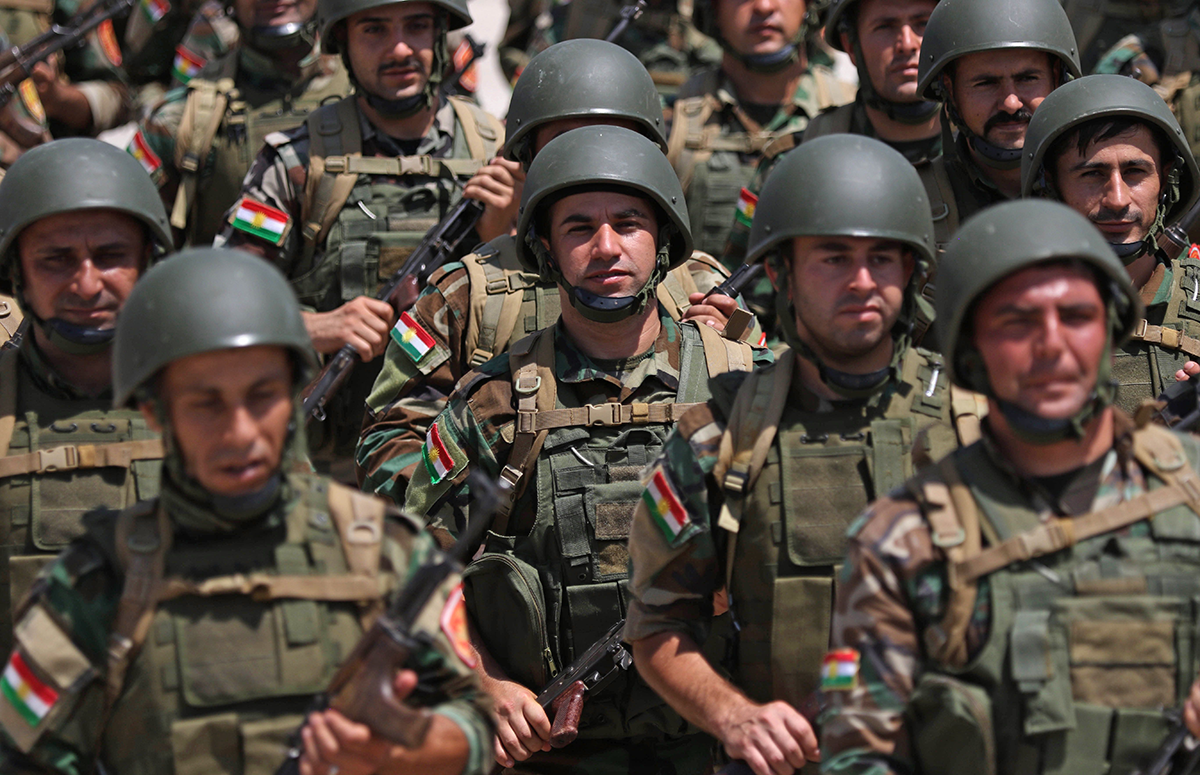
The Iraqi Peshmerga, the military arm of the Iraqi Kurdistan Regional Government (KRG), remains one of the United States’ most important defense partners in the Middle East. This monograph provides an in-depth assessment of Peshmerga combat effectiveness, particularly considering its experience in the war against the Islamic State and its subsequent clash with the Iraqi Army and Iran-backed militias. Drawing on past research and more than two dozen interviews with Peshmerga officers, US military officers, and subject matter experts, this study includes detailed policy recommendations as well as a discussion of their implications.
Contents
The Army of Kurdistan: The Post-2014 Iraqi Peshmerga and US Policy
A Brief History of the Peshmerga
Institutionalization and Structure of the Peshmerga
A Note on the Impact of Geopolitics
The Peshmerga’s War Against the Islamic State
The Iraqi Offensive of October 2017
Executive Summary
The Iraqi Peshmerga, the military arm of the Iraqi Kurdistan Regional Government (KRG), has been one of the United States’ most important defense partners in the Middle East, with a security relationship extending back to 1991. However, the loyalty of Peshmerga forces remains bitterly divided between the KRG’s two main political parties, the Kurdistan Democratic Party (KDP) and Patriotic Union of Kurdistan (PUK), each of which maintains partisan command over its units, hampering operations. This monograph assesses Peshmerga combat effectiveness, focusing on its 2014-17 experience in the war against the Islamic State (IS) and its subsequent clash with the Iraqi Army and Iran-backed militias. A better understanding of the Peshmerga’s strengths and weaknesses should inform US-KRG cooperation moving forward.
Notwithstanding some notable defeats, the Peshmerga has generally proven an adaptable and capable fighting force and an effective and reliable US partner. Going forward, if political circumstances align, the US should prioritize bolstering the Peshmerga so it can secure the KRG’s borders against future conventional military threats, constrain Iran’s ability to operate in its territory, and continue combating terrorist groups. To this end, the US should push for a stronger definition of the Peshmerga as the main body responsible for protecting the KRG’s borders. This effort should include arranging for heavier Peshmerga armament and upgrading air defense, the latter particularly aimed at addressing threats from Iran.
At the same time, upgrades to the US-KRG relationship should be conditional upon real progress in Peshmerga reform, the effort to unify command-and-control under the officially nonpartisan KRG Ministry of Peshmerga Affairs rather than split between the KDP and PUK. Despite years of touting the importance of reform, the KRG has made few real advances. Deeper engagement with the KRG will also need to be sensitive to the concerns of US ally Turkey and the Iraqi government in Baghdad. The case for upgrading the partnership would be much stronger if Baghdad continues to harbor Iran-backed militias, including terrorist organizations, and otherwise works against US interests through its close relationship with Tehran. Deeper US involvement in reform would include insisting on a say in sensitive personnel issues to ensure commanders are promoted for merit and do not answer to party bosses. If the Peshmerga makes more robust progress following such deeper involvement, the US could reward it by providing direct arms transfers, including small surveillance drones, antitank missiles, air defense systems, and armored fighting vehicles, all of which the Peshmerga will need to fulfill a territorial defense role while maintaining its strength in counterterrorism. Contingent on verification of electronic payment systems, the US can also renew stipends for Peshmerga salaries.
The Army of Kurdistan: The Post-2014 Iraqi Peshmerga and US Policy
The Iraqi Peshmerga, the military arm of the Iraqi Kurdistan Regional Government (KRG), is one of the United States’ most important defense partners in the Middle East. With a security relationship extending back to 1991, the Peshmerga has been deeply involved in US counterterrorism efforts and the major 2014-17 military campaign to deprive the jihadist group Islamic State (IS) of its territory in Iraq. Iraqi Kurdistan has long been a region where US forces enjoy a warm welcome, basing, and strong relations with the local security services. However, the loyalty of Peshmerga forces remains bitterly divided between the KRG’s two main political parties, the Kurdistan Democratic Party (KDP) and Patriotic Union of Kurdistan (PUK), each of which maintains partisan command over its units, hampering operations.
This monograph provides an in-depth assessment of Peshmerga combat effectiveness, particularly considering its experience in the war against IS and its subsequent clash with the Iraqi Army and Iran-backed militias. The purpose of this assessment is to better understand the Peshmerga’s strengths and weaknesses to highlight its future needs and areas for potential US-KRG cooperation moving forward. Drawing on past research and more than two dozen interviews with Peshmerga officers, US military officers, and subject matter experts, this study includes detailed policy recommendations as well as a discussion of their implications.
A Brief History of the Peshmerga
The Pre-KRG Peshmerga
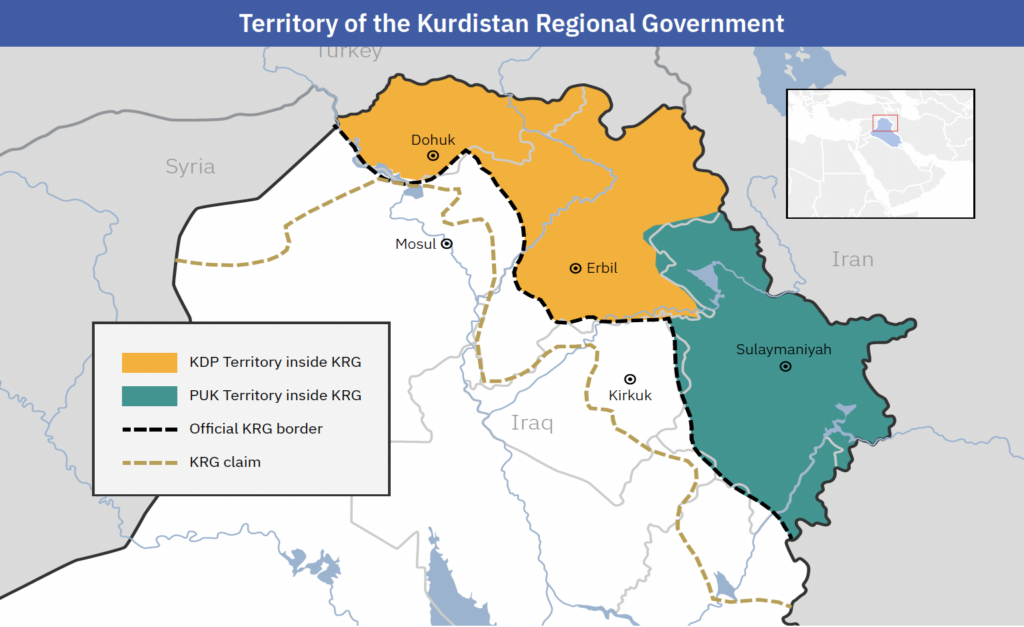
The Peshmerga (Kurdish for “those who face death”) is the military body of the Kurdistan Region of Iraq, comprising the governorates of Dohuk, Erbil, and Sulaymaniyah and under the administration of the autonomous KRG. The origins of the Peshmerga lie in the 1946 Soviet-backed organization of 1,200 tribal fighters under Mullah Mustafa Barzani created to serve as the army of the newly independent Kurdish Mahabad Republic. Barzani’s men fought well against the Iranian Pahlavi forces, but shortly after the republic’s creation in January 1946, the Soviet Union discontinued its support, enabling Tehran to destroy Mahabad and reconquer its wayward Kurdish lands by the end of the year.[1] Fleeing back to his original home in the neighboring Iraqi Kurdish region, Barzani sought to create a “national” Kurdish entity transcending tribal identity and founded the KDP to this end.[2] To the chagrin of some Kurdish clans excluded and persecuted by Barzani as well as the Iraqi government, the KDP began a long, still-ongoing process of creating formal fighting units that came to be known as the Peshmerga. The leading figures of the KDP’s significant leftist faction, Jalal Talabani and Ibrahim Ahmad, became the principal opposition to Barzani, before later splitting off to found the PUK in 1975.[3]
Until the 2003 US invasion of Iraq, Peshmerga forces established a combat record fighting either each other or the Iraqi regime of the day. Barzani launched the first major Kurdish uprising in 1961 (the First Kurdish War), after Iraqi dictator Abdul-Karim Qasim issued several anti-Kurdish decrees. By the end of the war’s first fortnight, Barzani’s forces numbered 5,000 full-time and 5,000-15,000 part-time fighters and had occupied most of Iraqi Kurdistan, with Kurds flocking to join the uprising and defecting from Qasim’s army.[4] However, with the Kurds unprepared for territorial defensive operations, Qasim’s subsequent counterattack drove Barzani’s forces back into the mountains of Iraqi Kurdistan to avoid the army’s clumsy, road-bound advances. Following the Iraqi Ba’ath Party coup of 1963, the new regime decided to carry out another offensive along the entire Kurdish frontline with three division-sized units but could not break Barzani’s hold. They became bogged down in the Rawanduz Gorge and proved unable to secure the Kirkuk-Sulaymaniyah road, while the Kurds received supplies from their brethren in Turkey and Iran. Following two more coups in Baghdad and through four more major Iraqi offensives, Barzani’s forces held their own, repelling government attacks, becoming proficient at ambushing advancing troops and supply lines, and even counterattacking to secure strategic towns.[5] In one particularly disastrous episode during the May 1966 offensive, advancing Iraqi forces set camp in between Mt. Zozik and Mt. Handrin, which opened the opportunity for Barzani to descend on them, killing 2,000, capturing many others, and effectively ending the offensive.[6] By early 1970, the government conceded and granted autonomy to the Kurdistan region. The Peshmerga’s first war thus ended with a positive outcome and proved it was adept at guerrilla actions as well as limited conventional operations to seize and hold territory.
Distrusting that the Iraqi government, now under Saddam Hussein, would stand by the 1970 concessions, Barzani launched another uprising in 1974 (the Second Kurdish War). By this time, the Peshmerga had grown to 50,000-60,000 fighters and Barzani had cultivated ties with (erstwhile enemy) Iran, the US, and Israel to obtain access to better equipment and prepare his forces for a more conventional war. The Kurdish attack, however, culminated quickly, as Peshmerga fighters lacked the heavy weapons needed to crack fortified army positions. Saddam reacted mercilessly, relying on heavy firepower to grind down Peshmerga defenders, who now attempted to hold their ground rather than retreat to the mountains. Iran temporarily turned the tide by increasing its support to the Kurds, even sending troops with antiaircraft and heavy weapons to even the odds. However, Saddam turned the tables again with the diplomatic coup of the March 1975 Algiers Accord with Iran, in which he convinced the shah to withdraw his support for the Kurds in return for territorial concessions. The Iranian forces withdrew suddenly, stunning the Kurds, who quickly collapsed before the renewed Iraqi regime assault. The outcome proved a disaster for the Kurds: 70% of the Peshmerga surrendered, with another 30,000 fighters fleeing to Iran together with 200,000 refugees, while Saddam began a large-scale campaign of massacres and forced resettlement of the Kurdish population.[7]
When the Iran-Iraq War broke out in 1980, the KDP and PUK were still recovering from their shocking defeat five years earlier. They saw the outbreak of war as possibly advantageous to them but remembered Tehran’s betrayal and remained wary of the new Islamic Revolution — especially because most Kurds are Sunni (and often quite secular) and Ayatollah Ruhollah Khomeini espoused a radical Shi’a ideology. By 1983, the Kurds had decided to throw in their lot with Iran in an attempt to regain control of their lands. They conducted guerrilla actions against Iraqi military positions and aided Iranian forces with logistics and guidance through unfamiliar terrain, at times participating in Iranian operations. For example, Iranian units counted on cooperation from Kurdish guerrillas during the 1983 Valfajr 2 campaign to occupy the heights around Haj Umran.[8] In 1987, the PUK conducted sabotage operations on Iraqi military targets, including the Erbil radar station, to support another Iranian offensive.[9] Saddam was enraged by the Kurdish uprising and redoubled his atrocities against the Iraqi Kurdish population, culminating in the infamous 1988 Anfal campaign, which saw the Iraqi use of chemical weapons on civilian areas, most notoriously at Halabja, and resulted in the deaths of 50,000-100,000 people, according to a Human Rights Watch study.[10] In this period, the Peshmerga reverted to its guerrilla roots, but by giving up territorial defense, it could not hope to protect the civilian population against Saddam’s atrocities.
The Establishment of the KRG and Intra-Kurdish Strife
Following the 1991 Gulf War, the Peshmerga again rose up in what was known as the Rapareen (“uprising”) under an eight-party coalition called the Iraqi Kurdistan Front and seized Kirkuk. Government forces quickly repelled the rebels, but the intervention of 7,000 US troops together with contingents from France, the United Kingdom, and the Netherlands to establish a “safe zone” in and no-fly zone over Iraqi Kurdistan resulted in the withdrawal of Saddam’s troops.[11] For the first time, the region gained de facto independence, and the KRG was established in 1992, with Erbil as its capital.
However, the region’s two dominant parties were deeply divided, and their differences — extending back decades — quickly rose to the surface with their common external enemy defeated. The creation of the KRG came with a fragile 50-50 power-sharing arrangement between the KDP and PUK that broke down in May 1994 as the two sides fought over an array of issues.[12] Initially, the PUK seized the initiative, capturing about two-thirds of the region with considerable Iranian military assistance, including Erbil, by 1995. After turning to Washington for help and getting none, the KDP countered the following year by enlisting support from Saddam, who provided 40,000 troops and 450 tanks to help take Erbil. The PUK successfully counterattacked in 1997 to prevent the KDP from overrunning their capital of Sulaymaniyah, largely restoring the status quo of 1995. At that point, the US finally stepped in to quell the fighting with the 1998 Washington Agreement, to try to unify and redirect the Kurds to support the American goal of overthrowing Saddam after he evicted United Nations weapons inspectors.[13] The civil war resulted in at least 5,000 deaths.[14]
Institutionalization and Structure of the Peshmerga
The 2003 US invasion of Iraq toppled Saddam, the greatest threat to the KRG, and helped strengthen Erbil-Washington ties. Task Force Viking, a large US special operations forces (SOF) contingent committed to the invasion, used the Kurdistan Region as its base of operations and cooperated with the Peshmerga. As an Iraqi insurgency emerged following Saddam’s downfall and jihadist groups took on a greater role within it, Iraqi Kurdistan stood out for its stability. The Peshmerga and the KRG’s internal security services proved effective at suppressing the Kurdish jihadist group Ansar al-Islam.[15] Iraqi Kurdistan began to serve as an important base for US forces, and the Peshmerga became an outstanding counterterrorism partner.
The current Iraqi Constitution, adopted in 2005, lent legitimacy to the KRG and Peshmerga by recognizing the “region of Kurdistan, along with its existing authorities, as a federal region” (Article 117) and acknowledging its right to administer “internal security forces for the region such as police, security forces, and guards of the region” (Article 121).[16] Although the KRG president is the formal commander-in-chief of the Peshmerga, command remains partisan, with the KDP and PUK retaining their own forces, known as the 80 Unit and 70 Unit, respectively. These forces are set to be formally absorbed into the KRG Ministry of Peshmerga Affairs (MOPA) as “Regional Guard Brigades” (RGBs) by September 2026.[17] There are currently at least 28 RGBs.[18] A series of laws passed in 2007 by the Kurdistan National Assembly (now called the Kurdistan Regional Parliament) codifies the status of the Peshmerga as “Guards of the Region” and defines some responsibilities and duties, as well as qualifications for service and retirement.[19] The official KRG website states that MOPA “is responsible for protecting the borders, land and sovereignty of the Kurdistan Region, and for ensuring security and freedom of Kurdistani citizens.”[20] Alongside MOPA, the Kurdistan Region Security Council (KRSC) formally commands the region’s law enforcement, intelligence, and counterterrorism forces, but is in practice also split along party lines, perhaps more so than the Peshmerga brigades are.[21] These forces are at times also referred to as Peshmerga:
- Law Enforcement Agency: Asayish, formally under the KRSC;[22]
- Intelligence Agencies: the Parasatin of the KDP and Zanyari of the PUK, formally under the KRSC;
- Gendarmerie/Paramilitary: the Zerivani of the KDP and Emergency Response Forces (ERF) of the PUK, formally under the KRG Ministry of Interior; and
- Counterterrorism Forces: the Directorate of Counter-Terrorism (CTD) of the KDP and the Counter-Terrorism Group (CTG) of the PUK, formally under the KRSC.
While the “RGB” label and its constitutional status might give the impression that the Peshmerga is a sort of national guard subordinate to Baghdad, its ethos and functions reflect a quasi-state army striving for the same capabilities as any other conventional army. As discussed below, the US and the KRG should embrace this by better defining the Peshmerga’s role and mission, enabling more effective cooperation and clarifying US support for the force’s future development.
The Peshmerga is organized in a brigade-centric model across eight sector commands spanning the KRG’s territory. This structure crystallized in 2014 to organize forces along the frontline against IS, replacing the previous regional and functional commands.[23] Each sector holds multiple brigades and may contain units from various forces, namely the RGBs, 70 Unit, 80 Unit, Zerivani, and ERF, under the formal authority of a sector commander.[24] Sector commanders coordinate frequently with brigade commanders, each with their own staffs and directorates.[25] Among MOPA forces, units are organized with a conscious effort to mix KDP and PUK members, with the norm being that officers from one party should have deputies from the other.[26] Nonetheless, Kurdish politics pervade military organization, and sector commands and compositions correspond strongly to areas of party control. Thus, PUK officers dominate in Sectors 1-4 (Sulaymaniyah Governorate) while KDP officers do so in Sectors 5-8 (Erbil and Dohuk governorates). The contested, oil-rich city of Kirkuk was split between Sectors 4 and 5, though it has been under Iraqi government control since October 2017. As MOPA absorbs more partisan units, newly formed divisional commands are meant to become more central to military organization.[27] There are also two units of “Support Forces” — one under the KDP and the other under the PUK — responsible for the Peshmerga’s heavy weapons, including tanks, artillery pieces, and armored vehicles.[28]
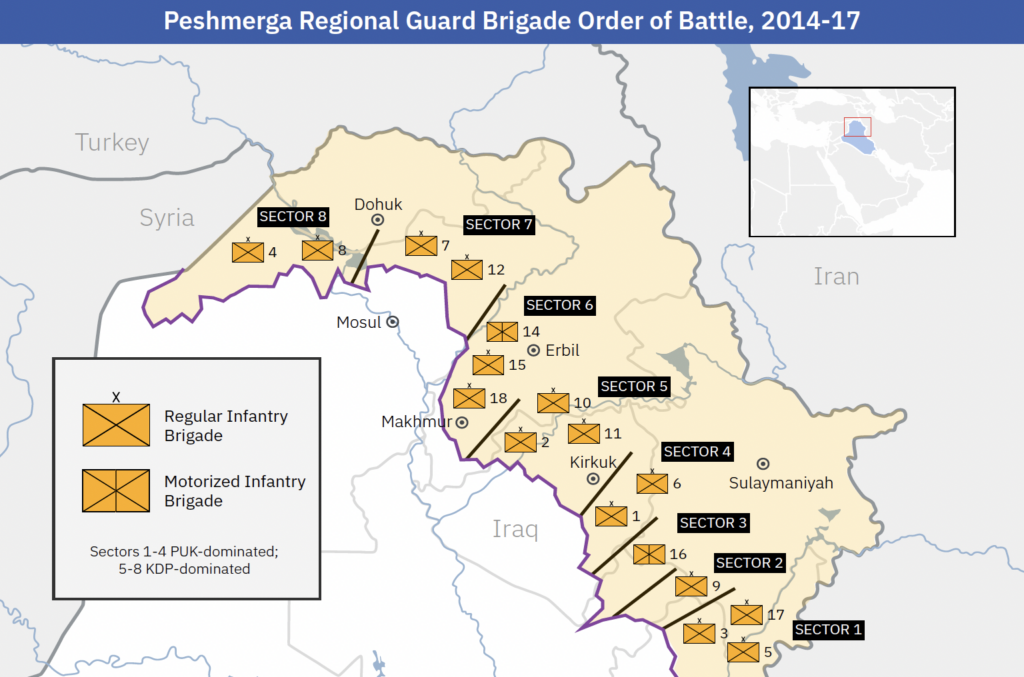
While force levels are difficult to estimate, each brigade typically contains 2,000-3,000 fighters, though numbers may vary considerably.[29] Sardar Aziz and Andrew Cottey estimate the total number of Peshmerga members at 190,000-250,000.[30] One officer put it significantly higher, at as many as 350,000.[31] A report from 2017, at the height of Peshmerga mobilization for the war against IS, by Kurdish broadcaster Rudaw suggested a total of 150,000, including 42,000 under MOPA and 58,000 each for the KDP and PUK.[32] This would equate to up to 60 partisan brigades alongside the then-existent 18 RGBs, though with the caveat that not all of these are combat brigades.[33] There has since been an effort to retire older members and merge partisan brigades to form new RGBs, likely resulting in a reduction in force levels, in line with the goals of the Peshmerga reform initiated in 2015 to fully unify the KRG’s military units.[34] For example, one officer estimated that the 3rd RGB, with an “authorized strength” of 3,040, contained at its height during the war against IS 2,800 fighters, falling over the course of the conflict to 2,300, and now standing at about 2,000.[35] A significant force reduction would also be in line with the 2021 assessment by Michael Knights and Alex Almeida that the Peshmerga contains 54 “brigade equivalents” and 56,000 combat-ready members.[36]
As for equipment, the Peshmerga is predominantly a light infantry force armed with small arms and light weapons, including common assault rifles (mainly AK-47s and M16s), rocket-propelled grenades (RPGs), light machineguns, and light mortars. For mobility, “technicals,” or pickup trucks with mounted heavy machineguns, are most common, though the KRG also possesses Humvees and armored personnel carriers, maintained by the Support Forces and some better-equipped brigades. Antiarmor weapons, most notably the MILAN antitank guided missile (ATGM) system, have become an important part of the Peshmerga’s arsenal. The Support Forces also have tanks and artillery pieces — mostly Soviet models captured from the Iraqi military over the years — though not in large numbers and it is unclear how many are operational at any time.[37]
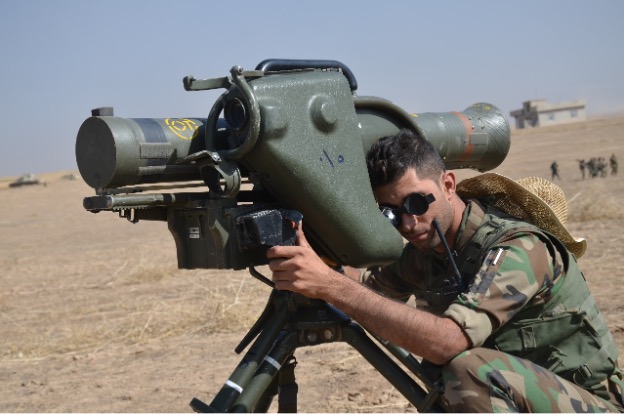
As discussed below, a stronger US-KRG relationship should focus on bringing these various forces under a unified command and bolstering their capabilities, particularly in heavy weapons. A lack of heavy weapons and disjointed command-and-control featured in some of the Peshmerga’s major setbacks over the past decade.
A Note on the Impact of Geopolitics
Another important factor for US-KRG cooperation and the Peshmerga’s disposition is regional geopolitics, in particular the web of ties among the KRG, Baghdad, its neighbors, and the US. Significant Kurdish minorities inhabit Iraq, Iran, Syria, and Turkey, each with a history of persecution by the authorities governing them and struggle for Kurdish self-determination. The long history of rebellion and animosity fueling chronic distrust between Erbil and Baghdad is one of these stories, even if the two have cooperated to fight the common threat of IS. Absent that shared existential threat, the two have regularly been at each other’s throats, with Baghdad aiming to assert its sovereign authority over the region and the Kurds fighting to maintain their autonomy. As the US confronted Saddam Hussein’s Iraq, the Iraqi Kurds became a closer partner; after his overthrow, the US had to moderate Erbil-Baghdad tensions while building a new Iraq. With Iranian influence on the rise in Baghdad, the KRG offers a useful alternative for advancing US interests.[38]
Turkey is another important player in KRG affairs. With major concerns over Kurdish secessionism of its own, Turkey has sought to keep its neighbors from becoming safe havens for Kurdish militants, particularly the Kurdistan Workers’ Party (PKK), the Turkish Kurdish Marxist group that has fought Turkey since the 1980s. The KDP has cultivated relatively good relations with Turkey, whose borders touch KDP-dominated areas of the KRG. Maintaining these ties has been important for managing oil flows through the Iraq-Turkey Pipeline, which crosses the border between the two countries at KDP-held Fayshkhabur, and the distribution of oil revenues has been a flashpoint in both KDP-PUK and Erbil-Baghdad tensions.[39] In addition, the KDP does not oppose the considerable Turkish military presence in northern Iraq, occupying at least 600 square miles, or 3.5% of KRG territory, to combat the PKK, which has been based in the area since the 1990s.[40] This has been a convenient arrangement for Turkey, which can countenance a relatively compliant KDP sitting on its border. For the US, the challenge has been bolstering the Peshmerga to fight common enemies in Iraq while being sensitive to its ally Turkey’s position on the KRG.
At the same time, the PUK has maintained significant ties with Iran, partly to manage trade and security over the Iran-Iraq border, which touches PUK-dominated territory. Similar to Turkey’s pursuit of the PKK, Iran has targeted Iranian Kurdish armed groups based in Iraqi Kurdistan largely with PUK acquiescence.[41] The PUK has also maintained ties with the PKK and its Syrian offshoot, the People’s Protection Units (YPG), souring relations with Turkey (and comprising yet another point of tension with the KDP), which has taken action against the PUK as a result.[42] During the war against IS, the Peshmerga in PUK-dominated areas had little difficulty coordinating with Iran-backed militias to fight against IS, likely because the PUK already had a working relationship with Iran at the war’s outset. And as discussed below, a number of PUK units withdrew before an Iran-sponsored offensive against the KRG in late 2017, suggesting the potential complicity of some senior PUK leaders. Sulaymaniyah-Tehran ties pose a conundrum for the US, which must work with both parties while taking care to maintain distance from Iran. Arms transfers and intelligence sharing with PUK-aligned units, for instance, must be conducted in a way that Iran cannot benefit from them. Indeed, in the war against IS, the US eschewed cooperating with Peshmerga units that openly worked with Iran-backed cadres.
Finally, Syria can do less than Turkey or Iran on its own but it, too, has concerns about Kurdish autonomy. Under dictator Bashar al-Assad, Syria sought to play various Kurdish factions against each other to stymie nationalist movements in the country, but the Syrian civil war, starting in 2011, enabled the creation of an autonomous zone in northeast Syria under the YPG.[43] The YPG was a key partner in the US-led war against IS in Syria, and it maintained a complicated relationship with the KRG, with the KDP unfriendly toward it and the PUK keeping cordial ties. PUK-aligned fighters entered Syria to aid the YPG’s anti-IS efforts and coordinate US support, and some YPG fighters crossed into the KRG to help the Peshmerga. Since the December 2024 rise of the new Syrian government under Ahmed al-Sharaa, the US has reduced its ties to the YPG and, in April 2026, it officially withdrew from Syria.[44] Sharaa has sought to form a centralized Syrian state with little tolerance for autonomist movements, taking over much of the YPG’s territory by force in early 2026.[45] He cannot do much in Iraq alone, but seeks to maintain ties to the US, which has now partnered with his government to fight IS remnants and combat Iranian proxies, and he views any hint of Kurdish secessionism with deep suspicion.
Overall, the two major KRG factions are situated among two large competing states (Iran and Turkey), a wary Damascus, and a hostile Baghdad, with the KDP and PUK at odds over relations with these different actors but still managing to cooperate with them to combat the common threat that IS poses. These dynamics are important to keep in mind to understand the course of the war against IS, its aftermath, and US-KRG relations.
The Peshmerga’s War Against the Islamic State
The decade preceding the war against IS was a time of relative calm before the storm for the KRG, even while the rest of Iraq descended into bloody civil war. Multiple armed factions formed following the 2003 US invasion of Iraq and overthrow of Saddam, with IS’s predecessor al-Qaeda in Iraq emerging as a major actor. The Shi’a Islamist Mahdi Army as well as Iran-sponsored Iraqi groups like Kata’ib Hizballah and Asaib Ahl al-Haq also rose in this period. US forces took on the bulk of the ensuing combat, fighting major battles to oust insurgents from Fallujah, Mosul, Baqubah, Ramadi, and other areas, while also working to rebuild the Iraqi Security Forces (ISF) virtually from scratch.[46] Taking advantage of the anti-jihadist Sunni tribal mobilization (that became known as the Sahwa or “Awakening”) begun in 2005, the US implemented its famed “surge” strategy in 2007, deploying 20,000 additional troops to secure Baghdad, bolster the tribal uprising, and further support the ISF.[47] Insurgent violence dropped precipitously in the following months, reaching a low point in 2010.[48] In parallel, Washington and Baghdad started negotiating in 2008 to have US troops withdraw from Iraq, with President Barack Obama completing the withdrawal in December 2011.[49]
As the civil war subsided after 2007, Iraq’s sectarian Prime Minister Nouri al-Maliki set his sights on reasserting Baghdad’s dominance. Having operated as a de facto independent entity since 1992, the KRG was in no mood to yield ground, leading to confrontations and clashes as Iraqi Army units tried to move back into northern Iraq. One US SOF officer described an incident in 2008 in which PUK fighters took up positions near Khanaqin to block an Iraqi Army unit from reaching the city, necessitating US intervention to restore calm.[50] After the 2011 US withdrawal from Iraq, such confrontations turned to skirmishes. In November 2012, when Iraqi forces moved to take control of Tuz Khurmatu, Peshmerga fighters stopped them from advancing, with one report claiming they inflicted casualties, while Peshmerga leader Mahmoud Sangawi (who later went on to become the Sector 1 commander) threatened to strike back at Iraqi Army forces with tanks.[51] Such confrontations still occur occasionally and should be addressed in future discussions of US-KRG cooperation.
The Islamic State Invasion of Iraqi Kurdistan
Although badly pummeled as US forces departed Iraq in 2011, the leading jihadist group of the Iraqi insurgency, the Islamic State of Iraq, went to ground and sought to regenerate itself by joining in the then-intensifying civil war in neighboring Syria. By the end of 2013, it achieved spectacular success, absorbing much of the Syrian opposition to Assad, seizing half of Syria’s territory, and recruiting more than 40,000 foreign fighters from over 110 countries.[52] In December, IS extended its military operations into northern Iraq, with Fallujah falling to the jihadists in early January 2014 as fighting spread.[53] More cities fell over the following months, and in June IS occupied Mosul, Iraq’s second-largest city, facing minimal resistance from the ISF, and was approaching the outskirts of Baghdad.[54] On June 29, IS leader Abu Bakr al-Baghdadi declared the restoration of the “caliphate” (historic Islamic empire) from the Grand al-Nouri Mosque in Mosul and named himself its caliph.[55]
ISF units in northern Iraq, hollowed out by corruption and sectarianism, mostly disintegrated in the face of IS attacks, opening the way in some areas disputed between the KRG and Baghdad for the Peshmerga to extend its control beyond the official KRG boundary line.[56] Some Kurdish-majority units within disintegrating Iraqi Army divisions fled to Iraqi Kurdistan to “rejoin” the Peshmerga. The 14th and 16th RGBs were composed of such units and noted for the Humvees and other American-provided equipment that they brought with them, which they had in greater numbers than other Peshmerga brigades.[57]
In August 2014, following smaller-scale attacks since at least June, IS turned north and assaulted multiple areas across the KRG border. Even if it put its rivals in Baghdad to shame, the Peshmerga still was unprepared when IS attacked the KRG’s territory. Indeed, it had been years since the force had to fight a real battle against a determined foe. As military analyst Kenneth Pollack noted, the force had settled into a “garrison/checkpoint army” ethos and the average fighter was “an urban youth” with little, if any, combat experience, with many of the veterans of past Kurdish uprisings demobilized.[58] Additionally, the KDP and PUK remained profoundly at odds, with one US advisor noting that fighters would disregard their officers if they were from different parties.[59] Thus, on the eve of the war against IS, the Peshmerga was on an uncertain footing, tested as a counterterrorism and internal security force but not yet proven as an army, while it was likely hampered by overconfidence and hamstrung by political divisions.
In a matter of days, Sinjar, Makhmour, Gwer, Jalawla, Mosul Dam, Zummar, Qaraqosh, and other population centers fell under IS control against brief Peshmerga resistance, with continuous fighting around Kirkuk. This brought IS to within 50 kilometers of Erbil. However, unlike the ISF divisions previously stationed in northern Iraq, Peshmerga units remained cohesive, regrouped, and prepared to counterattack. Virtually all Peshmerga officers I interviewed noted that where they initially fell back, Peshmerga brigades were overwhelmed by the firepower IS brought to bear against them, in particular the group’s heavy use of suicide vehicle-borne improvised explosive devices (SVBIEDs), as well as armor the jihadists captured from the Syrian and Iraqi militaries.[60] IS used these in tandem with infantry assaults similar to how a regular army might use artillery, armor, or airstrikes: to punch holes in enemy lines and shock opposing forces.[61] The relatively inexperienced Kurdish frontline fighters lacked the antiarmor weapons and defensive fortifications needed to face this threat. Considering the difficulty that even the professional, well-armed Turkish military faced dealing with IS SVBIEDs on the battlefield for the first time in 2016, it is understandable that the lightly armed, then-less experienced Peshmerga retreated for this reason.[62] Even so, the jihadists inflicted a stinging defeat on the KRG at the war’s outset, and it would take the Peshmerga three years of hard fighting, tactical adaptation, and heavy US and international support to recover their losses — only to suffer another humiliation at the hands of the Iraqi Army and Iran-backed militias. In the future, the Peshmerga will need to bolster its heavy weapons arsenal — with US support — if it seeks to ensure it can deal with another large jihadist incursion or other conventional military threat.
The Peshmerga Counteroffensives, August 2014-November 2015
The Peshmerga campaigns against IS featured a well-planned and -executed military effort, with much to build on for future US-KRG cooperation, though the inexperience of much of the force arguably showed in the uneven initial progress of the counteroffensives. KRG President Massoud Barzani (the son of Mustafa) called on older Peshmerga veterans to join the fight after IS began intensifying strikes in June.[63] On August 7, President Obama authorized airstrikes to help “stop the advance on Erbil,” protect US personnel in Iraq, and prevent IS massacres of Yazidis in Sinjar.[64] The following month, Obama expanded the mandate of the US military mission to “degrade and ultimately destroy” IS altogether by supporting ground forces in Iraq and Syria, namely the Peshmerga, ISF, and the YPG.[65] Thus, on August 10, when Sirwan Barzani, Massoud’s 45-year-old nephew, rejoined the Peshmerga and set out from Erbil with 150 fighters, US air cover helped ensure his recapture of Gwer within four hours.[66] One KRG official observed that the elite PUK-aligned CTG was also involved in this operation, a notable instance of KDP-PUK cooperation in the war’s initial period.[67]
Yet, the Peshmerga faltered where it lacked experienced leaders and fighters, elite units, or support from other forces and international assistance. About 200 kilometers west of Erbil, the Peshmerga struggled to retake Zummar, first driving IS out on September 1 when it could draw on air support, then losing it once more before finally securing it by late October.[68] US air coverage also proved crucial to the liberation of Mosul Dam on August 16-17, in which Peshmerga fighters secured the outskirts while Iraqi special operations forces from the US-built Counter-Terrorism Service (CTS) under Maj. Gen. Fadhil Barwari (a former Peshmerga fighter) led the main thrust.[69] Indeed, in the case of Mosul Dam, Peshmerga had to rely on both US airpower and a contingent from the ISF’s very best formation — itself US-trained — to repel IS.
Other Kurdish factions also assisted the Peshmerga in liberating territory from IS, again helping compensate for the uneven quality of Peshmerga units. At Makhmour, fighters from the PKK engaged with IS until the Peshmerga returned with heavy weapons to finally drive the jihadists back by August 8.[70] On October 2, Peshmerga forces seized Rabia, a town on the Syria-Iraq border that fell to IS in June after it was abandoned by the ISF, with the help of snipers posted on the Syrian side of the border from the Women’s Protection Units (YPJ), the all-female wing of the YPG, which is itself an offshoot of the PKK.[71] Possibly involved in the Rabia liberation as well were fighters from the Rojava Peshmerga, a force of two brigades composed of Syrian Kurds founded in 2012 by the KDP.[72] Overwhelming numbers also helped bolster the KRG in this early period: about 8,000 Peshmerga fighters were involved in the operation, which also relied on intelligence from and cooperation with local Arab tribes. Civilians were evacuated prior to the fight, which lasted for two days and resulted in 50 IS deaths, including 22 from airstrikes.[73] In addition, PUK-affiliated CTG fighters crossed into Syria via Turkey to assist the YPG in liberating Kobane, notable for their ability to coordinate US airstrikes through a US-CTG hub in Sulaymaniyah.[74] All of this underscored Iraq’s importance for sustaining operations in Syria, which remained the case going forward.
Farther east, Peshmerga units worked with Iran-backed militias, many of which were organized under the Popular Mobilization Forces (PMF) umbrella created at the behest of Iraqi Grand Ayatollah Ali al-Sistani.[75] Near the oil-rich city of Tuz Khurmatu, Peshmerga fighters and local volunteers held off the initial IS assault, but the group did take over most of the Tuz district south of the city and besieged the Shi’a Turkmen town of Amerli.[76] US fears of an impending IS-induced famine and massacre in Amerli prompted close American involvement in organizing forces to break the siege. The 16th RGB approached from the north to clear the outskirts and provide secure assembly points for Iraqi Army and militia forces.[77] An Iraqi Army brigade advanced from the south, and Iran-backed militias from the east.[78] The participation of these militias, created and sustained by Iran’s Islamic Revolutionary Guard Corps (IRGC) under the leadership of Qassem Soleimani, complicated US involvement, but American airstrikes proved crucial in supporting the other two forces as well as in picking off IS fighters that tried to flee west.[79] Peshmerga forces and the PMF then cooperated to clear the rest of Tuz, with the former taking the areas north of the Tuz-Tikrit road and the latter sweeping south, with more Kurdish involvement in the clearance of Suleiman Bek.[80]
However, in Diyala Governorate, where IS occupied Jalawla and Sa’adiyah, the US withheld its support due to the heavy involvement of IRGC-backed elements, providing an opportunity to observe Peshmerga performance early in the war without air support.[81] The Peshmerga’s 16th RGB, together with 70 Unit’s 3rd Special Brigade (or Hezekani Kosrat Rasul, personal forces of former PUK Peshmerga commander Kosrat Rasul Ali) and 117 Brigade under Sector 1 commander Mahmoud Sangawi, tried to retake Jalawla shortly after it fell in August, but stalled after meeting heavy IS resistance, with the jihadists reinforcing their positions from other towns they had seized nearby. The 3rd RGB secured Kobashi and swept north to Anwar to block potential further IS advances toward Khanaqin while the IRGC-backed Badr Brigade under Hadi al-Amiri secured Sa’adiyah to Jalawla’s south. By November, these maneuvers considerably strengthened the Peshmerga’s position, enabling a multi-axis assault on Jalawla that caused IS to quickly withdraw toward Lake Hamrin after losing only 10 fighters. The 2nd Support Forces also participated in the final offensive, with 10 tanks and up to 30% of its engineer regiment involved, as well as a company from the CTG, for a total of 10,000 or more Peshmerga fighters in the field.[82]
The last major push before the Peshmerga transitioned to a mainly defensive posture was the liberation of Sinjar. After the fall of the city on August 3, 2014, thousands of residents fled to the nearby Mt. Sinjar as IS began massacring and enslaving the Yazidi population. Threatening to exacerbate the humanitarian catastrophe, IS surrounded the mountain, where thousands of refugees, some Peshmerga, and about a dozen US Marines and SOF were holed up. US airstrikes broke the siege of the mountain by August 13, although IS fighters were still present in some areas.[83] The liberation of Rabia and Zummar by the end of October gave the Peshmerga launching points for an assault on Sinjar. The first offensive began on December 18 with 45 coalition airstrikes softening IS targets around Mt. Sinjar and Peshmerga fighters pushing east and southeast from Zummar and Rabia to secure a corridor to the mountain, working in tandem with the PKK and the local Yazidi PKK-aligned self-defense militia known as the Sinjar Resistance Units (YBS). YPG forces simultaneously captured IS-held villages on the Syrian side of the border to cut off jihadist supply lines and support their PKK and YBS allies. These operations, involving some 8,000 Peshmerga members and spanning more than 2,000 square kilometers, resulted in more than 100 IS dead, according to KRG officials, and secured the areas around Sinjar, even approaching the important IS stronghold of Tal Afar.[84] On December 21, Kurdish fighters pushed into Sinjar itself, driving IS from the city center, though the jihadist group retained control of the strategic Highway 47 and some sections of Sinjar linking the IS “capital” of Raqqa, Syria, and its largest holding, Mosul, in Iraq.[85] Peshmerga, PKK, and YBS fighters finally liberated the city in its entirety in November 2015, after cutting off the IS supply route by capturing Gabara village to Sinjar’s west while Zerivani forces under Maj. Gen. Aziz Waisi flanked from the east, with more than 7,000 Kurdish fighters involved overall against an estimated 700 IS defenders.[86] KRG authorities reported 300 IS dead as a result.[87] The city itself fell with little resistance; a German filmmaker embedded with PKK fighters noted that IS had left Sinjar before they entered.[88]
In this initial period of the war, the Peshmerga had a mixed record, likely due to the inexperience of much of its frontline combat power. Where veterans and elite units were available together with air support, the Peshmerga held its own and retaliated forcefully, as at Gwer in August 2014. However, conditions were rarely so ideal, and its counteroffensives most often relied on heavy support from the US or erstwhile partners (that would be rivals were it not for the common threat of IS) like the PKK, ISF, and Iran-backed militias. In addition, the Peshmerga sometimes required large numerical advantages over IS forces to succeed, as in the campaigns to liberate Diyala and Sinjar. As a result, progress could stall while the Peshmerga gathered strength and coordinated with its allies. At the same time, its commanders proved imaginative planners and maneuvered their fighters well, regularly executing multi-axis advances that overwhelmed IS defenders. As the war progressed, battle-tested Peshmerga fighters adapted and proved more tenacious in holding the frontline.
Protecting the Frontline, Early 2015-October 2016
From June to late December 2014, the Peshmerga’s campaign to recover territory cost it 727 dead and more than 3,500 wounded, per KRG figures.[89] As the Peshmerga regained its footing, a more defined frontline emerged separating the KRG from IS and Iraqi government territory. The frontline, which would become known as the Kurdistan Coordination Line (KCL) by the US-led multinational coalition, extended from Sinjar to Khanaqin, spanning about 1,050 kilometers.[90] With some exceptions, the KRG’s war against IS from this point until late 2016 took on more of a positional defensive character, with only limited efforts to expand Peshmerga control. Gains measured in single kilometers contrasted sharply with the tens — or even hundreds — of kilometers taken in earlier operations in Jalawla, Tuz, Sinjar, and Makhmour.
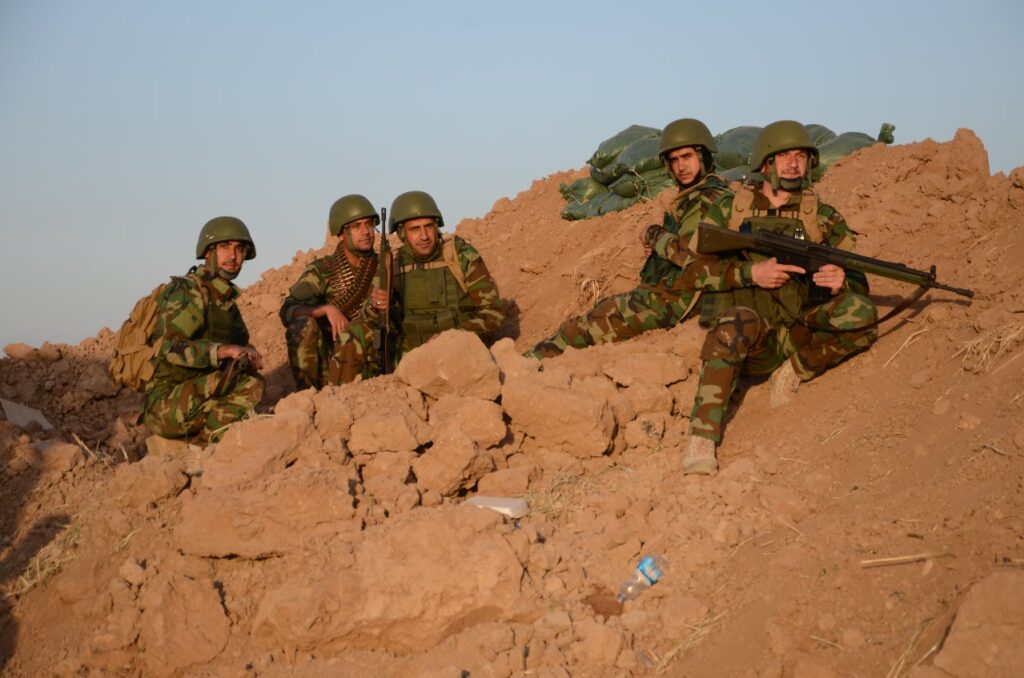
Now battle-hardened and armed with coalition-provided equipment, training, and air support, the Peshmerga raised frontline defenses that stopped IS from making any further significant gains in Iraqi Kurdistan for the duration of the war, an impressive step forward after the stunning defeats and uneven performance of the war’s initial period. At the frontline, Peshmerga forces set up fortifications with earthen berms, trenches, stone walls, and sandbags together with observation posts and some cement bunkers in strongpoints. Fighting positions were typically hundreds of meters apart from one another, though in some types of more difficult terrain, such as mountains or desert, they were placed farther apart. Most had a team-sized guard element armed with AK-47s and sometimes light machineguns or sniper rifles and some grenades, though one Peshmerga officer described frontline “bases” containing 10-20 fighters each.[91] Cognizant of the SVBIED threat, positions closer to roads had at least one antiarmor weapon, most commonly an RPG.[92] One Peshmerga officer on the Makhmour front of Sector 6 recalled at least 30 incidents in which IS launched SVBIEDs against his positions, saying that his forces destroyed 90% of these before they reached their targets using MILANs, RPGs, SPG-9s, and coalition airpower.[93] According to Gen. Zaim Ali, commander of the Zummar-Rabia-Sinjar front in Sector 8, some IS assaults included 10 or more SVBIEDs.[94] Considering IS SVBIED attacks were cutting through KRG defenses only a short time before, this suggests the Peshmerga was able to make significant successful adaptations under fire.
Although in short supply, antiarmor weapons were crucial to Peshmerga defensive tactics and were distributed well along the KCL. Michael Knights, who visited the Peshmerga frontline, reported that between August 2014 and August 2015, the coalition provided 40 MILAN ATGM systems together with 800 missiles, 370 planeloads of munitions, almost 60,000 short-range antitank rockets, and 700 mortar tubes with 74,000 mortar rounds.[95] The Peshmerga’s own Support Forces had a significant number of armored vehicles as well as dozens of tanks and artillery systems, though these were mostly aging platforms in questionable states of operational readiness and short on ammunition.[96] Distributed across the KCL, entire Peshmerga brigades would typically not have more than one MILAN system with a few missiles and several mortar tubes with fewer than 10 rounds for all of them.[97] Nonetheless, with crucial coalition surveillance and strike support and consistently strong Peshmerga strategic planning, antiarmor capabilities were generally positioned in the right spots on the frontline and Kurdish fighters used them effectively. Bolstering Peshmerga armor/antiarmor capabilities is, thus, an area with considerable potential for future cooperation.
When breaches occurred, Peshmerga defenders reacted quickly and effectively. Even as large urban battles raged in Syria and other parts of Iraq, IS constantly tried to break the KCL and drive deeper into Kurdistan. The group never managed to make a strategic breakthrough, but it did achieve multiple localized breaches in the line. One such notable breach came in May 2016, when IS penetrated more than 4 kilometers using several truck SVBIEDs in the Tal Asqof area, resulting in the brief occupation of that town and the death of US Navy SEAL Charlie Keating.[98] A US military spokesperson reported the attack involved about 125 IS fighters and that Keating was part of a quick reaction force that helped repel IS, along with 31 airstrikes, killing 58 jihadists and destroying more than 20 of their vehicles, including a bulldozer and two truck SVBIEDs.[99] According to US Brig. Gen. Matthew Isler, deputy commander of Operation Inherent Resolve’s air component, who observed the ensuing battle, Peshmerga units responded so quickly that they were already engaged with IS fighters by the time coalition aerial surveillance reached the area.[100] Another US advisor recounted a 2015 incident south of Gwer in which IS overran a frontline post. Within two hours, Peshmerga units responded by planning and executing an aggressive counterattack with dozens of vehicles and fighters, killing all the original attackers and reclaiming the position.[101] These operations reflected substantial improvement upon the slower, more hesitant operations of the war’s initial period.
During this period, KRG forces also made limited advances along the KCL. Bernard-Henri Lévy’s Peshmerga shows some of these offensive strikes, mostly composed of light infantry mounted on technicals with a handful of armored vehicles and one or two tanks.[102] One Peshmerga officer explained that such strikes virtually always involved a multi-axis advance with a “backbone” of “engineer” and “commando” elements together with regular infantry forces with an overwhelming numerical advantage (the doctrinal 3:1, though often far more than this). Designated fighters would advance first to clear areas of IS explosives and boobytraps — the “engineer” component, usually no more than a company-sized element — while a battalion- or brigade-sized force of commandos spearheaded the assault at the vanguard of each axis.[103]
Although the Support Forces do have a couple of engineer regiments and commando/special forces units exist within the Peshmerga, in practice these terms were applied rather broadly, often referring to various types of units employing tactics, techniques, and procedures that at best approximated Western combat engineer or commando forces. Units with veteran fighters, better or more vehicles and equipment, or superior training, especially by coalition trainers, all were given the commando label during the war. These fighters did not necessarily perform direct action, unconventional warfare, or special guerrilla strikes as Western special forces do, but most often served as aggressive strike forces that could spearhead assaults and offensives, or as locally mobilizable interception units to foil IS attacks based on intelligence.[104] Per Matthew Cancian, a researcher who surveyed Peshmerga officers, “When they say ‘commando,’ they seem like a decent run-of-the-mill American or NATO unit.”[105] Receiving coalition training and equipment was perhaps the primary avenue toward meriting the commando label, hence the proliferation of “special forces” units in the Peshmerga coinciding with deeper coalition involvement. One example is the Dutch-trained, 550-man Zerivani battalion considered a mobile commando unit that participated in multiple major offensives.[106] One Peshmerga commando estimated there were some 7,000 special forces personnel across different units as of 2023, though given how Peshmerga officials have applied the term, these are probably better described as well-trained infantrymen.[107] In addition, brigades under the personal command of important party figures and Peshmerga veterans, including Sirwan Barzani, Nechirvan Barzani, Sheikh Jafar, and Kosrat Rasul Ali, were considered elite and generally had access to the Peshmerga’s best equipment.
Raising fortifications and removing explosive ordnance were crucial components of Peshmerga operations, but experienced individual fighters were most often the ones to carry out these tasks rather than an institutionalized engineer corps. One US SOF officer recalled Peshmerga fighters using shovels and pickaxes to remove emplaced IS explosive devices.[108] Another officer recounted an exceptional case in which a Peshmerga company commander used his bare hands to remove IS boobytraps from vehicles and structures.[109] Despite the danger and crudeness of these methods, US officers noted that Kurdish fighters employed them effectively to deal with obstacles and facilitate the Peshmerga’s preferred rapid pace of operations. As for fortifications, the Peshmerga proved adept at constructing defensive lines across the KCL with sandbags, earthen berms, trenches, and hard bunkers, benefiting from some special coalition training at the Bnslawa camp focused on erecting these defenses.[110] Peshmerga defenses around Kirkuk are particularly notable in this respect, comprising several layers of trenches and barriers. Future US-KRG cooperation might capitalize on this by seeking to further professionalize Peshmerga combat engineering capabilities.
Overall, the Peshmerga became significantly more adept in its operations to secure the KCL following its initial losses. Now hardened by months of fighting against IS, Peshmerga units attained a more rapid pace of operations and learned how to stop IS breakthroughs. Tenacious frontline defenders and imaginative and resourceful leadership ensured IS could not make any real gains along the KCL. Where IS tried to punch holes, Peshmerga units reacted quickly to plug them. At this point, the Peshmerga had advanced a great deal from the days when much of its ranks were filled with green youths without significant training or combat experience.
Securing Mosul, August 2016-July 2017
The liberation of Mosul would be the largest anti-IS campaign of the war, with the CTS playing the leading role and bearing the brunt of the casualties. The Peshmerga occupied an important supporting position in the campaign. In early 2015, Peshmerga units drove IS out of several areas north of Mosul in preparation for an anticipated offensive that year, ultimately postponed by IS’s seizure of Ramadi in May.[111] The ISF liberated the city in January 2016, then nearby Fallujah in June, beginning a gradual push north to the outskirts of Mosul and taking the strategic town of Qayyarah in August.
The Peshmerga captured the northern and eastern approaches to Mosul to isolate the city and open staging areas for an assault. In August 2016, Peshmerga units advanced toward Mosul along some 150 kilometers of frontage between Gwer and Khazir, crossing the Zab River and liberating 11 villages, as well as reaching Qaraqosh, Bartallah, and Bashiqa, with the latter serving as an important base for US fire support.[112] After liberating the areas around the Yazidi-majority town of Bashiqa in late October 2016, Peshmerga forces cut it off from Mosul to the southwest and assaulted the town from southern, eastern, and western axes on November 7.[113] According to Peshmerga officials, at least 14 coalition airstrikes supported the advance, and they had to fend off about 40 SVBIEDs, with local media reports of US forces accompanying Kurdish fighters in the town.[114]
KRG territories proved important in strategic planning as well as operational and tactical maneuvers for the battle of Mosul. The ISF and coalition established a firebase and their principal strategic planning center for the battle in February 2016 at the Ninewa Operations Command in Makhmour.[115] The original ISF plan envisioned an advance into Mosul from the south using the Peshmerga as an anvil to the north to catch any IS fighters fleeing the city. The coalition altered the plan to start from the east instead due to fears of inadvertent clashes between ISF and Peshmerga units as well as coalition logistical concerns.[116] Nonetheless, throughout the battle, KRG territories hosted refugees from Mosul, provided medical evacuation and treatment to wounded Iraqi soldiers, and assisted with intelligence and logistics, while also continuing to serve as important coalition nodes for fire and air support.[117]
The ISF finally liberated Mosul in July 2017, with follow-up operations in Tal Afar and Hawija through early October bringing the IS caliphate in Iraq to an end. The Peshmerga played a support role in this battle and paid its share in blood. Up to June 2016, the KRG reported 1,466 fighters killed and 8,610 wounded since the war’s beginning.[118] By the end of the battle of Mosul, Kurdish officers and a US official reported a total of about 2,000 dead and 12,000 wounded over the course of the war, indicating that the last major battle alone cost the Peshmerga more than 500 fighters killed and 3,300 injured.[119]
Overall, the Peshmerga’s performance against IS was noteworthy for its improvement over time, from the nadir of the initial IS attack, to far more creditable operations later on, especially with the benefit of better weapons and American training. Virtually all US advisors interviewed for this study enjoyed working with the Peshmerga and rated the force among the best in the Middle East. They even preferred working with Iraqi Army battalions composed of Kurds/former Peshmerga fighters; Lt. Gen. Michael Nagata, former commander of Special Operations Command Central, rated the Peshmerga as second only to the Israel Defense Forces among Middle Eastern militaries, remarking, “When there was a Kurdish element involved, performance went up.”[120] Another SOF officer expressed a similar sentiment, qualifying that the Peshmerga was limited mainly by its lack of heavier materiel.[121] Indeed, US forces have found the Peshmerga an easier partner to work with than the Iraqi government, a good omen should they need to relocate to the Kurdistan Region (a possibility further discussed below).
The Iraqi Offensive of October 2017
As soon as the war against IS ended in Iraq, the KRG and the Iraqi government resumed their strife and would shortly be locked in mortal combat once more. The events that followed underscore the stakes involved for the KRG in making real progress on Peshmerga reform. Already in 2015, President Massoud Barzani asserted that the rise of IS demonstrated the failure of the status quo, indeed that a “new border is drawn in blood. … A new Iraq must be formulated.”[122] On September 25, 2017, the KRG held a referendum on independence for Iraqi Kurdistan, with 92% voting yes. Rejecting the initiative, Iraqi Prime Minister Haider al-Abadi declared, “We will impose Iraq’s rule in all districts of the region with the force of the constitution.”[123] He made good on his pledge (albeit at Iran’s behest and with heavy Iranian involvement) on October 16, launching a joint Iraqi Army-PMF offensive into KRG-held territory that ultimately resulted in the Peshmerga losing control of virtually all the lands it had secured since 2014.
The main axes of advance converged on Kirkuk and Sinjar and pushed farther into Kurdistan from those cities. Tens of thousands of Iraqi soldiers and PMF militiamen — including forces from the elite CTS, the respected 9th Armored Division, the notorious Emergency Response Division, and the Iraqi Federal Police — were already in Hawija since liberating it on October 8, hardened from the grueling Mosul campaign and ready to push into Kirkuk, the oil-rich city long and hotly disputed between the KRG and the federal government.[124] Holding the Kirkuk frontline across Sectors 4 and 5 were about 20,000 Peshmerga fighters, mostly PUK-aligned.[125] However, most PUK-aligned units withdrew before Iraqi forces made contact, likely reflecting complicity between Iran and senior party leaders, also evident in mass withdrawals from PUK-dominated Sector 1 as well as the movement of Brigades 111 and 112 of the 70 Unit out of Sector 8.[126] This episode exemplifies the importance of unifying the Peshmerga brigades to the force’s future development.
Consequently, Jalawla and Khanaqin fell without a fight.[127] PUK senior figure and then-KRG Vice President Kosrat Rasul lambasted his party colleagues for leaving the city and ordered his personal brigade, Hezekani Kosrat Rasul, to remain.[128] Thus, Rasul’s fighters, the 1st RGB and 70 Unit’s Brigade 102, and KDP-aligned forces in the area offered resistance to the advancing Iraqi soldiers, but according to one officer, they were overwhelmed by the attackers’ numerical and materiel advantage, with each defending brigade sustaining dozens killed in action.[129] One Peshmerga officer also noted fear of encirclement as a factor in the retreat as Iraqi units moved to surround the city.[130] One PUK-affiliated battalion commander claimed a total of 105 fighters died defending Kirkuk, alongside 200 wounded and 45 captured.[131] An International Crisis Group assessment reported 70 dead, mostly from KDP forces that did not immediately retreat, per a MOPA director.[132]
In the KDP-dominated sectors, the Peshmerga offered virtually no resistance. The forces holding Sinjar and the surrounding areas withdrew without a fight across the Tigris River, leaving the city, along with Zummar, Rabia, Mosul Dam, and other areas, to Iraqi government control.[133]
Fearing the attackers intended to cut the KRG’s links with Turkey or take Erbil, Peshmerga forces fought hard to halt the Iraqi advance at two major Tigris River crossings: the KDP at Suheila just south of Fayshkhabur and the PUK at Altun Kupri/Perde. Elements from other units concentrated at these points to reinforce retreating fighters and immediately began raising fortifications and disabling the bridges. Iraqi Army and PMF forces advancing on the main roads met fierce resistance. One US SOF officer observing the battle recalled the Peshmerga’s proficiency at employing antiarmor weapons to destroy the tanks and other vehicles, with “entire [Iraqi] platoons” decimated: “It was very clear that the Peshmerga had dug-in position in covered, concealed terrain and the Iraqi Army were going straight up the roads, and were being destroyed doing it.”[134] This assessment comports with the claim by a Peshmerga officer involved in the fighting that the force destroyed more than 100 Iraqi vehicles and inflicted hundreds of deaths while sustaining losses of 50-60 Kurdish fighters.[135] Another officer estimated 800-900 Iraqi deaths against several dozen Peshmerga.[136] The Iraqi Army and PMF subsequently halted their advance and have held their positions until today.
This episode highlights both the enduring weaknesses of the Peshmerga and the strengths it developed during the war against IS. On the one hand, partisan control of combat units spelled disaster for the Peshmerga in Kirkuk, as PUK-aligned units left KDP-aligned fighters in an untenable position. On the other hand, once regrouped among their co-partisans and in more favorable terrain, Peshmerga fighters demonstrated the combat proficiency they gained fighting IS, stopping Iraqi units in their tracks with tested defensive tactics and characteristically quick reaction.
Elements of Peshmerga Military Effectiveness
The 2014-17 war against IS pitted the Peshmerga against a new kind of enemy that forced it to adapt its strategy and tactics to conventional warfare. The October 2017 Iraqi Army-PMF offensive put these adaptations to the test, with mixed results. This section identifies the main determinants of Peshmerga combat performance to reveal insights with implications for its future as well as that of US-KRG relations.
A Robust Fighting Spirit
There is a cultural and ideological mythos surrounding the Peshmerga in Kurdish society, as tough warriors and the guardians of Kurdish freedom. Scholars Sardar Aziz and Andrew Cottey refer to this as a “heroic-mythic status,” stating, “Peshmerga is a status, a hero, a herculean figure.”[137] Lévy’s film Peshmerga emphasizes this in one scene showing fighters near the frontline in 2015 reverently watching old clips of Peshmerga guerrillas fighting in the mountains from decades past.[138] Peshmerga officers interviewed for this project said that this symbolic status was largely responsible for the force’s stalwart morale and fighting spirit.[139] One also stated that the Peshmerga’s perceived honor facilitated the rapid mobilization of both older veterans and younger volunteers who were not previously members, as the former desired to burnish their reputation and the latter sought to avoid the shame of sitting on the sidelines amid an existential war for Kurdistan.[140] One study connects this high fighting spirit to “Kurdeity,” a cultural notion within Iraqi Kurdish society that holds Kurdish language, land, and heritage as “sacred values” worthy of sacrifice.[141]
This spirit translated into high determination and aggression in combat. One US advisor noted Peshmerga commanders “were generally leading from the front” and noted older fighters’ pride in their battle scars from wounds incurred during the 1980s.[142] A Peshmerga officer stated that seeing officers in the thick of battle and advancing from the front spurred younger fighters to charge forth as well.[143] Such aggression often resulted in higher casualties, but Gen. Isler noted that Kurdish fighters expressed great pride in their willingness to advance under fire and give up their lives to win a battle, and liked to contrast this with the general sluggishness of the Iraqi Army.[144] He cited as an example an Iraqi Army battalion composed of former Peshmerga fighters that he observed assaulting a position on the outskirts of east Mosul so aggressively that they completed their mission two hours ahead of schedule and he almost mistook them for IS fighters, who fought with a similarly aggressive tactical style.[145] Another instance of Peshmerga aggression is the aforementioned episode in which Kurdish forces counterattacked against an IS breach in the frontline so rapidly that they even outpaced coalition aerial surveillance. Indeed, virtually all US officers interviewed for this study emphasized that the Peshmerga mystique was real for its members, manifesting in tactical aggression and high morale.[146]
Strong Mobility, Flexibility, and Planning
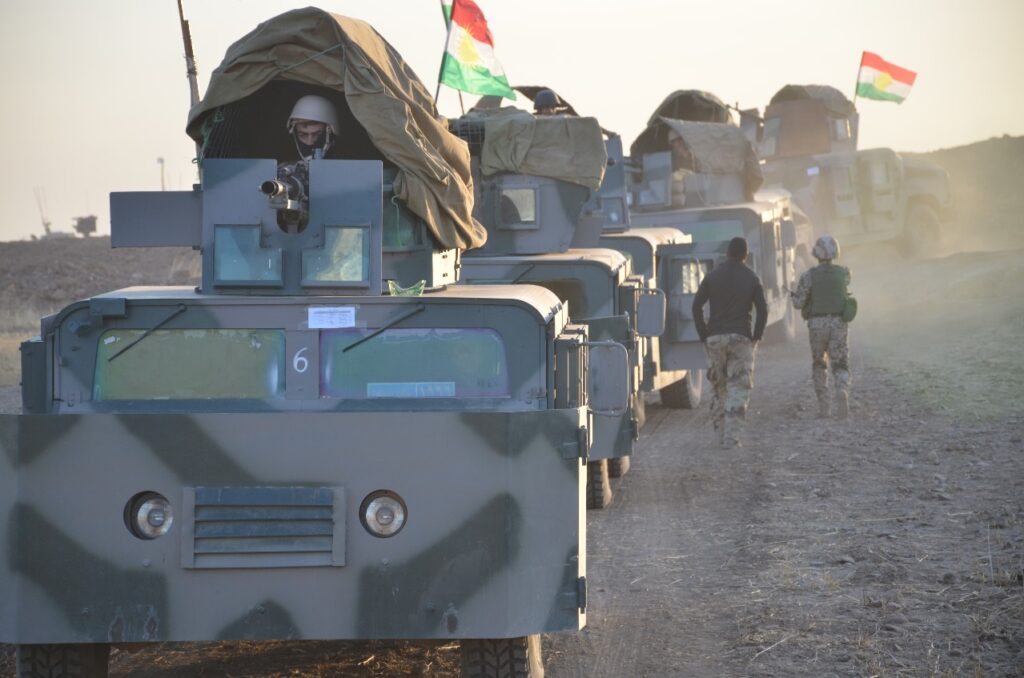
In marked contrast to the general pattern of the ISF’s anti-IS campaigns, the Peshmerga demonstrated considerable mobility at the tactical and operational levels. One US official described the ISF (with the important exception of CTS units) as “McClellan-esque” — in reference to the American Civil War general who hesitated to move his men forward even when he possessed an overwhelming advantage — due to its near-refusal to advance without heavy coalition air and fire support.[147] Largely deriving from its strong determination, the Peshmerga demonstrated the opposite: a willingness to advance to the point of recklessness at times. At the tactical level, this manifested in sustained forward motion even when encountering minefields or boobytraps, and quick reaction to disturbances along the frontline. Technicals were the most common tool to provide mobility for Kurdish fighters, though they also possessed some armored vehicles and tanks that came in handy for planned operations. Imaginative commanders knew how to leverage even small amounts of heavier and more specialized assets for good effect. The Peshmerga did not run into significant difficulties bringing adequate forces to meet their defensive needs along the frontline, a notable feat considering the length of the KCL. When the Iraqi Army and PMF forced Peshmerga units back, they quickly regrouped at defensible strongpoints and massed there, an improvement upon their slower reactions to the initial IS invasion of KRG territory.
Strong planning fed into increased mobility and flexibility. US officers interviewed for this study noted that the Peshmerga planned its operations well,[148] with one officer contrasting it with the generally “performative” planning of ISF leaders.[149] A study by Kurdish Iraqi Army veteran Hussein Khorsheed highlighted the detailed maps Peshmerga officers used to plan offensive operations.[150] One Peshmerga officer added that commanders always strove to include multiple axes of advance in operational plans, designating a main effort as well as secondary or deceptive movements to present IS with several dilemmas and accounting for coalition support for each axis.[151] Peshmerga units showed they could often execute complex plans, as with the multi-pronged assaults on Sinjar or Bashiqa. Even if their advances proved less sophisticated than desired, having a solid plan in place enabled the optimal employment of determined fighters, who typically pressed forward to attain their objectives. It also helped ensure that Peshmerga forces had their heavier equipment in critical locations when needed. Moreover, Kurdish commanders demonstrated that they could quickly formulate good plans, most notably by rapidly reinforcing frontline points under heavy IS attack. Hence, strong planning complemented Peshmerga mobility.
The Peshmerga’s mobility also meant that it was able to operate effectively in more than one major area of operations at once. Especially early in the war, the Peshmerga needed to stabilize frontlines and counterattack along the entirety of the KCL. It launched major counteroffensives to reclaim Jalawla, Gwer, Makhmour, and Tuz at roughly the same time with different sets of brigades, albeit with significant support from Iran-backed militias, the YPG, PKK, and local forces, and with success coming slower at some places than others. At the same time, the KRG had an “expeditionary” capacity to contribute forces to assist with the liberation of Amerli, Mosul Dam, and even Kobane in Syria. Inadequate mass sometimes limited the extent of these operations, as with early efforts to retake Jalawla and the second Sinjar counteroffensive. In such cases, other forces, like the PKK and PMF, supplemented Peshmerga fighters or the coalition compensated.
Proficient Exploitation of Non-Urban Terrain
One notable aspect of the Peshmerga’s style was its adept exploitation of terrain outside of urban areas. One US advisor noted that Peshmerga fighters instinctively sought high-ground positions off of main roads, moving “ridgeline to ridgeline” and through tree lines, and exploiting inter-visibility lines formed by hills and broken ground to maximize cover and concealment while maintaining advantageous positions.[152] They typically sited defensive positions strategically on high ground and well outside of population centers. The Peshmerga’s sectors of operation appropriately conformed to the local terrain, with open areas approaching Sinjar forming a larger sector.
At the same time, Peshmerga attachment to a fighting style that sought advantageous terrain often made the Kurds reluctant to fight where they could not gain that advantage. Kurdish fighters eschewed urban centers, and this unease with urban warfare, together with the flatter terrain in western Iraqi Kurdistan, likely contributed to the initial decision to withdraw from Sinjar, also known as Shingal. Former Minister of Peshmerga Affairs Mustafa Saed Qadir said, “Massoud Barzani understood that one of the weak points for us was Shingal because Shingal was a long and wide area and it is not easy to defend … therefore, we needed to send better forces [there] and improve our defenses.”[153] Similarly, Zerivani chief Aziz Waisi stated that “the frontline fight with [IS] in Shingal was too wide” to defend properly.[154]
Other Peshmerga figures noted that they were wary of entering more populated areas without sufficient intelligence, especially in non-majority-Kurdish areas, because they were uncertain whether the locals would align with IS. For instance, they faced particular difficulties with the local populations in Rabia and the southern part of Kirkuk City.[155] When Peshmerga fighters did need to enter cities and towns, they typically tried to finish the fight as quickly as possible. Most Peshmerga offensive maneuvers on population centers did not last more than a few days, with assiduous shaping operations beforehand, including intelligence preparation, coalition bombardment, and the seizure of surrounding villages. The Peshmerga could typically concentrate overwhelming force when attacking populated areas, but left an avenue of escape for IS defenders, whom the Kurds squeezed out quickly through rapid multi-axis advances. For the Mosul campaign, some Peshmerga officers feared that the battle for the city would become a prolonged slog (which it did) and urged a strategy of stoking a local uprising rather than engaging in a long urban fight.[156] They pointed to the destructive urban battle of Kobane as an example, and some officers proudly contrasted the Peshmerga’s efforts to spare cities and their civilian inhabitants to the high levels of destruction resulting from the YPG and ISF operations to oust IS from other urban centers.[157]
A preference for advantageous terrain and a disinclination to fight in cities converged with the Iraqi Army-PMF offensive in October 2017, when Peshmerga forces retreated from the flat and urban terrain and regrouped at river crossings, where they fought well.
US and Coalition Support
The US-led coalition provided crucial support to the Peshmerga. Air and fire support proved essential for the lightly armed Kurdish fighters facing a well-equipped jihadist enemy. Thanks to the strong relationship the KRG had developed with the US since the 1990s, each sector was able to quickly set up squads of 3-10 US-trained joint fire observers (JFOs) tasked with coordinating strikes with the coalition.[158] Erbil became the site of an important US coordination center for air support, Combined Joint Operations Center-Erbil (CJOC-E). One officer noted the strength of the relationship, which resulted in zero friendly fire incidents from airstrikes.[159] Kurdish JFOs would relay strike requests to US SOF personnel at CJOC-E, who would then format and submit the request. Next, US forces would verify the request through aerial observation and input from US SOF and Kurdish JFOs on the ground, with final approval held at the one-star general level.[160] This process aimed to minimize harm to civilians from the strikes.[161] In addition, coalition-provided MILAN antitank missiles played an important role in addressing the SVBIED problem. Coalition air and fire support became integral to Peshmerga operations and planning, and indispensable in the counteroffensives against IS in the KDP-dominated sectors.
Coalition training helped bolster Peshmerga capabilities. The Kurdistan Training Coordination Center (KTCC), run by eight coalition member states, trained thousands of RGB members — the coalition did not work directly with partisan brigades — mainly in skills needed for offensive and holding operations, as well as more specialized skills tailored to the needs of different Kurdish units.[162] The US also ran parallel independent advise-and-assist efforts to train and equip Peshmerga forces. US and coalition training and equipment was often what separated Peshmerga special units from regular ones, including the elite CTG and CTD. A study by Matthew Cancian found that coalition training “dramatically increased” the confidence and battlefield participation of Peshmerga units compared to those that did not receive such training.[163]
While coalition support was vital in some sectors, Peshmerga forces demonstrated an ability to fight without it too. Particularly in the early counteroffensives in the PUK-dominated sectors, Peshmerga units had to fight without coalition assistance due to concerns over cooperation with Iran-backed militias. Nonetheless, Peshmerga brigades working with certain PMF units retook important areas in Diyala Governorate and Tuz District without air support, including Jalawla and Suleiman Bek. In October 2017, however, the lack of coalition support left lighter-armed Peshmerga forces at a grave disadvantage against hardened and well-equipped Iraqi Army-PMF formations, driving the Kurds to retreat to more defensible areas. Still, Peshmerga fighters did put up fierce and successful resistance without coalition assistance once they regrouped at the river crossings. Thus, coalition support was crucial and at times decisive, but Peshmerga brigades also showed they could hold their own without it.
Another major form of US support was payment of about $20 million in monthly stipends starting in 2014 for the salaries of RGB members.[164] The US stipends helped ensure RGB members were paid on time as the war strained KRG resources, compounded by Baghdad’s long-running inability or unwillingness to release federal funds for the Peshmerga despite its official recognition in the Iraqi Constitution.[165] This financial support helped prevent morale problems among the Peshmerga during the war against IS.
Disjointed Strategic-Level Command-and-Control, Robust Tactical-Level Cohesion
The most noticeable and significant limit on Peshmerga combat power is its disjointed top-level command-and-control, resulting from the deep KDP-PUK political divisions. Attempts to unify the partisan Peshmerga forces go back to the founding of the KRG in 1992.[166] The latest effort officially began in 2017, when the KRG endorsed a UK-conducted scoping study completed the previous year to guide unification efforts.[167] This initiative builds on the 2009 creation of the first RGBs and identifies priority areas — from training noncommissioned officers to establishing an electronic payment system — to foster a unified, professionalized force not beholden to party interests.[168] Each RGB is usually composed of two battalions each from KDP and PUK brigades, with the brigade commanders and deputy commanders drawn from different parties.[169]
In the test of battle, this arrangement worked at the tactical level. RGBs contributed to the war effort as much as partisan units did, and in many frontline areas, one would be hard-pressed to differentiate between KDP and PUK members. RGB commanders worked well with their deputies, and fighters maintained good relations among themselves and with their commanders. To the extent that there were problems for command-and-control on the frontlines, they stemmed from the specific individuals involved rather than broader political disagreements.[170] Compared to just a few years earlier, when it was common to find fighters ignoring orders from commanders from opposing parties, the level of internal cohesion that the RGBs maintained is remarkable. This bodes well for future US-KRG cooperation on advancing reform.
Nonetheless, bitter divisions hampered effectiveness at the strategic level. The two parties continued to exchange accusations over responsibility for the KRG’s initial setbacks, its shortcomings during the war, and the loss of significant territory to Baghdad. The literal scars of the civil war remain, as do memories of betrayal and abuse. As a result, sector commands had to be aligned with KDP and PUK areas of control in western and eastern Kurdistan, respectively, with the symbolically and economically important city of Kirkuk split between KDP-dominated Sector 5 and PUK-dominated Sector 4. Sector commanders had broad discretion to act autonomously, and seams between KDP and PUK lines posed problems. These problems surfaced most prominently in cases where different party leaders issued separate orders to Peshmerga units during the Iraqi Army-PMF offensive of 2017. This resulted in a clear partisan divide in whether certain brigades offered resistance or retreated, with even integrated units succumbing. Both sides felt so deeply betrayed by the other that this episode continues to breed distrust today and imposes an ongoing strain on reform efforts.
Lack of Heavy Weapons
Throughout the war, the Peshmerga generally lacked heavy weapons. As a result, it had a limited ability to deal with armor and SVBIED attacks initially, a major reason for its early territorial losses. The coalition compensated with artillery and air support to provide the firepower the Peshmerga needed to turn the tide. However, when the coalition withheld its support in the 2017 Iraqi offensive, the Peshmerga again found itself at a significant disadvantage, prompting it to withdraw across the Tigris in the face of the Iraqi Army-PMF offensive. This lack of heavy weapons fed a belief by the Peshmerga that it could not stand against some of its enemies without outside assistance. The Peshmerga still lacks a robust heavy weapons arsenal, which is likely to create difficulties in the future should it again face a determined foe — whether that is the ISF or a renewed jihadist threat — intent on seizing territory in the Kurdistan Region of Iraq.
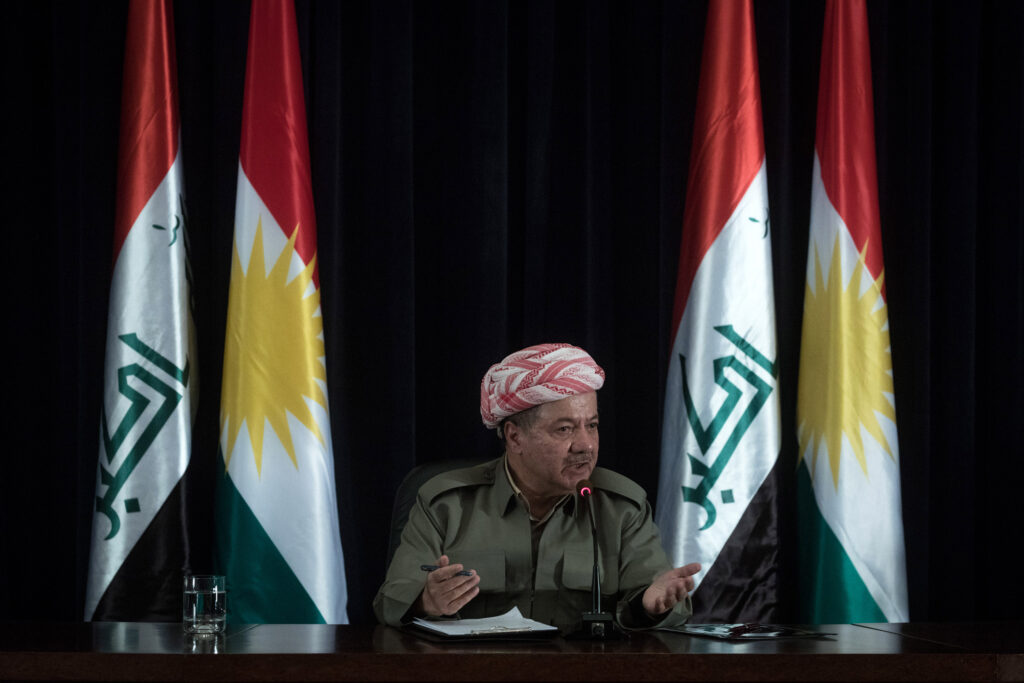
Overall Assessment
Multiple Peshmerga members noted that the fight against IS necessitated new modes of operating to which the force was not accustomed. This was neither the guerrilla campaign of the old Kurdish uprisings nor the counterterrorism actions that followed the 2003 US invasion.[171] Rather, it was a conventional war — one with clear frontlines in which territorial control was the measure of success — against an innovative foe leveraging jihadist experience in other theaters and adapting the suicide bomb as a battlefield weapon. Ultimately, the Peshmerga rose to the occasion and established a strong battle record in its successful three-year war against IS. At the same time, the conflict revealed significant military weaknesses, which resurfaced in October 2017.
Despite the novelty of the IS war for the Peshmerga, its way of fighting belied greater continuity with its guerrilla roots than its members acknowledge. The Peshmerga’s greatest assets — determination, mobility and flexibility, and effective exploitation of terrain — are also key characteristics of a proficient guerrilla organization. With older brigade and sector commanders who fought in the previous Kurdish insurgencies in charge of the combat forces, this is no surprise. It was, thus, less a matter of learning conventional warfare from scratch and more about adapting its existing military traits to a new challenge. Also, the Peshmerga did have some previous experience with conventional warfare, most notably in the failed uprising of 1974-75 and some episodes of the 1994-98 civil war. Therefore, while IS did pose a new threat in the innovative ways in which it fought, this was not the Kurds’ first attempt at a conventional strategy. In preparing for future conflicts, the Peshmerga can build on its guerrilla legacy by consciously institutionalizing the strengths it bestows while also adapting them to the needs of high-intensity warfare.
Still, it was no foregone conclusion that the Peshmerga could successfully shift from conducting raids and manning checkpoints to seizing and holding territory in a sustained way, and that the force did so is a testament to its adaptability, albeit not without initial setbacks. KRG territorial losses early in the war largely reflected the Peshmerga’s unpreparedness, but it learned quickly in the cauldron of combat to fight differently. Coalition support, as well as the assistance of other ground forces in Iraq, proved crucial in this transition, particularly in compensating for the Peshmerga’s shortcomings in the war’s first year. Also important was the experience of the hardened commanders who led the Peshmerga, no doubt an asset for the force’s morale and planning. Air and fire support gave the Peshmerga the firepower it needed to halt the IS advance in some places, as well as to plan and execute successful counteroffensives. In other sectors, the PMF, PKK, or more localized forces supplemented Peshmerga combat power. Throughout the war, there were no major IS breakthroughs in the KCL, despite the jihadists’ repeated efforts to achieve one. Robust internal defense upheld by the Asayish and intelligence services ensured that Peshmerga forces virtually always enjoyed a secure rear and could focus their efforts on holding the line and pushing it forward. Thus, in taking and holding territory against IS, the Peshmerga proved an effective fighting force, especially when receiving coalition support. Ensuring the Peshmerga can retain this capability with minimal dependence on outside forces will be an important line of effort moving forward.
The absence of coalition support in October 2017 tested Peshmerga capabilities and forced it to rely more heavily on mobility and terrain exploitation, though the PUK’s decision to withdraw its forces from Kirkuk was decisive in the catastrophe that ensued. As the Iraqi Army and PMF advanced on October 16, the much reduced remaining Peshmerga forces, stunned by the PUK’s defection, could barely offer resistance and retreated to more defensible lines. However, when the Peshmerga regrouped at Suheila and Perde, the Kurds once again displayed tenacity and effective use of terrain by bloodying the opposing forces that pursued them. Partisan division will continue to impose major problems for the Peshmerga as long as it persists.
A final assessment of effectiveness might compare these outcomes against the goals of the KRG. As military analyst Dennis Chapman noted in his comprehensive study of KRG security institutions, “The appropriate roles and missions of the Peshmerga has been a point of friction between the Government of Iraq and the Kurdistan Regional Government.”[172] Consequently, a desire to avoid friction could prompt the KRG to moderate any declared goals for the Peshmerga, regardless of what its true aims are. A 2008 KRG-Iraqi federal government conference enumerated several core Peshmerga functions, among them securing the territory of the KRG and its government institutions, combating terrorism, and keeping the peace during times of “civil disturbance.”[173] The official KRG website states that MOPA “is responsible for protecting the borders, land and sovereignty of the Kurdistan Region, and for ensuring security and freedom of Kurdistani citizens.”[174] During the war against IS, top KRG officials made bolder statements about their defensive goals, with President Barzani stating in 2015 that the rise of IS marked the end of Iraq as a cohesive state and later framing the 2017 referendum as his vision for Kurdistan’s future. In 2016, Vice President Kosrat Rasul asserted, “What has been conquered with Kurdish blood shall remain Kurdish soil,” referring to Kirkuk and other areas disputed between Baghdad and Erbil that the Peshmerga have occupied since 2014.[175] Such statements signal a desire to extend KRG control and ultimately achieve independence.
Measured by the goals enumerated in the 2008 conference, the Peshmerga demonstrated a high level of effectiveness. In 2014, it pushed beyond the KRG’s official boundaries of Dohuk, Erbil, and Sulaymaniyah. Even after the IS offensive of August, the jihadists did not penetrate these core regions and were unable to stoke much turmoil from the outside. Still, in October 2017, the Iraqi Army and PMF came close and although fierce Peshmerga resistance bloodied the attackers, the outcome might have been less certain were they more determined to press the attack and commit additional forces. Superior Iraqi (and Iranian) firepower would likely have begun to take its toll over time, underscoring the Peshmerga’s lack of heavy weapons and antiarmor capabilities.
Nonetheless, by this same token, the Peshmerga failed to meet the loftier goals signaled by statements like those made by Barzani and Rasul and arguably set the KRG back. Prior to the war, Baghdad and Erbil had arrangements for joint patrols in Kirkuk and certain other disputed territories. When the Iraqi Army left in 2014, these fell under exclusive Peshmerga control, before later returning to Iraqi control after the Peshmerga’s withdrawal in 2017. The post-referendum fighting, KDP-PUK squabbling, and the Peshmerga’s withdrawal from Kirkuk, Sinjar, and elsewhere, therefore, saw the end of the joint patrols and the resumption of both intra-Kurdish and Erbil-Baghdad animosity. Although now relegated to an insurgent organization without territory in Iraq, IS takes advantage of the lack of patrols between the frozen frontlines separating KRG and Iraqi/PMF forces to continue its terrorist activities. The KRG has not fully recovered from the loss of these territories, and the Iraqi government continues to use the referendum and its aftermath to further weaken Erbil. The Peshmerga failed to prevent this strategic disaster. It proved unprepared to meet the ISF and PMF and damaged its credibility in the process. This failure should be kept front of mind in any future reform efforts as a reminder of what happens when the two main Kurdish parties cannot coordinate.
Implications for US Policy
The war against IS and the post-referendum conflict with the Iraqi Army and PMF hold important implications for the US-KRG military partnership going forward. This relationship is now arguably more important than ever as US troops have departed their bases in Iraq outside of the KRG.[176] American forces are still welcome in Iraqi Kurdistan. The approximately 2,000 troops remaining in the country are based mostly in Erbil. Even as the future of the US presence in the KRG too is in flux, Erbil will be looking for opportunities to strengthen its ties with the United States.[177]
This move to basing exclusively in Iraqi Kurdistan opens a new opportunity for the US to deepen its military relationship with the Peshmerga. Erbil will no doubt relish a closer relationship with Washington, which will strengthen the Kurds’ position vis-à-vis Baghdad and other players. A stronger KRG would also benefit Washington, bolstering a friendly actor in the region with a proven track record as a reliable counterterrorism and military partner. Peshmerga officers highly value US support and acknowledge how indispensable it was in the fight against IS.[178] US advisors generally enjoy working with the Peshmerga and develop strong bonds with its fighters.[179]
Push for a Stronger Definition of the Peshmerga as the Predominant Military Force in the Kurdistan Region of Iraq
The US has a significant strategic interest in partnering with the KRG and the Peshmerga, in addition to — and in some ways despite — its relationship with Baghdad. America’s North Atlantic Treaty Organization (NATO) ally Turkey is also an obstacle to expanded US-KRG ties. Consequently, to the extent that US relations with Iraq and Turkey allow it, the US should support a Peshmerga role as the predominant military force in the Kurdistan Region of Iraq, with the primary mission of addressing external threats to KRG borders. Moreover, if at any point US relations with Iraq sour or collapse, the US should expand its relationship with the Peshmerga as both leverage against Baghdad and a hedge against a total break.
Should the US proceed with deepening its relations with the Peshmerga, an expanded US commitment should entail the provision of heavier armament and the development of mechanized forces and air defense to defend against large ground incursions and airborne threats like Iranian-launched projectiles, respectively. These threats might emanate from jihadist groups, as with the 2014-17 military campaign against IS, or from the Iraqi government and Iran-backed militias, as occurred in October 2017.
Deepen US Involvement in Reform
The main problem complicating US-Peshmerga relations today is the reform process, the effort to unify Peshmerga brigades under MOPA rather than continued control by political parties. This is first and foremost a political problem, and Washington should recognize that there is only so much it can do with military-to-military incentives to overcome that. Nevertheless, it is still worth trying. The US has pushed the Peshmerga to address this critical issue by tying the stipends it provides to the KRG to real progress in unification. This has motivated KRG officials to give reform more attention and move more partisan battalions, including some more well-equipped units, into new RGBs, which institutionally answer to MOPA rather than a political party.[180] The KRG plans to absorb all RGBs and partisan units into a new divisional structure under two regional commands. According to a senior MOPA official, by the end of September 2026, this effort will result in the formation of 11 divisions, with six under one area command and five under the other. It will be important for US advisors to verify whether this new structure brings true nonpartisan command or simply repackages existing partisan influences.[181] Per the latest four-year US-KRG memorandum of understanding signed in 2022, US stipends for integrated brigade salaries were reduced gradually each ensuing year, in line with American expectations that the KRG will by then be able to fund its own defense.[182] Standing at $240 million in 2023, this support decreased to $135 million in 2024, $60 million in 2025, and zero in the 2026 budget request. At the same time, the US has allocated an increasing amount to training and equipping MOPA units, going from just under $5 million in 2024 to over $57 million in 2025, with more than $61 million requested for 2026.[183]
Significant, mainly political obstacles remain, but deeper US involvement in Peshmerga affairs can help ensure the KRG stays on the right track. The October 2017 battles showed that the parties still have the power to override MOPA, and one coalition officer who recently served in Erbil noted that KRG officials are markedly opaque about this issue.[184] At the same time, the KRG has had trouble paying Peshmerga members as US stipends decreased.[185] Thus, the US should offer to renew its payment of Peshmerga salaries, but should also demand a greater role in determining promotions, retirements, and other personnel decisions in return. Former Assistant Secretary of Defense for Strategy, Plans, and Capabilities Mara Karlin has shown that involvement in the sensitive military affairs of partner forces is a central ingredient for successful security force assistance; it is time the US take this approach to the Peshmerga, ensuring that promotions are based on merit and helping to safeguard command-and-control from partisan misuse.[186] In other words, the US now has an opportunity to recalibrate its “carrots,” as scholar Rachel Tecott has advocated in a security force assistance context, to ensure positive future development of the Peshmerga.[187]
Involve US Advisors in Peshmerga Personnel Decisions
Meanwhile, the US should press the KRG to move toward a smaller, more professional force with a more meritocratic promotion system. To be sure, the Peshmerga has already taken steps in this direction, and one US advisor noted that there is largely a culture of meritocratic promotion.[188] Still, one Peshmerga officer said that it is bloated and would be better off with a smaller but higher-quality force,[189] while another stated that the goal is to reduce its size from as many as 350,000 to 125,000 fighters by the end of the reform process.[190] Moreover, senior party figures still hold considerable sway within Peshmerga command-and-control, and younger veterans of the 2014-17 war should be promoted in their place. Besides committing themselves to involvement in personnel decisions, US advisors should insist on inspecting Peshmerga rosters and bases to measure progress. Absent this level of monitoring, there is a risk that KRG officials could settle for cosmetic or less significant technical achievements, like switching to an electronic payment system, over real unification.
Indeed, through deeper involvement in personnel decisions, the US has contributed positively to building effective foreign militaries in the past. Karlin examines how American advisors pushed the Greek military to professionalize during the communist uprising of 1946-49.[191] Stephen Biddle and his coauthors note that an “unusually intrusive and conditional [US] assistance mission” in South Korea helped build a proficient Republic of Korea Army.[192] Military analyst Kenneth Pollack discusses how deep American influence in the Iraqi Army in 2007-09 helped produce a well-led fighting force before it was subsequently degraded when US advisors reduced their involvement and the Iraqi government under Prime Minister Maliki renewed practices that promoted sectarianism, corruption, and cronyism.[193] Building on an already close relationship, the US is in a strong position to positively influence the Peshmerga through similar deeper involvement.
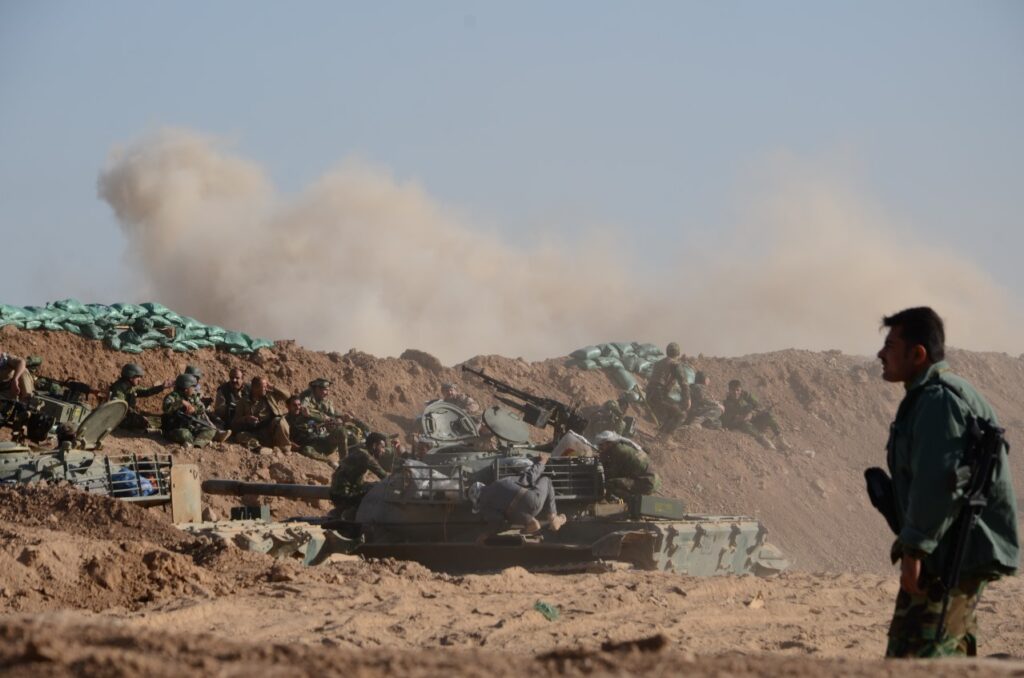
Reward Progress with Renewed Stipends and Direct Arms Transfers
If and when the Kurdish parties move toward full unification of the Peshmerga, the US should reward them by locking in and expanding stipends and transferring arms directly to Erbil rather than via Baghdad. Stipends will help ensure the KRG can maintain a professionalized military and support the unification process. Baghdad has withheld federal budgetary funds earmarked for the KRG while sharply increasing payments to the PMF — a force dominated by Iran-backed militias that have regularly attacked US and Israeli targets since the Israel-Hamas war began in October 2023, and renewed those attacks after the US-Israeli war with Iran erupted in February 2026.[194] There is, thus, ample cause for the US to seriously reevaluate its deference to Baghdad, which openly harbors and funds Iran-backed terrorist organizations.
At the same time, the Peshmerga’s lack of heavy weapons will continue to limit its development and leave it vulnerable to attack by better-armed adversaries. The US usually routes arms transfers to Erbil through Baghdad to respect Iraqi sovereignty, but as mentioned, this should now be subject to reassessment. During the war, coalition donations of arms to the KRG compensated for this issue, but properly preparing for a potential future conflict will require direct transfers of antitank, artillery, and armor systems, among other capabilities. Peshmerga officers interviewed for this study indicated the force needs everything from basic small arms and light weapons to more advanced antitank missiles and air defense systems.[195]
If circumstances were to permit it, the US could start with more transfers of armored vehicles, including Humvees, Bradleys, Strykers, and mine-resistant ambush protected vehicles. These build on existing Peshmerga strengths in mobility and aggression and can be adapted to a territorial defense posture. In the future, the KRG may well need to fend off another major attack, like the jihadist incursion from IS or an attempt by Baghdad and Iran-backed militias to seize KRG territory. It will be critical to deter or prevent IS or potential new jihadist threats from launching any future offensives into Iraq via Kurdistan, and a strong Peshmerga can back up a beleaguered ISF if such a shared threat were to emerge.[196] Alternatively, an Iran-backed ISF offensive against the KRG would give Tehran a significant victory at the expense of a reliable US ally. The KRG needs better armor to ensure it can meet such a conventional military threat. In the long term, and circumstances permitting, the US could consider transferring M1 Abrams tanks and towed or self-propelled artillery systems. Further progress in reform could warrant transfer of Javelin ATGM systems and Puma drones, both long desired by the Peshmerga and which would prove useful in spotting and repelling more conventional attacks.[197] At the same time, such higher-quality transfers should be contingent on the KRG — particularly the PUK — reducing its ties with Iran, which would exploit any opportunity to access American technology. The presence of US forces alone could be a deterrent to Iran’s designs on the KRG, but it may not be enough without a credible military capability that could meet the enemy itself.[198]
Another potential area for US-KRG cooperation is air defense. Although not a significant element of the KRG’s challenges against IS or the ISF, air defense has become increasingly important to counter Iranian projectiles, especially as Iran has continuously fired ballistic missiles and drones toward Israel, Iraq, the Gulf states, and other countries in the region since the US-Israeli war with Iran began in February 2026.[199] Since 2011, Baghdad has been nominally responsible for Iraqi airspace, but it has proven unwilling or unable to protect it.[200] The Peshmerga is mostly powerless to deal with projectiles launched from Iran, Turkish air raids, or potential Iraqi airstrikes on KRG territories. A more robust ability to shoot down Iranian projectiles would support the security of US personnel in the region as well as that of Israel. Provision of Avenger and older HAWK systems to the KRG, together with specialized training for how to use them, would be one place to start. American Stinger and Russian Pantsir SAMs would also be useful. Even older mounted gun systems, such as the Russian ZSU-23-2, could be useful against the less sophisticated drones and rockets that Iran employs.
Increase US SOF Ties with the Counterterrorism Forces
One of the best products of US security force assistance missions has been the creation of effective foreign special forces units.[201] The Iraqi CTS is one such example; the former Afghan commandos and the Somali Danab Brigade are two more.[202] The CTG and CTD have proven they can bring real combat power to the battlefield and are some of the most professional forces within the KRG security services. Already in a strong position, the CTG and CTD stand to benefit further from closer ties with US SOF advisors, comparable to other efforts to build partner special forces units, if the KRSC can be reformed to promote CTG-CTD integration. Closer ties here should come with the same conditions outlined above to ensure the counterterrorism forces also integrate into a unified command structure. This initiative will require rigorous efforts to reform the KRSC, which currently does not foster cooperation among the partisan units nominally subordinate to it.
Bolstering the counterterrorism forces would help ensure the KRG possesses a sharp spearhead in the event that it needs to react quickly to military threats in the future. While not meant for conventional warfare, the CTG and CTD did play an important role in the war as elite strike forces, much like the Iraqi CTS did, and as US-trained foreign special forces have in other countries as well. They have also continued to effectively carry out their original mandate of addressing terrorist threats through intelligence-driven raids, arrests, and strikes on IS hideouts. An expanded counterterrorism contingent prepared for sharp counterstrikes against larger threats would help to mitigate the risk of major territorial losses when such dangers arise and support efforts to suppress IS. In the event of a jihadist attack, it would also help buy time for regular forces to regroup and reinforce CTG/CTD operations.
Encourage Greater Tactical Adaptability and Innovation
The Peshmerga has shown its ability to adapt to changing security environments well, particularly when it has US support, but it can do more on its own to improve its position. It can, for example, invest in developing indigenous arms production capabilities. Even smaller-scale efforts to fabricate small arms and light weapons and build explosives could go a long way in bolstering Peshmerga ammunition and supply reserves while reducing dependence on outside suppliers of varying reliability. If the US finds itself in a position to expand its military cooperation with the KRG, this could promote a division of labor whereby the KRG could rely on itself for more basic needs and on the US for heavier and more advanced equipment. If IS managed to create such an industry, complete with standardized packaging and labeling, then the KRG certainly can too.[203] Absent industrial capacity, the Peshmerga can also modify more easily accessible technologies, like small drones or remote-controlled ground vehicles, to strengthen its tactical intelligence and antiarmor capabilities.
A serious KRG effort to develop such capabilities would help substitute for coalition support when needed and mitigate the impact of the Peshmerga’s shortage of heavy weapons. Off-the-shelf drones can fill intelligence, surveillance, and reconnaissance roles at the small-unit level. Arming such drones with explosives could give the Peshmerga some antiarmor and air attack capability, not equal to that the coalition can provide, but adequate for many of the threats that the KRG faces. Building explosives for emplacement could enable the KRG to deny strategic areas to advancing enemies, for example, though any such effort would need to adhere to ethical standards and best practices to allow for post-conflict demining.
Conclusion
The Iraqi Peshmerga has proven itself a reliable US security partner and effective fighting force. Although it performed unevenly in the opening of the 2014-17 war against IS, the Peshmerga quickly rebounded and learned to dominate the new battlefield. It went from a largely green counterterrorism body to a hardened, aggressive, mobile, and adaptable force capable of seizing and holding territory. US advisors enjoyed working with Peshmerga fighters and a synergistic relationship developed between them. These traits make the Peshmerga an ideal US partner. The 2017 renewal of hostilities between the KRG and the Iraqi government tested the Peshmerga once more. Although the Kurds fought tenaciously in the end, the defection of the PUK cast light on the enduring internal divisions and deep feelings of distrust and betrayal still plaguing the KRG in general and the Peshmerga in particular. Hence, US support must continue to try to push toward Peshmerga reform — for the sake of both the US-KRG partnership and the military effectiveness of the Peshmerga. Barring progress on reform, it would be extremely difficult to deepen the partnership.
There is a real opportunity to forge closer US-KRG ties, provided progress on reform is made and the complex politics of Iraq and its neighbors align. The US should continue to insist on genuine advances in the effort to unify Peshmerga units under nonpartisan command. As the force institutes a new command structure, US advisors should verify that the creation of divisions leads to real changes in how the Peshmerga operates. If they have suspicions, US advisors need to be able to intervene in personnel decisions to ensure commanders are promoted based on merit and do not answer to party bosses. If and when such progress takes place, the US could consider upgrading the partnership with direct transfer of heavier weapons and renewal of stipends for Peshmerga salaries. Besides addressing the conventional military threat posed by a renewed IS, new jihadist groups, or an Iran-backed ISF, future transfers should also bolster KRG air defense to combat the growing danger of Iranian missile and drone strikes.
The US would also need to be sensitive to the politics of deepening ties with the Peshmerga. Baghdad and Ankara would surely have concerns about the US strengthening relations with an entity they view with suspicion. The US understandably must balance its ties with the KRG with its relations with Turkey and the Iraqi government. At the same time, as Baghdad grows closer to Iran and continues harboring Iran-sponsored terrorist organizations, Washington’s relations with Baghdad could worsen, reinforcing the case for an upgraded relationship with Erbil. The Peshmerga has proven a capable US partner, and where circumstances allow, Washington should deepen the relationship.
Endnotes
[1] Dennis P. Chapman, Security Forces of the Kurdistan Regional Government, Mazda Publishers, 2011, pp. 46-47.
[2] Hussein Tahiri, Structure of Kurdish Society and the Struggle for a Kurdish State, Mazda Publishers, 2007, pg. 208.
[3] Michael M. Gunter, “The KDP-PUK Conflict in Northern Iraq,” Middle East Journal, Vol. 50, No. 2, Spring 1996, pp. 226-29.
[4] David McDowall, A Modern History of the Kurds, revised ed., I.B. Tauris, 2007, pp. 304-9; Kenneth M. Pollack, Arabs at War: Military Effectiveness, 1948-1991, University of Nebraska Press, 2002, pp. 156-57.
[5] Pollack, Arabs at War, pp. 159-64.
[6] Pollack, Arabs at War, pp. 162-63.
[7] Pollack, Arabs at War, pp. 176-80.
[8] Pesach Malovany, Wars of Modern Babylon: A History of the Iraqi Army from 1921 to 2003, University Press of Kentucky, 2017, pp. 233-35.
[9] Malovany, Wars of Modern Babylon, pg. 343.
[10] Human Rights Watch, Iraq’s Crime of Genocide: The Anfal Campaign Against the Kurds, Yale University Press, 1995.
[11] Chapman, Security Forces of the Kurdistan Regional Government, pp. 17-19; Phillip Gibbons, “US No-Fly Zones in Iraq: To What End?” The Washington Institute for Near East Policy, July 1, 2002; Gareth R. V. Stansfield, Iraqi Kurdistan: Political Development and Emergent Democracy, Routledge, 2003, pg. 121.
[12] Gunter, “The KDP-PUK Conflict,” pg. 233.
[13] “Containing Saddam Hussein’s Iraq,” The White House, accessed June 3, 2026; Alan Makovsky, “Kurdish Agreement Signals New US Commitment,” The Washington Institute for Near East Policy, September 29, 1998; Kenneth M. Pollack, “Escaping the Inspections Trap,” Brookings, November 18, 2002; Stansfield, Iraqi Kurdistan, pp. 100-101.
[14] Chapman, Security Forces of the Kurdistan Regional Government, pg. 25.
[15] “Ansar Al-Islam,” National Consortium for the Study of Terrorism and Responses to Terrorism (START), April 2015.
[16] See Constitution of the Republic of Iraq, 2005.
[17] Efforts to unify the Peshmerga date back to 1992. Author interview with a Peshmerga officer, May 2024; “By 2026, Peshmerga’s 70, 80 Units Will Be United: KRG Minister of Peshmerga,” Kurdistan24, March 9, 2024; Wladimir van Wilgenburg, “Kurdistan Region President Underlines Importance of Peshmerga Unification,” Kurdistan Chronicle, May 15, 2026.
[18] This figure was last updated in 2023. Myles B. Caggins III, “Peshmerga Reforms: Navigating Challenges, Forging Unity,” Foreign Policy Research Institute, October 31, 2023.
[19] Chapman, Security Forces of the Kurdistan Regional Government, pp. 99-100.
[20] Ministry of Peshmerga Affairs, accessed September 10, 2024.
[21] Michael Knights and Lahur Talabani, “The Iraqi Kurdish Battle Against ISIS: Reports from the Front,” The Washington Institute for Near East Policy, November 6, 2015.
[22] See Chapman, Security Forces of the Kurdistan Regional Government, pp. 184-95.
[23] On the previous organization see Chapman, Security Forces of the Kurdistan Regional Government, pp. 116-17.
[24] Author interview with US and Peshmerga officers, February-May 2024.
[25] Author interview with a Peshmerga officer, February 2024.
[26] Author interview with Peshmerga officers, February-May 2024.
[27] Author interview with a Peshmerga officer, May 2024; Press Release, “Kurdistan Regional Government and Coalition Forces Progress in Unifying 28 Peshmerga Brigades,” Kurdistan Regional Government, August 15, 2023.
[28] Author interview with Peshmerga officers, February-May 2024.
[29] Author interview with Peshmerga officers, February-May 2024; Author interview with a Peshmerga officer, January 2022.
[30] Sardar Aziz and Andrew Cottey, “The Iraqi Kurdish Peshmerga: Military Reform and Nation-Building in a Divided Polity,” Defence Studies, Vol. 21, No. 2, 2021, pg. 229.
[31] Author interview with a Peshmerga officer, March 2023.
[32] “Over 150,000 Enlisted as Peshmerga Troops in Kurdistan Region, Official Data Shows,” Rudaw, April 3, 2017.
[33] Author interviews with Peshmerga officers, May 2024.
[34] Author interview with Peshmerga officers, February-May 2024; Aziz and Cottey, “The Iraqi Kurdish Peshmerga,” pp. 235-37; Wladimir van Wilgenburg and Mario Fumerton, “Kurdistan’s Political Armies: The Challenge of Unifying the Peshmerga Forces,” Carnegie Endowment for International Peace, December 16, 2015.
[35] Author interview with a Peshmerga officer, May 2024.
[36] Michael Knights and Alex Almeida, “Back to Basics: US-Iraq Security Cooperation in the Post-Combat Era,” The Washington Institute for Near East Policy, October 26, 2021, pg. 31.
[37] Author interview with a Peshmerga officer, May 2024.
[38] See David Schenker, “Leaving Iraq May Be America’s Wisest Choice,” Foreign Policy, February 26, 2024.
[39] Yerevan Saeed, “US-Brokered Deal Turns on Iraq-Turkey Pipeline Spigots,” Arab Gulf States Institute, October 23, 2025.
[40] Michael Knights, “Turkey’s War in Northern Iraq: By the Numbers,” The Washington Institute for Near East Policy, July 28, 2022.
[41] “Iran’s Western Frontier: The Kurdish Factor in the Expanding Conflict,” The Soufan Center, March 4, 2026.
[42] Mehmet Alaca, “Roots of the Rift between Turkey and Iraqi Kurdistan’s PUK,” Fikra Forum, April 28, 2023.
[43] Amy Austin Holmes, Statelet of Survivors: The Making of a Semi-Autonomous Region in Northeast Syria, Oxford University Press, 2024; David Pollock, “Syria’s Kurds Unite against Assad, but Not with Opposition,” The Washington Institute for Near East Policy, July 31, 2012.
[44] Raja Abdulrahim, “US Completes Handover of Military Bases in Syria,” New York Times, April 16, 2026.
[45] The YPG created the Syrian Democratic Forces (SDF) in 2015 as a coalition to absorb other armed groups. Sara Harmouch, “Ahmad Al-Sharaa Is Building the State Abu Mohammed al-Golani Promised,” Lawfare, March 15, 2026; Ahora Qadi, “SDF Chief Sits Down with Al-Sharaa as Syria Moves to Absorb Kurdish Forces into Its Military,” Kurdistan24, April 16, 2026.
[46] Jeanne F. Godfroy et al., US Army in the Iraq War Volume 2 Surge and Withdrawal, US Army War College Press, 2019; Joel D. Rayburn and Frank K. Sobchak, The US Army in the Iraq War – Volume 1: Invasion – Insurgency – Civil War, 2003-2006, US Army War College Press, 2019.
[47] “Fact Sheet: The New Way Forward in Iraq,” The White House, January 10, 2007; Myriam Benraad, “Iraq’s Tribal ‘Sahwa’: Its Rise and Fall,” Middle East Policy, Vol. 18, No. 1, 2011, pp. 121-31.
[48] Stephen Biddle et al., “Testing the Surge: Why Did Violence Decline in Iraq in 2007?” International Security, Vol. 37, No. 1, 2012, pp. 7-40.
[49] James Jeffrey, “The Iraq Troop-Basing Question and the New Middle East,” Policy Note No. 21, The Washington Institute for Near East Policy, November 2014.
[50] Author interview with US special operations forces officer, March 2024.
[51] “Iraq Tensions Added to Regional Turmoil,” Hürriyet Daily News, November 21, 2012.
[52] Richard Barrett, “Beyond the Caliphate: Foreign Fighters and the Threat of Returnees,” The Soufan Center, October 2017, pg. 7; Ido Levy, Soldiers of End-Times: Assessing the Military Effectiveness of the Islamic State, Rowman & Littlefield, 2023; Charles R. Lister, “Profiling Jabhat Al-Nusra,” Brookings, 2016.
[53] Bill Roggio, “Al Qaeda Seizes Partial Control of 2 Cities in Western Iraq,” Long War Journal, January 2, 2014.
[54] Jessica D. Lewis, “ISIS Battle Plan for Baghdad,” Institute for the Study of War, June 27, 2014.
[55] Abigail Hauslohner, “Islamic State Leader Abu Bakr Al-Baghdadi Appears in Public, According to Video,” Washington Post, July 5, 2014.
[56] See Ben Connable, “Iraqi Army Will to Fight: A Will-to-Fight Case Study with Lessons for Western Security Force Assistance,” RAND Corporation, January 11, 2022.
[57] Author interview with a Peshmerga officer, May 2024.
[58] Kenneth M. Pollack, “Iraq: Understanding the ISIS Offensive Against the Kurds,” Brookings, August 11, 2014.
[59] Author interview with US special operations forces officer, March 2024.
[60] Author interviews with Peshmerga officers, 2022-2024.
[61] See Hugo Kaaman, “The Unique SVBIEDs Used in The 2013 Capture of Menagh Airbase,” Hugo Kaaman: Open Source Research on SVBIEDs (blog), September 21, 2020; Hugo Kaaman, “Car Bombs as Weapons of War: ISIS’s Development of SVBIEDs, 2014-19,” Middle East Institute, April 2019; Levy, Soldiers of End-Times, 2023, pp. 98-99; Craig Whiteside and Vera Mironova, “Adaptation and Innovation with an Urban Twist: Changes to Suicide Tactics in the Battle for Mosul,” Military Review, December 2017, pp. 78-85.
[62] For a good analysis of the Turkish Armed Forces’ ground operations against IS, see Metin Gurcan, “Assessing the Post-July 15 Turkish Military: Operations Euphrates Shield and Olive Branch,” The Washington Institute for Near East Policy, March 26, 2019, pp. 3-9.
[63] Lazar Berman, “Kurdish President Calls on Retired Fighters to Return to Units,” Times of Israel, June 20, 2014.
[64] “Statement by the President,” The White House, August 7, 2014.
[65] David Hudson, “President Obama: ‘We Will Degrade and Ultimately Destroy ISIL,’” The White House, September 10, 2014.
[66] Wladimir van Wilgenburg, “Millionaire Commander Protects Kurdish Capital against IS,” Middle East Eye, January 19, 2016.
[67] Author interview with a KRG official, June 2024.
[68] “Peshmerga Enter Strategic Town Northeast of Mosul,” Rudaw, October 25, 2014; Erica Gaston and András Derzsi-Horváth, “Iraq after ISIL: Zummar,” Global Public Policy Institute, August 16, 2017.
[69] Born in the Dohuk Governorate town of Zakho, Gen. Fadhil served in the Peshmerga for over a decade prior to joining the Iraqi Army in 2003 and becoming one of the founding members of the 1st Iraqi Special Operations Forces Brigade of what would become the CTS. Dana J. H. Pittard and Wes J. Bryant, Hunting the Caliphate: America’s War on ISIS and the Dawn of the Strike Cell, Post Hill Press, 2019, pp. 129-33; David M. Witty, “Remembering MG Fadhil Barwari – ISOF Commander,” SOF News, September 25, 2018.
[70] The PKK has waged an armed struggle, including by conducting terrorist attacks, against Turkey for decades with the goal of gaining autonomy for Kurds in Turkey. The group moved its camps to Iraq’s Qandil Mountains in the late 1990s. John Beck, “Meet the PKK ‘Terrorists’ Battling the Islamic State on the Frontlines of Iraq,” Vice, August 22, 2014.
[71] András Derzsi-Horváth, “Iraq after ISIL: Rabi’a,” Global Public Policy Institute, August 4, 2017.
[72] Derzsi-Horváth, “Iraq after ISIL: Rabi’a,” 2017; András Derzsi-Horváth, Erica Gaston, and Bahra Saleh, “Who’s Who: Quick Facts About Local and Sub-State Forces,” Global Public Policy Institute, August 16, 2017.
[73] Hussein M. Khorsheed, “The Role of Subnational Forces in Combating Terrorism During Civil War: The Case of Peshmerga of Kurdistan Region-Iraq Against ISIS (2014-2017),” Naval Postgraduate School, 2020, pp. 65-69.
[74] Michael Knights and Wladimir van Wilgenburg, “Accidental Allies: The US-Syrian Democratic Forces Partnership Against the Islamic State,” The Washington Institute for Near East Policy, June 22, 2021.
[75] See The Washington Institute’s Militia Spotlight series; Ido Levy, “Shia Militias and Exclusionary Politics In Iraq,” Middle East Policy, Vol. 26, No. 3, 2019, pp. 123-33.
[76] András Derzsi-Horváth, “Iraq after ISIL: Tuz,” Global Public Policy Institute, August 16, 2017.
[77] Author interview with a Peshmerga officer, June 2024.
[78] Per András Derzsi-Horváth, the Iran-backed militias at Amerli included the Khorasani Brigades, “the Badr Brigades, Hezbollah Brigades, League of the Righteous, Peace Brigades, Imam Ali Brigades, Risaliyyoun [kata’ib al-tayyar al-risali], and the Master of Martyrs Brigade [kata’ib sayyid al-shuhada].” Derzsi-Horváth, “Iraq after ISIL: Tuz,” August 16, 2017; Pittard and Bryant, Hunting the Caliphate, pp. 143-47.
[79] Pittard and Bryant, Hunting the Caliphate, pp. 143-47.
[80] Derzsi-Horváth, “Iraq after ISIL: Tuz,” August 16, 2017.
[81] Author interview with a Peshmerga officer, May 2024.
[82] Author interview with a Peshmerga officer, May 2024.
[83] Helene Cooper and Michael D. Shear, “Militants’ Siege on Mountain in Iraq Is Over, Pentagon Says,” New York Times, August 13, 2014.
[84] AFP, “Kurds Press Sinjar Operation in North Iraq,” Gulf News, December 20, 2014; Fazel Hawramy, “Kurdish Pershmerga Forces Prepare Escape Route for Yazidis Trapped on Sinjar,” The Guardian, December 19, 2014.
[85] Ali A. Nabhan and Matt Bradley, “Iraqi Kurds Advance Against Islamic State,” Wall Street Journal, December 21, 2014.
[86] Michael R. Gordon, “Kurds, Backed by US Air Power, Try to Regain Sinjar From ISIS,” New York Times, November 11, 2015; Michael R. Gordon and Rukmini Callimachi, “Kurdish Fighters Retake Iraqi City of Sinjar From ISIS,” New York Times, November 13, 2015; Michael R. Gordon and Rukmini Callimachi, “Kurds Retake Strategic Highway in Iraq’s North From ISIS,” New York Times, November 12, 2015.
[87] “Operasyon %100 Tamam: 300 Işid’li Cesedi… Kurtarılan 28 Köy,” Rudaw, November 13, 2015.
[88] Gordon and Callimachi, “Kurdish Fighters Retake Iraqi City of Sinjar from ISIS,” 2015.
[89] Hawramy, “Kurdish Peshmerga Forces Prepare Escape Route,” 2014.
[90] Author interview with a Peshmerga officer, February 2024.
[91] Author interview with a Peshmerga officer, March 2024; Author interview with a US military advisor, February 2024.
[92] Author interview with a US military advisor, February 2024.
[93] Author interview with a Peshmerga officer, March 2024.
[94] Marianna Charountaki, “From Resistance to Military Institutionalisation: The Case of the Peshmerga versus the Islamic State,” Third World Quarterly, Vol. 39, No. 8, April 2018.
[95] Michael Knights, “The Peshmerga: A Long Road Behind, A Long Road Ahead,” Washington Kurdish Institute, August 5, 2015.
[96] Author interview with Peshmerga officers, February-May 2024.
[97] Author interview with Matthew Cancian, May 2024; Author interviews with Peshmerga and US officers, February-May 2024.
[98] “US Navy Seal Killed in Iraq as IS Breaches Peshmerga Lines,” BBC, May 4, 2016.
[99] “Inside the Battle With ISIS That Killed a US Navy SEAL,” ABC News, May 4, 2016.
[100] Author interview with Brig. Gen. Matthew C. Isler, March 2024.
[101] Author interview with a US military officer, February 2024.
[102] Peshmerga, directed by Bernard-Henri Levy, Cinephil, 2016.
[103] Author interview with a Peshmerga officer, February 2024.
[104] Author interview with a Peshmerga officer, February 2024.
[105] Author interview with Matthew Cancian, May 2024.
[106] Author interview with Matthew Cancian, May 2024; Author interview with a Zerivani officer, February 2022. Some officers and analysts refer to the Zerivani as a whole to as a “special forces” formation. However, the force is more akin to a gendarmerie, formally under the KRG Ministry of Interior, that secures critical infrastructure and areas, including highways, airports, and borders. At around 30,000-strong as of 2009, Zerivani members were drawn from veteran 80 Unit forces. Researchers András Derzsi-Horváth and Erica Gaston claim that the “original” Zerivani was drawn from PKK fighters who surrendered to the KDP. Chapman, Security Forces of the Kurdistan Regional Government, pg. 119; Derzsi-Horváth et al., “Who’s Who,” 2017; Gaston and Derzsi-Horváth, “Iraq after ISIL,” pp. 38, 70.
[107] Author interview with a Peshmerga officer, March 2023.
[108] Author interview with a US special operations forces officer, May 2024.
[109] Author interview with a US special operations forces officer, March 2024.
[110] Office of Inspector General, “Assessment of US and Coalition Efforts to Train, Advise, Assist, and Equip the Kurdish Security Forces in Iraq,” US Department of Defense, December 16, 2016, pg. 6.
[111] Felicia Schwartz, “Kurdish Forces, Backed by Coalition Airstrikes, Move Toward Mosul,” Wall Street Journal, February 9, 2015; “Defense Chief: Mosul Offensive to Start in June with Thousands of Volunteer Fighters,” Rudaw, January 23, 2016.
[112] Jeffrey Martini et al., Operation Inherent Resolve: US Ground Force Contributions, RAND Corporation, 2022, pp. 139-40.
[113] “Mosul Offensive Day 22: Peshmerga Liberate Bashiqa,” Rudaw, November 7, 2016; Khorsheed, “The Role of Subnational Forces in Combating Terrorism During Civil War,” 2020, pp. 73-76.
[114] “Mosul Offensive Day 22.”
[115] Martini et al., Operation Inherent Resolve, pg. 127.
[116] Author interview with Brig. Gen. Matthew C. Isler, May 2022.
[117] Author interview with a Peshmerga officer, January 2022; Author interview with a Peshmerga officer, February 2024.
[118] Michael Knights, “The US, the Peshmerga, and Mosul,” The Washington Institute for Near East Policy, July 28, 2016.
[119] Author interview with a Peshmerga officer, February 2024; Brett McGurk, “Press Conference by Special Presidential Envoy McGurk in Erbil, Iraq,” United States Department of State, September 4, 2017.
[120] Author interview with Lt. Gen. Michael Nagata, March 2024.
[121] Author interview with US special operations forces officer, March 2024.
[122] Quoted in Ariel I. Ahram, Break All the Borders: Separatism and the Reshaping of the Middle East, Oxford University Press, 2019, pg. 2.
[123] “Iraqi Kurds Decisively Back Independence in Referendum,” BBC, September 27, 2017.
[124] Author interview with a US special operations forces officer, May 2024; Ali Arkady, “Not Heroes, But Monsters: How Iraqi Forces Torture, Rape, and Kill Civilians,” Der Spiegel, May 19, 2017; Derek Henry Flood, “The Hawija Offensive: A Liberation Exposes Faultlines,” CTC Sentinel, Vol. 10, No. 9, October 18, 2017, pg. 24.
[125] Author interview with a Peshmerga officer, May 2024.
[126] Author interviews with Peshmerga officers, February-May 2024; “The Occupation of Kirkuk in 2017 Was in Coordination with Bafel Talabani: Haider al-Abadi,” Kurdistan24, April 2, 2023; “Kurdish VP Accuses Certain PUK Leaders of Fall of Kirkuk, Calls Them ‘Apostates,’” Rudaw, October 18, 2017.
[127] Author interviews with Peshmerga officers, February-May 2024.
[128] “Kurdish VP Accuses Certain PUK Leaders of Fall of Kirkuk, Calls Them ‘Apostates,’” Rudaw, 2017.
[129] Among the dead was one battalion commander from Brigade 102. Author interview with a Peshmerga officer, May 2024.
[130] Author interview with a Peshmerga officer, May 2024.
[131] Seyit Ervan, “Peshmerga Commander Reveals Details about Kirkuk Attack,” ANF News, October 22, 2017.
[132] “Iraq: Fixing Security in Kirkuk,” International Crisis Group, June 15, 2020, pg. 9.
[133] Author interview with a Peshmerga officer, April 2024.
[134] Author interview with a US special operations forces officer, March 2024.
[135] Author interview with a Peshmerga officer, January 2022.
[136] Author interview with a Peshmerga officer, July 2024.
[137] Aziz and Cottey, “The Iraqi Kurdish Peshmerga,” 2021, pp. 226, 234.
[138] Lévy, Peshmerga, 2016.
[139] Author interviews with Peshmerga officers, February-May 2024.
[140] Author interview with a Peshmerga officer, May 2024.
[141] Ángel Gómez et al., “The Devoted Actor’s Will to Fight and the Spiritual Dimension of Human Conflict,” Nature Human Behaviour, Vol. 1, No. 9, September 2017, pg. 674.
[142] Author interview with a US special operations forces officer, March 2024.
[143] Author interview with a Peshmerga officer, February 2024.
[144] Author interview with Brig. Gen. Matthew C. Isler, March 2024.
[145] Michael Knights and Alexander Mello, “The Cult of the Offensive: The Islamic State on Defense,” CTC Sentinel, Vol. 8, No. 4, April 30, 2015, pp. 1-6; Levy, Soldiers of End-Times, 2023.
[146] Author interviews with US military officers, February-May 2024.
[147] Levy, Soldiers of End-Times, 2023, pg. 247.
[148] Author interviews with US military officers, February-May 2024.
[149] Author interview with a US special operations forces officer, May 2024.
[150] Khorsheed, “The Role of Subnational Forces in Combating Terrorism During Civil War,” 2020.
[151] Author interview with a Peshmerga officer, February 2024.
[152] Author interview with a US special operations forces officer, March 2024.
[153] Hawre Hasan Hama, “What Explains the Abandonment of Yezidi People by the Kurdish Forces in 2014? Foreign Support or Internal Factors,” Ethnopolitics, Vol. 20, No. 4, 2021, pg. 442.
[154] Hama, “What Explains the Abandonment,” 2021, pg. 442.
[155] Author interview with a KRG official, June 2024; Hama, “What Explains the Abandonment,” 2021, pp. 442-43.
[156] Derek Henry Flood, “The Hard March to Mosul: A Frontline Report,” CTC Sentinel, Vol. 9, No. 8, August 22, 2016, pg. 21.
[157] Author interview with Matthew Cancian, May 2024; Flood, “The Hard March,” 2016.
[158] Author interview with a Peshmerga officer, January 2022; Author interview with a Peshmerga officer, February 2022; Author interview with Brig. Gen. Matthew C. Isler, March 2024.
[159] Author interview with a Peshmerga officer, February 2022.
[160] This was reduced to the colonel level after October 2016 to streamline strikes to support the Mosul campaign. Author interview with Brig. Gen. Matthew C. Isler, March 2024.
[161] One Peshmerga officer proudly noted that US coordinators had more confidence in Kurdish strike requests than in those of the Iraqi Army; Brig. Gen. Isler described a more nuanced picture in which he indeed put more faith in observations made by Peshmerga members for common civilian structures than he did in those of regular Iraqi Army but put comparable stock in CTS requests. Author interview with a Peshmerga officer, February 2024; Author interview with Brig. Gen. Matthew C. Isler, March 2024.
[162] The eight countries are Italy, Germany, the Netherlands, United Kingdom, Norway, Finland, Hungary, and Turkey. “Assessment of US and Coalition Efforts,” Department of Defense, 2016.
[163] Matthew Cancian, “The Impact of Modern-System Training on Battlefield Participation by Kurdish Soldiers,” Journal of Conflict Resolution, Vol. 66, No. 7-8, August 1, 2022, pp. 1449-80.
[164] Sura Ali, “Peshmerga Ministry Calls for Increased US Funding,” Rudaw, February 23, 2021.
[165] Knights and Almeida, “Back to Basics,” pg. 53.
[166] Chapman, Security Forces of the Kurdistan Regional Government, pg. 97.
[167] This study does not delve into the details and prospects of Peshmerga reform. For more information on the reform process, see Aziz and Cottey, “The Iraqi Kurdish Peshmerga,” 2021, pg. 235; Kamaran Palani, “Peshmerga Reform: High Stakes for the Future of Iraqi Kurdistan,” Italian Institute for International Political Studies, September 15, 2022; Wilgenburg and Fumerton, “Kurdistan’s Political Armies,” 2015.
[168] Briefing by Peshmerga officers in Erbil, March 2023.
[169] Author interview with a Peshmerga officer, May 2024.
[170] Author interview with a Peshmerga officer, May 2024.
[171] Author interviews with Peshmerga officers and KRG officials, 2022-24.
[172] Chapman, Security Forces of the Kurdistan Regional Government, pg. 132.
[173] Chapman, Security Forces of the Kurdistan Regional Government, pg. 136.
[174] Ministry of Peshmerga Affairs, accessed September 10, 2024.
[175] Luca Foschi, “Italian-Trained Kurds Itch to Liberate Mosul from Isis,” Italian Insider, May 10, 2016.
[176] “Iraq announces complete withdrawal of US-led coalition from federal territory,” Le Monde, January 18, 2026.
[177] Nicholas Slayton and Jeff Schogol, “US Reduces Total Number of Troops in Iraq amid Shift in Bases,” Task & Purpose, October 1, 2025; Sinan Mahmoud, “Unusual movement of US forces in Iraqi Kurdistan prompts early drawdown questions,” The National News, August 2, 2026.
[178] Author interviews with Peshmerga officers, 2022-24.
[179] Author interviews with US officers, 2022-2024. See also Ido Levy, “Fighting Jihadists By, With, and Through US Partners: Lessons Learned and Future Prospects,” The Washington Institute for Near East Policy, October 20, 2022.
[180] Knights and Almeida, “Back to Basics,” pg. 39.
[181] Osman Mohammed, “Kurdistan Region to Complete Unified 11-Division Peshmerga Force by September,” Kurdistan24, June 30, 2026. Earlier, the US Department of Defense budget request for support to the Peshmerga states there would be only six divisions. Author interview with a Peshmerga officer, February 2024; “Justification for Fiscal Year 2026: Counter-Islamic State of Iraq and Syria Train and Equip Fund,” US Department of Defense, June 25, 2025, pg. 6; Kamaran Aziz, “Peshmerga Promotes 1,385 Officers in Major Step Toward Military Unification,” Kurdistan24, June 1, 2026.
[182] Author interview with a Peshmerga officer, February 2024.
[183] Wladimir van Wilgenburg, “New Pentagon Budget Request Shows Increased Support for Peshmerga,” Kurdistan Chronicle, March 13, 2024; “Justification for Fiscal Year 2026: Counter-Islamic State of Iraq and Syria Train and Equip Fund,” pg. 3.
[184] Author interview with a former coalition advisor, March 2024.
[185] Author interview with a Peshmerga officer, February 2024.
[186] See Mara E. Karlin, Building Militaries in Fragile States: Challenges for the United States, University of Pennsylvania Press, 2018.
[187] Rachel Tecott, “All Rapport, No Results: What Afghanistan’s Collapse Reveals About the Flaws in US Security Force Assistance,” Modern War Institute, August 26, 2021.
[188] Author interview with Lt. Gen. Michael Nagata, March 2024.
[189] Author interview with a Peshmerga officer, March 2023.
[190] This represents a reduction of potentially more than 60%. Author interview with a Peshmerga officer, February 2024.
[191] Karlin, Building Militaries in Fragile States, pp. 20-64.
[192] Stephen Biddle, Julia Macdonald, and Ryan Baker, “Small Footprint, Small Payoff: The Military Effectiveness of Security Force Assistance,” Journal of Strategic Studies, Vol. 41, No. 1-2, February 23, 2018, pg. 119.
[193] Kenneth M. Pollack, Armies of Sand: The Past, Present, and Future of Arab Military Effectiveness, Oxford University Press, 2019, pp. 165-168.
[194] See The Washington Institute’s Militia Spotlight tracker of these attacks; Knights and Almeida, “Back to Basics,” pp. 29-30; Victoria J. Taylor, “Iran-Backed Militias Are Destroying Iraq. Baghdad Must Take Them On,” Atlantic Council, April 2, 2026.
[195] Author interviews with US officers, 2022-24.
[196] Charles Lister, “CENTCOM Says ISIS Is Reconstituting in Syria and Iraq, but the Reality Is Even Worse,” Middle East Institute, July 17, 2024; Devorah Margolin and Camille Jablonski, “Five Years After the Caliphate, Too Much Remains the Same in Northeast Syria,” The Washington Institute for Near East Policy, March 19, 2024.
[197] As such gun systems have proven useful in Ukraine against Russian use of Iranian drones. Jack Watling and Sidharth Kaushal, “Requirements for the Command and Control of the UK’s Ground-Based Air Defence,” Royal United Services Institute, September 12, 2024; Michael Peck, “Ancient Anti-Aircraft Guns Are Taking on a New Mission amid Russia’s War in Ukraine,” Business Insider, November 23, 2022.
[198] A recent report claims that a US-Baghdad understanding on a US withdrawal from Iraq would allow for a residual American force to remain in the Kurdistan Region to reassure the KRG against Iran-backed militias. Mustafa Salim, Missy Ryan, and Abigail Hauslohner, “Iraq Touts Deal with US to Withdraw Most Troops by 2026,” Washington Post, September 12, 2024.
[199] “Kuwait Says Iranian Drones Hit Airport and Killed 1 as Ceasefire Is Tested Again,” Politics, NPR, June 3, 2026; Ashley Ahn and Lynsey Chutel, “Iran War Timeline: Key Moments and Attacks,” New York Times, May 23, 2026; Seth Frantzman, “Iran Conducts New Attacks on Kurdish Opposition Groups in Northern Iraq,” Long War Journal, May 27, 2026.
[200] Stacie N. Shafran, “Air Force Assists in Historic Final Transfer of Iraq’s Airspace,” Air Force, November 2, 2011.
[201] See Levy, Fighting Jihadists By, With, and Through US Partners, 2022; Frank Kenneth Sobchak, Training for Victory: US Special Forces Advisory Operations from El Salvador to Afghanistan, Naval Institute Press, 2024.
[202] Michael Knights and Alex Mello, “The Best Thing America Built In Iraq: Iraq’s Counter-Terrorism Service and the Long War Against Militancy,” War on the Rocks, July 19, 2017; Ido Levy and Abdi Yusuf, “The ‘Lightning’ Brigade: Security Force Assistance and the Fight Against al-Shabaab,” Studies in Conflict & Terrorism, March 13, 2022; Ido Levy, “Don’t Let Over-the-Horizon Counterterrorism Eliminate the Premier Security Force Assistance Product: Partner Special Operations Forces,” Modern War Institute, May 18, 2022.
[203] See “Standardisation and Quality Control in Islamic State’s Military Production,” Conflict Armament Research, December 2016.
About the Author
Ido Levy is an associate fellow at The Washington Institute for Near East Policy and a PhD candidate at the School of International Service at American University. He is the author of Soldiers of End-Times: Assessing the Military Effectiveness of the Islamic State. His research focuses on military operations, counterterrorism, and jihadist groups, with regional interests in the Middle East and East Africa.
Acknowledgements
This project would not have been possible without the insights of the Peshmerga officers and coalition advisors I interviewed. I am deeply grateful to them. My thanks to Michael Nagata, Matthew C. Isler, Matthew Cancian, and many others I cannot name here to maintain anonymity. I also thank the Kurdistan Regional Government Representation in Washington, DC, former Representative Bayan Sami Abdul Rahman, and former Director of Academic Affairs and Strategic Initiatives Delovan Barwari for assistance in the early stages of my research.
I give special thanks to The Washington Institute for Near East Policy Executive Director Robert Satloff, Director of Research Dana Stroul, and Research Counselor Patrick Clawson for supporting this project. I thank the Middle East Institute and Vice President for Policy Kenneth M. Pollack for taking on this study. For excellent comments on past versions of this monograph, I am grateful to Michael Eisenstadt, Michael Knights, Kenneth M. Pollack, Jason H. Campbell, Gareth Stansfield, and Alistair Taylor. I thank Rebekah Wharton for editorial support and Ryan Farnes for graphics production.
Additional Photos
Cover photo: Kurdish Peshmerga forces attend a ceremonial lineup in Erbil, Iraq, on August 21, 2019. Source: Safin Hamid/AFP via Getty Images.
Contents photo: An Iraqi Kurdish Peshmerga fighter, next to a Kurdish flag, holds a position in Sheikh Ali village north of Mosul, on November 6, 2016. Source: Safin Hamid/AFP via Getty Images.