The news from Lebanon reads like a litany of loss. Since the war began more than two months ago, not only have 2,882 people been killed and 8,768 wounded, according to Lebanon’s Health Ministry, but once again multiple heritage sites — especially those in the south — have been damaged and destroyed. Indeed, Lebanese heritage, inexorably linked to its peoples, shares in their vulnerability and suffering.
On March 4, Lebanese Minister of Culture Ghassan Salamé called UNESCO Director-General Khaled el-Enany in Paris, demanding international intervention to protect Lebanese cultural heritage during the ongoing Israeli bombing of his country. Yet just two days later, Israel struck the ancient city of Tyre.
According to state media and AFP, that airstrike, which killed eight people, damaged an area adjacent to the UNESCO World Heritage site, one of the world’s oldest continuously inhabited cities with significant, predominantly Roman, archaeological sites.
The ancient city of Tyre includes a necropolis that was once the main entrance to the town, straddling a wide Roman- and Byzantine-era avenue dominated by a 2nd-century CE triumphal arch as well as an aqueduct and hippodrome, both from the same time period.
Near the city’s ancient hippodrome, an AFP photographer at the scene witnessed rescue workers recovering at least one body and collecting what appeared to be scattered human remains on the ground.
“Enemy warplanes carried out a strike on the ruins district of Tyre city,” near the al-Bass Palestinian refugee camp, the National News Agency said. Al-Bass is one of a dozen Palestinian refugee camps in Lebanon.
According to an expert from ICOMOS Lebanon, an advisory organization dedicated to safeguarding the country’s cultural heritage, the bombs fell within the buffer zone of the UNESCO World Heritage site, a few meters from the site itself, and directly affected the hippodrome and the archaeological area near the site’s entrance.
“A Serious Violation”
Lebanon ratified the 1999 Second Protocol to the Hague Convention governing the protection of cultural heritage amid conflict in 2023, and the Tyre site was granted enhanced protection in 2024, meaning that “any strike in such close proximity constitutes a serious violation and a threat to the integrity and attributes of the World Heritage property,” the ICOMOS Lebanon expert told the author.
In response to the attack on Tyre as well as other historically significant locations, as of April 1, UNESCO placed 39 cultural properties in Lebanon under enhanced protection, at the country’s request. In an extraordinary session of the Committee for the Protection of Cultural Property in the Event of Armed Conflict, over $100,000 of financial assistance was granted for emergency operations on the ground.
At the time, Lazare Eloundou Assomo, who directs UNESCO’s World Heritage Center, said, “Cultural heritage must be protected. It is the backbone of people’s identity, trust and hope, and it carries the promise of peace and recovery. When heritage is destroyed anywhere, moral standards are undermined, social cohesion is eroded, and trust and resilience are jeopardized. It is time to renew our commitment to protect culture — for the past, the present, and the future of all peoples.”
The 39 sites placed under enhanced protection include ones in Tripoli, Saida, and Beirut; they join 34 other cultural properties given similar protection in 2024, such as the world-famous Baalbek archaeological site and the Beiteddine Palace, which serves as the official summer residence of the Lebanese president. And yet the destruction continues unabated.
Airstrike Damages Chamaa Castle
On April 13, following an Israel Defense Forces (IDF) airstrike that caused severe damage to the historic site of Chamaa and the village enclosed within the walls of its ancient citadel — included on both the 2024 list and UNESCO’s tentative World Heritage list — ICOMOS Lebanon issued a statement expressing its “deep concern and unequivocal condemnation.”
“Chamaa is not an ordinary site,” the statement reads. “It is recognized for its outstanding cultural significance and is inscribed on the Enhanced Protection List under the 1954 Hague Convention for the Protection of Cultural Property. This designation represents the highest level of international legal protection granted to cultural heritage in times of armed conflict.”
The enhanced protection list, according to ICOMOS Lebanon, “imposed binding obligations on all parties to refrain from targeting, damaging, or using these sites for military purposes.” The Citadel of Chamaa, in particular, the advisory organization’s statement continues, “holds exceptional cultural and religious importance. It is not merely an architectural landmark, but a place where Christian and Islamic traditions intersect. Revered across faiths, the site reflects centuries of coexistence and spiritual continuity in southern Lebanon.”
Furthermore, ICOMOS notes that “historical and religious sources converge” around the shrine to Saint Peter, also damaged, and a sacred site to both Muslims and Christians — “a living model of southern Lebanon’s diverse and open identity.”
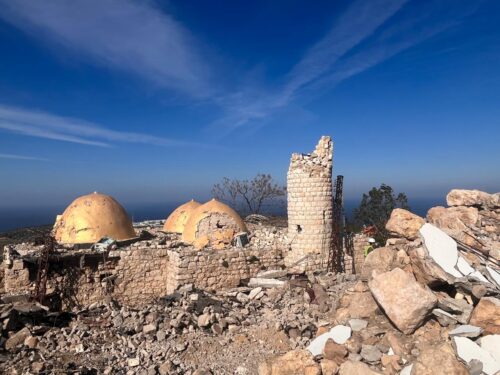
Lebanon’s Ministry of Culture condemned the Israeli attack, and the General Directorate of Antiquities submitted an urgent complaint to UNESCO, requesting its “immediate and swift intervention to protect the archaeological site of Chamaa Castle.” Reports suggest that the damage to the site is extensive, and its domes and minaret have disappeared entirely.
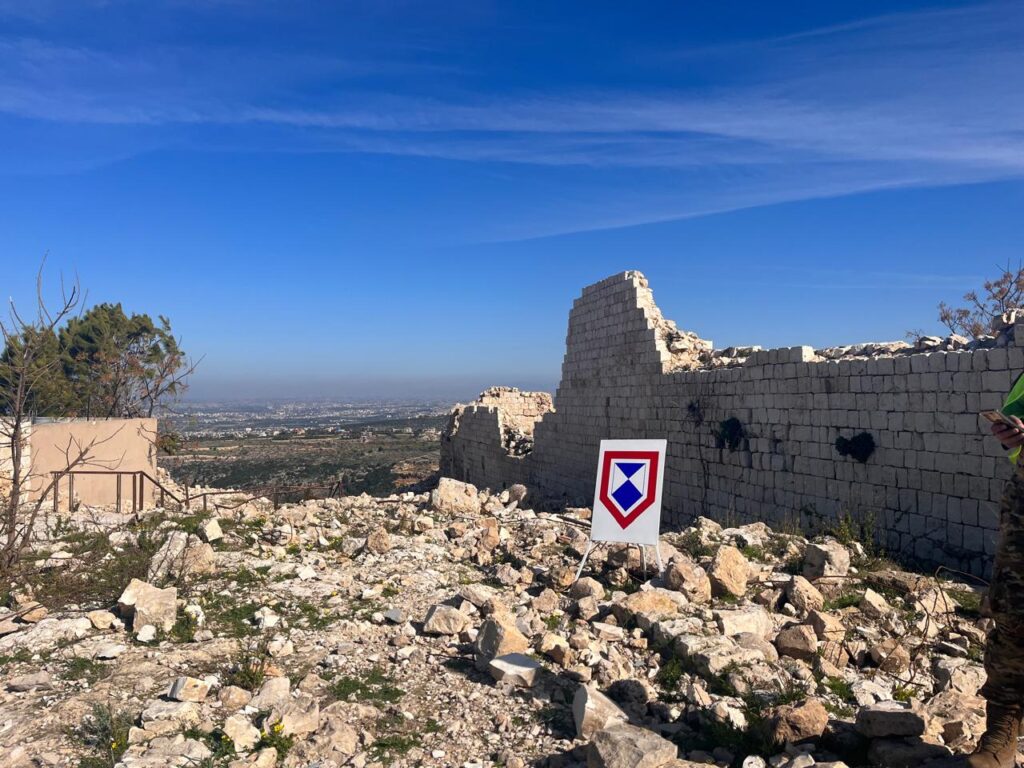
The archaeological site of Chamaa Castle in southern Lebanon. The “Blue Shield” emblem marks cultural heritage sites that are protected under the 1954 Hague Convention. Photo provided by Ali Badawi.
For many heritage advocates and archaeologists, especially those who documented the widespread destruction from the 2024 war with Israel as well as the damage from the 2020 Beirut port explosion and the 1975-90 civil war, it feels like déjà vu all over again, a never-ending cycle of history repeating itself.
Ali Badawi, director of archaeological sites in southern Lebanon at the General Directorate of Antiquities, told the author that the Chamaa Castle was also attacked during the 2024 Israeli offensive. Before that, it was damaged by Israeli forces in 1978, its ancient gateway was uprooted in 1998, and it was significantly impacted by the 2006 Israel-Hizballah war.
Badawi, a kind of Lebanese Don Quixote, tilting at windmills, or perhaps a Levantine Sisyphus, noted that after each blow to the monument, the Ministry of Culture worked with the support of the Italian Agency for Development Cooperation (AICS) — which has donated 13.8 million euros to safeguarding Lebanese cultural heritage sites — to rebuild it.
Destruction of Religious Sites
In 2024, Israeli forces demolished at least nine religious sites using controlled explosions in southern Lebanese villages near the Israeli border, including the historic churches of Dardghaya and Yaroun, the Shrine of the Prophet Benjamin in Muhaib, and the mosque of Blida. As documented by Amnesty International, IDF soldiers filmed themselves celebrating the destruction of religious sites after laying explosive charges inside them.
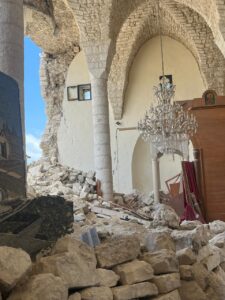
Damage to a historic church in the village of Dardghaya in southern Lebanon. Photo provided by Ali Badawi.
Indeed, Badawi, an archaeologist who has witnessed the destruction of heritage sites in his homeland for decades, told the author, “This is the worst it’s ever been.” The Israelis, he said, in their seemingly wanton destruction of heritage and religious sites, are committing “war crimes.”
While direct access to sites is not possible while they are under Israeli occupation, in the past several weeks, he noted, Israeli strikes have hit Qana, the site of Jesus’ first miracle when he turned water into wine at the wedding, as well as historic Ottoman-era churches containing relics and an important town for Christian pilgrimage. Qana, where more than 100 civilians and United Nations peacekeepers were killed by Israeli artillery shelling of a UN base during its invasion of Lebanon in April 1996, is literally a biblical landscape.
Many heritage advocates assert that Lebanese and larger Christian heritage is being damaged by IDF strikes funded by a so-called Christian America. While the Israeli government responded to the smashing of a large crucifix in the village of Debel on April 19 by jailing the soldiers responsible, it was far from an isolated incident. Just days later, on May 2, part of a convent was bulldozed in the border town of Yaroun. The convent compound included a school that had been closed since the 2006 war as well as a clinic that was recently moved to the nearby village of Rmeich. The IDF said it was “destroying Hezbollah infrastructure”; but the Catholic Church denied that the convent, which housed two nuns, was used for military purposes.
The damage has not been limited to Christian religious sites either. A number of mosques have been similarly affected, both in 2024 and 2026, including in Bint Jbeil — a place that, like Nabatieh and Qawzah, has had its historic town center destroyed.
Architectural Erasure
While Apple has been accused of “disappearing” southern Lebanese villages from its Maps app, many heritage advocates say this elimination is actually happening, physically and in real time, on the ground. But this larger issue of cultural and architectural erasure in southern Lebanese villages has received relatively scant international media attention.
The Lebanese non-governmental organization (NGO) Biladi, which specializes in heritage protection, has been cataloguing ongoing destruction of churches and predominantly Ottoman-era, vernacular architectural heritage in the area. Joanne Farchakh Bajjaly, president of Biladi, told the author that while UNESCO World Heritage sites remain vulnerable, the real issue is one of “urbicide” — the erasure of all architectural heritage — in the southern villages.
Lebanese archaeologist Hanan Charaf notes, in recently published research co-authored with Alia Fares, that, “Urban centers, particularly in Beirut’s southern suburbs and south Lebanon, have suffered the destruction of heritage-rich districts, including Ottoman-era souks and traditional residential quarters, erasing the spatial memory and cultural character that defined these communities.” The destruction, she notes, extends to intangible culture.
“Ancient agricultural traditions linked to olive or tobacco,” she writes, “were affected by fields set on fire during the conflict, and long-standing communal festivals have been disrupted, creating both cultural and environmental crises. The destruction of agricultural landscapes and natural reserves, essential to Lebanon’s ecological and cultural heritage, further compounds the loss.”
This “deliberate elimination of Lebanese identity,” she says, “demands urgent international attention.”
While major, well-identified sites benefit from UNESCO protection, she told this author, many others such as “historic souks, old houses, and lesser-known or undocumented sites have been damaged or destroyed. The full extent of this destruction remains unclear, as many affected areas are still inaccessible or too dangerous to survey.”
To date, she pointed out, only a limited number of cases, such as the castle of Chamaa, have received media coverage, “notably because it appears to have been intentionally targeted.”
Speaking about the 2024 invasion and its effect on Lebanese patrimony, she notes that the destruction was not limited to isolated incidents but rather followed certain patterns “that many heritage professionals and community advocates found difficult to dismiss as incidental.” According to Charaf, evidence pointed “to the deliberate use of cultural heritage as a target.” “Certain sites — particularly those associated with collective memory or minority identity — sustained damage. In several cases, sites with no military value were struck in ways that suggested deliberate elimination of local patrimony.”
Heritage, she maintains, was being used as a “psychological front — attacked not simply for what it was, but for what it represented.”
“Cultural Warfare”
It would seem that this pattern is repeating.
The deliberate bombing of mosques, churches, museums, Ottoman markets and piazzas, and traditional neighborhoods does more than destroy architecture, Charaf contends. “It reflects a form of cultural warfare, erasing communal presence through the elimination of historical markers.”
Such destruction aims, she says, citing the work of archeologist and anthropologist Lynn Meskell, “to cut ties between people and place, memory and identity as well as disrupt social cohesion of targeted populations.”
Charaf notes that one of the challenges in documenting damage to cultural heritage in Lebanon, both from war and concomitant looting, is that analogue information is centralized at government offices in Beirut, where there are major constraints on “time and human capacity.” She highlights the need for training of local stakeholders and people invested in cultural heritage across Lebanon to encourage greater community engagement. In line with this, Charaf proposes a kind of hyper-local geolocation movement that would empower villagers to document the destruction of their environment in tandem with a more widely accessible system of digitization and 3D modeling to assist with identification and restoration.
Ali Badawi also acknowledges the challenges of using satellite imagery to gauge damage to heritage sites, and he suggests that the extent of destruction is underestimated due to south Lebanon being under-excavated.
“The entire area has been under political tension and war since the early 20th century,” he said in an interview with this author, and thus there have been insufficient archaeological surveys. The area — a “flourishing historical center since the Bronze Age” — could contain many undiscovered Roman ruins, underneath the Ottoman-era architecture of villages, he contended, which are also being damaged by bombing.
Lebanon, the Lebanese archeologist Hanan Charaf argued, is considered one of the world’s “wealthiest countries in terms of cultural heritage density and diversity.” From Canaanite cities, Phoenician harbors, Roman temples, Byzantine churches, Islamic mosques, Crusader castles, and Ottoman-era towns, “Lebanon’s millennial patrimony constitutes a crucial element of the country’s historical and collective identity, often felt in daily existence’s routines.”
She explained that various invaders from different historical periods laid siege to the land as they exploited its resources, leading to the rise of both coastal cities like Tyre, Sidon, and Byblos, as well mountainous enclaves like Faqra and Deir el-Qalaa — the source of important archaeological objects now ensconced in international museums.
These sites are not merely historical remnants, she said, but “they play crucial active parts of daily life, shaping both social practices and physical spaces.” While their permanent presence has long been a source of cultural pride, she noted, it also “exposes them to increased risk during times of conflict and instability.”
Hadani Ditmars is the author of Dancing in the No-Fly Zone: A Woman’s Journey Through Iraq, a past editor at New Internationalist, and has been reporting from the Middle East on culture, society, and politics for two decades. Her book in progress, Between Two Rivers, is a travelogue of ancient and sacred sites in Iraq.
Main photo shows damage to the Chamaa Citadel. Photo provided by Ali Badawi.