The Kurdistan Region of Iraq (KRI), also known as Iraqi Kurdistan, is a semi-autonomous region in northeastern Iraq with a population of approximately 6.5 million. As its name suggests, Kurds constitute most of the population, though the region is also home to Arabs, Turkmen, Yezidis, Assyrians, Armenians, Shabaks, and Mandaeans. Kurds account for 15-20% of Iraq’s total population, with most living in the KRI. Across the broader Middle East, the Kurdish population is estimated at around 40 million, the region’s fourth-largest ethnic group, concentrated in the mountainous area where Syria, Iraq, Turkey, and Iran converge.
The KRI’s political landscape is shaped by its location, abundant oil resources, and the Kurdish people’s long-term aspiration for self-determination. As a result, Erbil must carefully balance its relationships with the Government of Iraq; neighboring states, each of which has its own concerns regarding Kurdish populations; and Western partners, particularly the United States. The region’s two dominant political parties, the Kurdistan Democratic Party (KDP) and the Patriotic Union of Kurdistan (PUK), continue to administer separate territories and institutions rather than functioning as a fully unified regional government. This fragmented political structure makes it difficult for the KRI to present a unified front in its dealings with Baghdad and foreign governments.
Background and History
The KRI’s contemporary politics are rooted in a century of Kurdish efforts to achieve self-rule. The 1920 Treaty of Sèvres briefly outlined a path to independence, but the 1923 Treaty of Lausanne superseded it, establishing the modern borders of Turkey and omitting any provision for Kurdish autonomy. Kurdish populations were left dispersed across Turkey, Iraq, Syria, and Iran. Since then, Kurdish political movements have pursued varying degrees of autonomy and self-government.
In Iraq, decades of uprisings against Baghdad culminated in the First Kurdish War (1961-70), ending with a 1970 Autonomy Agreement between Kurdish nationalist leader Mullah Mustafa Barzani and then-Iraqi Vice President Saddam Hussein. The agreement’s promises went largely unfulfilled, particularly regarding the oil-rich Kirkuk governorate, and fighting resumed as the Second Kurdish War in 1974. That rebellion collapsed a year later when the 1975 Algiers Agreement ended Iranian and US support, a defeat that fractured the Kurdish movement.
The 1980s and 1990s saw a series of tragedies for the Kurdish population and setbacks for the national movement but concluded with a de facto autonomous, though internally divided, Iraqi Kurdistan: Saddam’s Anfal campaign (1987-88), which killed thousands and destroyed thousands of villages; the failed 1991 intifada (uprising) and subsequent US-led Operation Provide Comfort that enabled the Kurdistan Regional Government’s (KRG) founding in 1992; and a Kurdish civil war (1994-98) that ended with a US-brokered peace but left the KDP and PUK administering separate territories and institutions.
Following the 2003 US invasion of Iraq, the Kurds emerged as one of Washington’s closest regional allies. The Peshmerga, the Kurdish military, fought alongside US troops, while Kurdish-controlled territory served as the Coalition’s northern front. Iraq’s 2005 Constitution formally recognized the KRI as a federal region within the country. Despite this recognition, relations between Erbil and Baghdad deteriorated over disputes concerning oil revenue and export authority.
The rise of the Islamic State (ISIS) in 2014 strengthened the US-Kurdish partnership, and the KDP and the PUK largely cooperated during this time. The Peshmerga used the conflict to expand into disputed territories like Kirkuk. However, this period of KDP-PUK unity quickly fractured when the KDP’s Masoud Barzani called an independence referendum in 2017 despite Washington’s explicit opposition. This provoked a strong response from Tehran, which exploited PUK divisions to help Baghdad retake Kirkuk.
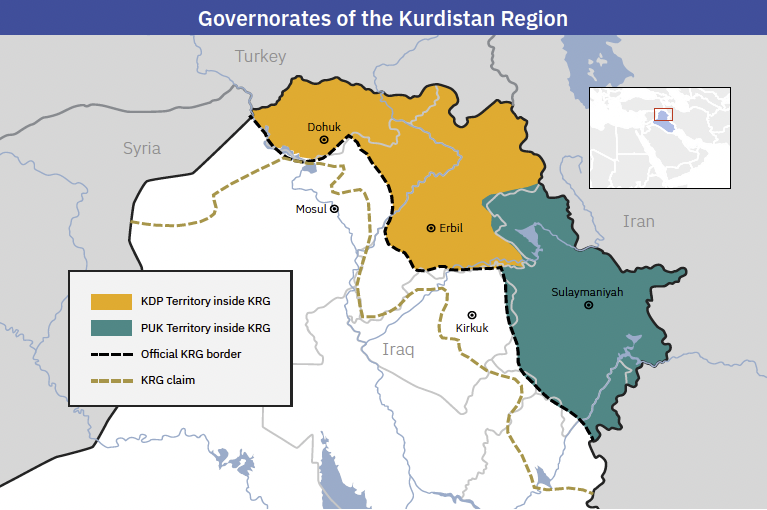
Graphic created by MEI. Source: Sardar Aziz and Bilal Wahab, “Family Rule in Iraq and the Challenge to State and Democracy,” The Washington Institute for Near East Policy, December 2023.
Divisions and Power-Sharing
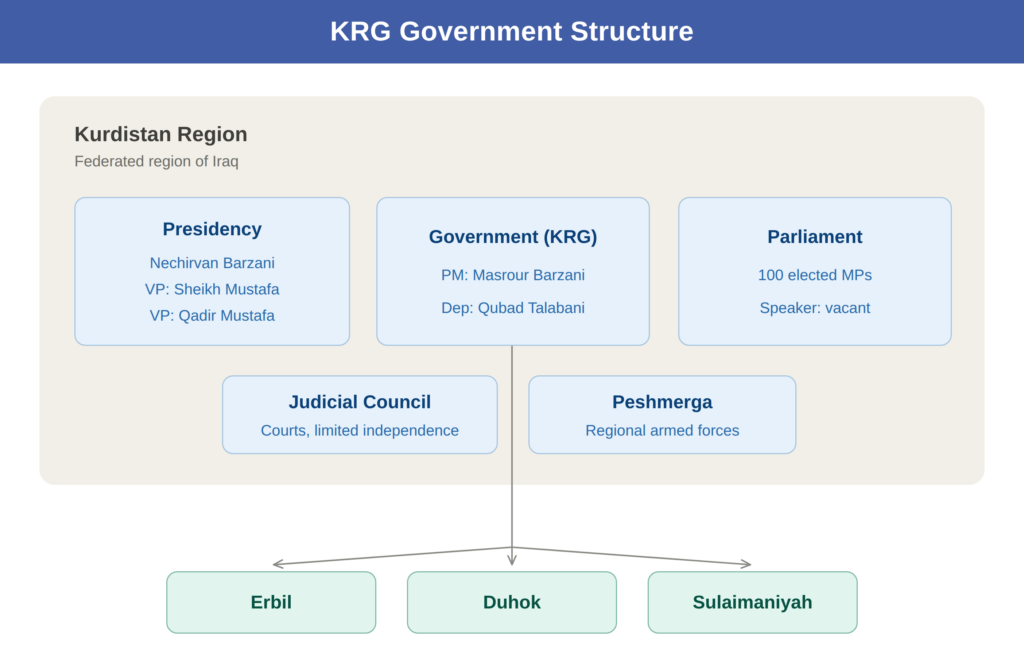
Politics in the Kurdistan Region remain defined by the KDP-PUK rivalry. Legally, the KRI is governed by a unified set of institutions, the KRG, composed of the Council of Ministers (cabinet), the Presidency of the Kurdistan Region, and the Kurdistan Parliament. In practice, however, the two dominant parties continue to administer and govern their respective territories and institutions separately.
Founded in 1946 by Mustafa Barzani and headquartered in Erbil, the KDP is generally characterized as more tribal, traditional, and nationalist than the PUK. It is strongly associated with the Barzani family, whose members hold key posts within the party and KRG.
The PUK splintered from the KDP in the 1970s over ideological differences. Jalal Talabani, fellow leftists, and urban intellectuals grew disillusioned with the Barzani family’s tribal, conservative leadership and its monopolization of power. After the 1975 collapse of the Kurdish revolt, Talabani broke from the KDP and founded the rival PUK. Based in Suleimaniyah, the party is characterized as more leftist and metropolitan, and less unified since it houses multiple ideological factions, which has led to formation of separate splinter parties, such as the Gorran Movement. It is strongly associated with the Talabani family and tends to favor closer integration and cooperation with Baghdad, whereas the KDP seeks full autonomy.
Tensions between the two parties have led to infighting and, in the 1990s, civil war, but a 2006 power-sharing agreement brought longer-term peace by formally merging the rival administrations into a single government, dividing key posts, ministries, budgets, and security institutions between them. Under the arrangement as of mid-2026, the presidency is held by the KDP’s Nechirvan Barzani, and the two vice presidents, Jaafar Sheikh Mustafa and Mustafa Qadir Mustafa, are members of the PUK. Though Kurdistan is governed by KRG institutions in law, in practice the parties administer their own territories: the KDP runs Erbil and Duhok, while the PUK controls Suleimaniyah and parts of Erbil and Kirkuk.
Security institutions reflect the same divide. The Peshmerga is formally commanded by the cabinet’s Ministry of Peshmerga Affairs but in reality is split into units loyal to either the KDP or the PUK. The Asayish, the KRI’s domestic security service, is formally part of the Ministry of Interior but is similarly divided into KDP- and PUK-affiliated branches. The KDP’s Parastin and the PUK’s Zanyari serve as the parties’ own intelligence agencies and have historically operated outside formal government control.
The geography of each party’s respective territory, and their differing philosophies and histories, shape the two rival factions’ relations with Baghdad and outside powers, specifically Iran, Turkey, Syria, and the United States.
KRI Economy
The KRI economy is heavily dependent on its oil and natural gas sector — with oil constituting about 80% of the autonomous region’s revenue — and therefore vulnerable to global price swings, pipeline disruptions, and disputes with Baghdad over export authority and revenue sharing. The KRG has made an effort to encourage diversification through other sectors, namely agriculture, industry, and tourism. While both the KDP and the PUK nominally support diversification, they have shown reluctance to allow an independent private sector to develop since it could challenge their political power.
Agriculture, historically one of the region’s largest sectors, has suffered a significant contraction in recent decades. Saddam’s Anfal campaign destroyed farmland and most Kurdish villages, displacing the rural workforce. Additionally, the United Nations Oil-for-Food program (1996-2003) incentivized the economy to prioritize oil and imported goods. It became cheaper to import subsidized food than to rebuild and invest in domestic farms. Agricultural output has improved in recent years, but the sector remains far below its potential given the available arable land and water.
Beyond oil and agriculture, the public sector is heavily bloated, employing over a third of adult workers by some estimates and representing a significant burden to the KRG budget. Periodic disputes with Baghdad over public salary payments and the KRI’s share of the federal budget have caused economic problems for the region.
The economy also features a substantial informal sector. Many transactions are conducted in cash, which makes it difficult to measure economic activity. The government has been working to build confidence in formal banking and payment systems to solve this problem.
Iraq-KRI Relations
Iraq’s 2005 Constitution established the KRI as a federal region with significant autonomy over its own parliament, armed forces, and internal affairs. The region’s relationship with the federal center, however, has vacillated based on the rival PUK’s and KDP’s differing approaches to dealing with Baghdad. Though not wholly consistent, the PUK has more often maintained closer ties with the Iraqi national government, while the KDP’s relationship has tended to be more strained, driven largely by the latter’s stronger push for Kurdish independence.
Those frequent tensions between the KDP and Baghdad, in particular, pushed the federal government to increasingly use judicial and administrative tools to limit Kurdish autonomy. Following the 2017 referendum, Baghdad reasserted federal authority by suspending international flights to Kurdistani airports, retaking disputed territories such as Kirkuk, and closing border crossings. The KRG is constitutionally entitled to about 17% of Iraq’s federal budget, but receives it only sporadically. At times, economic problems in Iraq have prevented timely or complete payments; on other occasions, Baghdad has purposely withheld transfers, causing serious economic crises given how many households rely on direct or indirect payments from the state.
Energy resource management is another notable source of discord with Baghdad, especially vis-à-vis the KDP, which has exported oil independently to Turkey through its Kirkuk-Ceyhan pipeline since 2014. Iraq’s Federal Supreme Court ruled these exports unconstitutional in 2022, and a 2023 International Chamber of Commerce arbitration held Turkey liable for facilitating them. Oil shipments abroad resumed in 2025, following a negotiated agreement. In contrast, the PUK has offered up its gas resources to help with Iraq’s energy crisis, exemplifying its more collaborative relationship.
The oil-rich but ethnically diverse province of Kirkuk is claimed by both Baghdad and the KRG and has long been a cause of conflict. Article 140 of the Iraqi Constitution required a referendum on the status of Kirkuk and other disputed territories by 2007 but was never implemented. This issue is further exacerbated by the history of Saddam’s Arabization policies, which forcibly displaced Kurdish populations to resettle Arab families, complicating demographic claims.
Kurdistan-Baghdad relations go beyond legal or constitutional frameworks, however. Post-Saddam Iraq operates under an informal sectarian power-sharing system known as muhasasa, according to which top positions and state resources are divided proportionally among the main communities, Shi’a Arab, Sunni Arab, and Kurd. Under this system, the presidency is reserved for a Kurdish representative; to date, all have come from the PUK. President Nizar Mohammed Saeed Amidi took office in April 2026, after a five-month deadlock that delayed the formation of a new government. The KDP, which boycotted the vote, seeks to end the PUK’s longstanding hold on the presidency.
Graphic created by MEI. Source: Philip Loft, “Kurdistan Region of Iraq: Introductory Profile,” UK House of Commons Library, December 5, 2025.
Iran-KRI Relations
Iran has in effect two separate relationships with the KRG: a relatively close one with the PUK and a more adversarial one with the KDP. This divergence deepened during the civil war, when the PUK sought Iranian assistance against the KDP, and the KDP, rebuffed by Turkey and the US, sought help from Saddam, whose forces smashed the PUK at Erbil in 1996. Although the US-brokered Washington Agreement ended the conflict in 1998, the underlying alignment did not change: the KDP remains oriented toward Turkey and the West, the PUK toward Iran. Iranian suspicions of the KDP have been exacerbated by the party’s close ties with the US and media reports of security cooperation with Israel.
Tehran opposes Kurdish independence, which it views as a threat to its territorial integrity and a potential encouragement of similar sentiment among its own Kurds, and because it seeks to preserve its influence over Iraq. Following the KRG’s 2017 referendum, Iran applied economic and political pressure to try to reverse the Kurdish demand for sovereignty, temporarily closing three KRI border crossings. Moreover, Islamic Revolutionary Guard Corps (IRGC) Quds Force commander Qassem Soleimani subsequently welded together an alliance of the PUK, the Hashd al-Shaabi militias under his control, and forces from the Iraqi army itself to drive the KDP from Kirkuk and the other disputed territories that Kurdish forces had taken in 2014, when the Iraqi army collapsed before ISIS’s advance. This further deepened the KDP-PUK rift and hardened their divergent postures toward Iran.
Tehran now relies on the PUK to help contain Iranian Kurdish opposition groups — including the Kurdistan Democratic Party of Iran (KDPI), Komala, Kurdistan Free Life Party (PJAK), and Kurdistan Freedom Party (PAK) — that operate from Iraqi Kurdistan. During the Iranian government’s crackdown on the 2022 Mahsa Amini (“Woman, Life, Freedom”) protests, Tehran pressured Baghdad to act against these groups. The following year, Iraq signed a security agreement with Iran, pledging to prevent cross-border attacks from the KRI and to disarm and relocate Iranian Kurdish groups away from the border. Because many of the affected areas fall within its territory, the PUK has played a central role in implementing the agreement, although enforcement remains incomplete.
Despite these political and security tensions, Iran and the KRI remain connected economically. Three border crossings facilitate bilateral trade, and in 2023, more than 1,000 local business licenses were issued to Iranian entrepreneurs. Informal energy trade also remains important. During the shutdown of the Kirkuk-Ceyhan pipeline, Kurdish oil was diverted to Iran, generating revenue for KDP and PUK elites, although the PUK benefited disproportionately. That said, Iraqi dependence on Iran’s natural gas has become problematic as regional conflict disrupts supplies and substituting PUK-controlled reserves could create new tensions in the Iranian-Iraqi-Kurdish relationship.
Turkey-KRI Relations
The Turkey-KRI relationship is shaped by strong economic interdependence and Turkey’s security concerns related to its own Kurdish population.
Ankara has historically maintained closer ties with the KDP than the PUK. This relationship strengthened after the US withdrawal from Iraq in 2011, when President Masoud Barzani pursued a strategic partnership with Turkey. The alliance benefited Turkish President Recep Tayyip Erdoğan, who viewed Iraqi Prime Minister Nouri al-Maliki as closely aligned with Iran, sought greater access to Kurdish energy resources, and hoped stronger ties with the KRG would increase his support among his own Kurdish constituency. This dynamic has persisted until the present.
Economically, Ankara must balance its relations with both Baghdad and Erbil. Historically, there has been strong cross-border trade between Turks and Iraqi Kurds. Additionally, the KRI has actively encouraged foreign investment as part of efforts to diversify its economy. Roughly one-third of foreign companies in the KRI are Turkish.
Energy governance has also complicated Turkey’s position: the 2023 arbitration ruling ordered Turkey to pay Baghdad directly for facilitating KRG oil exports without Baghdad’s approval, and shipments were suspended until the three parties negotiated a new agreement.
More recently, the Iraqi and Turkish governments have deepened economic cooperation in ways that exclude the KRG. The Iraq-Turkey Development Road Project (DRP), which connects Iraq’s Grand Faw Port to the Turkish border, bypasses the KRI, prompting the KRG to propose an alternative railroad corridor linking Iran and Turkey through its territory. Similarly, the bilateral “oil-for-water” agreement uses revenues from Iraqi oil exports to finance Turkish-built water infrastructure projects in Iraq, reducing the KRG’s ability to manage its revenues independently.
Security concerns also remain central to Turkey’s policy toward the KRG. The PUK has traditionally maintained closer ties with the Kurdistan Workers’ Party (PKK), which Turkey designates as a terrorist organization. The PKK operates from bases in PUK-administered areas and has launched attacks into Turkey from these locations. Consequently, Turkey has coordinated closely with the KDP on counter-PKK operations.
At the same time, Turkey has improved ties and enhanced security cooperation with the Iraqi federal government in recent years, particularly since Baghdad has become more willing to treat the PKK as a national security threat, officially designating it a banned organization in 2024. Although Turkey continues to cooperate with the KDP and maintains a significant military presence in the KRI to conduct anti-PKK operations, a closer Ankara-Baghdad relationship could eventually reduce the KDP’s importance to Turkey.
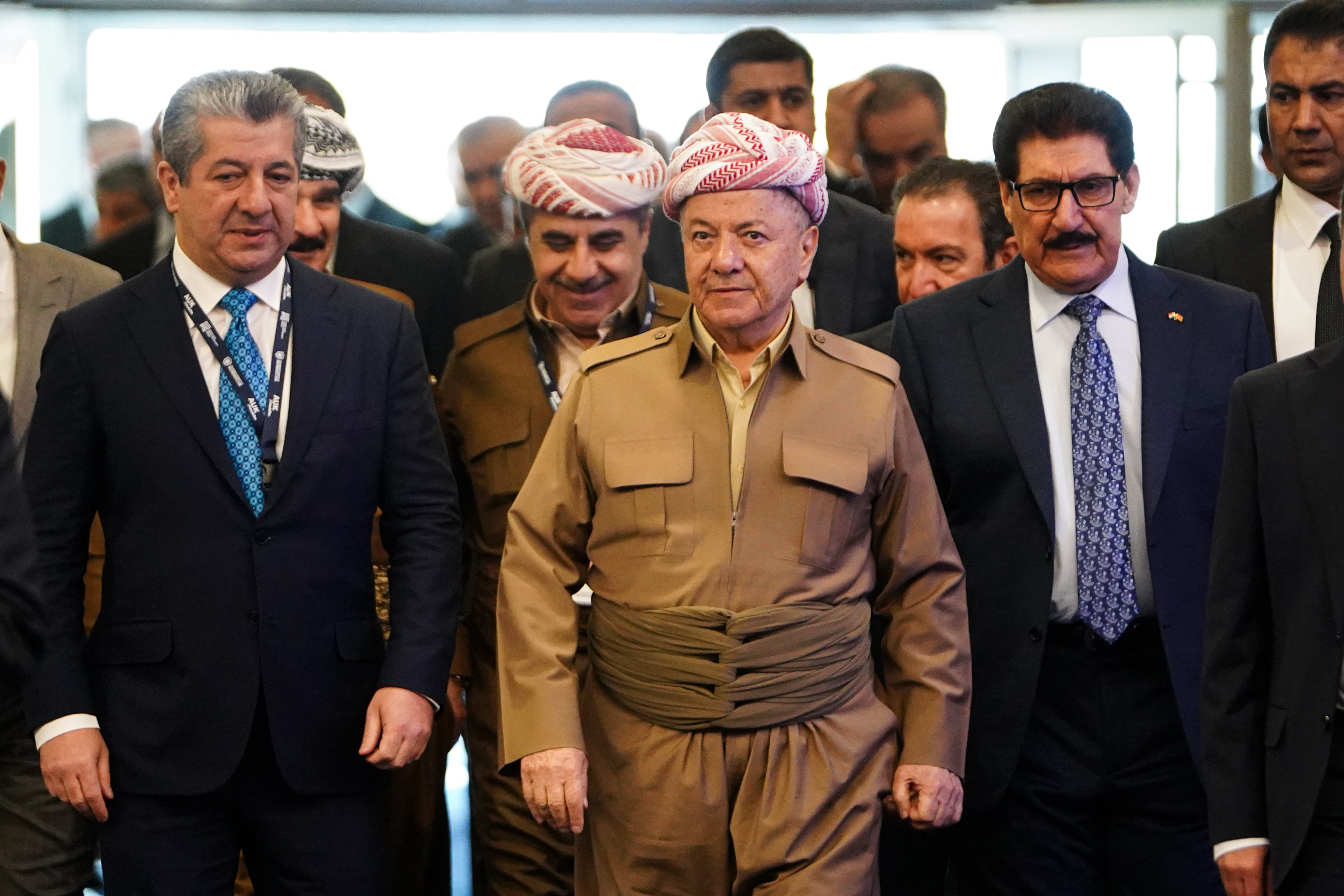
Masrour Barzani, prime minister of the KRI, receives Masoud Barzani, president of the KDP, as he arrives to attend the Middle East Peace and Security Forum (MEPS) in Duhok, Iraq, November 11, 2025. Source: Ismael Adnan/SOPA Images/LightRocket via Getty Images.
US-KRI Relations
The US supports a stable, federal Iraq while recognizing the KRG as an important regional partner but has consistently opposed Kurdish independence out of concern that it would destabilize Iraq and the broader region. Washington encourages cooperation between Baghdad and Erbil on security, energy, and budget disputes and maintains close relations with both governments. The US Consulate General in Erbil is one of the largest US diplomatic missions in the Middle East, reflecting the importance of the KRI to Washington.
US-Kurdish relations developed significantly following the 1991 Gulf War, when the US led Operation Provide Comfort to deliver aid to Kurdish refugees and establish a no-fly zone north of the 36th parallel.
The 2003 Iraq War fortified the alliance. The Peshmerga worked closely with US Special Forces to secure northern Iraq and continued to collaborate with the US during the campaign against ISIS. When ISIS advanced toward Erbil in 2014, US airstrikes helped halt the offensive and prevent the collapse of the KRG. The Peshmerga served as the primary partner on the ground, while America provided military training, weapons and equipment, intelligence sharing, and air support.
Military cooperation remains the foundation of the US-KRG relationship, with the Peshmerga continuing to be Washington’s principal security partner in northern Iraq. Congress annually authorizes military assistance to the KRG through the National Defense Authorization Act (NDAA). Coalition forces also maintain their military presence in the KRI for counterterrorism operations and security cooperation.
During the Iran War, media reports indicated that some officials within the Trump administration discussed the potential use of Kurdish forces in contingency planning against the Iranian regime, although no formal policy was adopted.
Despite this ongoing close partnership, the US-KRG relationship has witnessed several major political disagreements. For example, KRI President Barzani and many Iraqi Kurds expected US support for their independence following the Kurdish role in helping defeat ISIS. However, when Barzani went ahead with the 2017 independence referendum, President Donald Trump did not endorse it. More recently, the renewal of an expiring US security assistance agreement has been a point of contention between the two sides.
Conclusion
The KRI occupies a position of outsized strategic importance due to its oil wealth and location bordering three states with their own Kurdish populations and competing interests. The KDP-PUK divide is one of the region’s defining fault lines, and external relationships are best understood by this cleavage. Baghdad, Tehran, and Ankara each maintain distinct, often asymmetric relationships with the two parties, exploiting or accommodating the split rather than treating Kurdistan as a unified actor. This fragmentation has left the KRI dependent, whether on federal budget transfers from Baghdad, oil transit and investment from Turkey, or security and trade arrangements with Iran, without the internal unity to turn its economic and military assets into durable leverage.
Iraqi Kurdistan has consistently demonstrated strategic value to many countries, and its trajectory will likely continue to be shaped less by any single external relationship than by whether the KDP and the PUK are able to resolve their internal rivalry and present a more unified front amid a rapidly shifting regional order.
This backgrounder was researched and written by MEI summer 2026 intern Chloe Becker, with input from Vice President for Policy Kenneth M. Pollack.
Top image: Flag of the independent region of Kurdistan. Source: Probst/ullsteinbild via Getty Images.