Khamenei did this to himself. The US can help — without another Middle East quagmire
January 14, 2026
Share
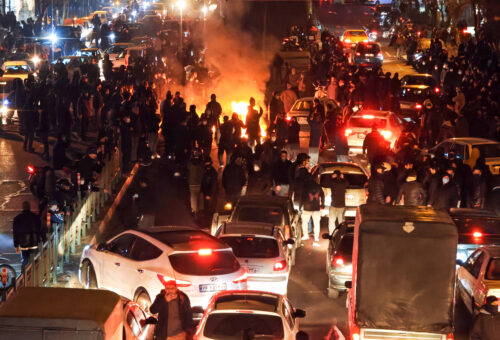
Last week, Iran’s Supreme Leader Ali Khamenei effectively greenlit mass killings to save his regime. His message was blunt: Blood would be spilled to preserve the system. His security forces followed through, unleashing a level of violence against protesters that, even by the Islamic Republic’s grim standards, marks a dangerous escalation.
This may suppress demonstrations in the short term. It will not solve the regime’s deeper problem though. Even if the system survives this round, the next wave of protests is already forming. Killing thousands of citizens is not a strategy for stability; it is an admission of political bankruptcy and a step that may ultimately hasten the regime’s demise.
Iran’s latest unrest is not just another eruption of anger. It is unfolding under the weight of experience: four decades of protests that rose, were crushed, and faded without delivering lasting change. What makes this moment different is not only the geographic spread — demonstrations have been reported in more than 100 towns and cities — but the record-high uncertainty inside Iran’s political system about whether repression alone can still contain unrest without accelerating systemic decay.
On the ground, the state followed a familiar script: arrests, intimidation, internet disruptions. When that failed, it escalated to live fire and mass killing on a scale not seen before. This does not reflect confidence; it is panic. Khamenei appears convinced that the movement is externally manufactured, a plot by Israel and the United States. That belief has driven a response so extreme that it risks breaking the regime’s remaining internal cohesion. History suggests regimes that cross this line do not emerge stronger.
Behind the scenes, many inside the system already understand this. For months, parts of the political establishment have openly debated whether the Islamic Republic’s governing model still works. Reformist-aligned groups have issued unusually candid statements recognizing peaceful protest as a legitimate right while warning that rhetoric about “listening to protesters” means nothing without economic reform, accountability, and real political channels.
Crucially, these voices insist the protests are entirely homegrown and reject foreign intervention, not out of loyalty to the regime, but from fear that outside involvement would militarize the crisis and justify even harsher repression. They are trying to preserve what remains of autonomous civil politics. Their message is a warning: Once dissent is fully securitized, politics disappears.
Today’s unrest is not driven by ideology or faith in reform. It is driven by depletion — economic, psychological, and institutional. Bazaar closures, labor unrest, and the participation of groups traditionally invested in stability point to a deeper crisis of governability. Participation remains uneven not because people trust the system but because fear of war, chaos, and regional collapse has made risk aversion rational.
This is why defections matter — and why they are now plausible.
The regime is hollowed out. It has no credible economic plan, no alternative political vision beyond survival, and no succession plan that reassures its own elites. Many technocrats, bureaucrats, and even security personnel know this. They also know something else: The more blood they spill for Khamenei, the greater the likelihood of reckoning later. Revenge is not a slogan in Iran; it is a historical pattern.
The question for Iran’s opposition — inside the country and across the diaspora — is how to force that realization into the open. How do you persuade regime insiders and rank-and-file security forces that continuing to kill for an aging leader with no future plan is against their own survival? How do you convince them that the regime’s time is up, if not today, then soon, and that jumping ship early is safer than going down with it? This is where US policy matters but not in the way Washington often assumes.
The wrong analogy is the 2003 US invasion of Iraq. Iran today is not Iraq then. There is no comparable case. The choice is not between war and doing nothing. It is between reckless escalation and smart, patient pressure that chips away at a decaying system.
Sanctions are largely exhausted. They have not changed regime behavior and mainly punish the society. Military strikes are even riskier. They might split public opinion, hand Tehran a national-security narrative to stay the course, and target the wrong problem. Protesters are not rebuking Iranian nuclear sites; they are facing batons, bullets, prisons, and internet blackouts.
The most effective US tool is less dramatic and more strategic: keep Iran connected to the world and raise the cost of repression. Visibility matters. Repression depends on darkness. Protecting communications, countering internet shutdowns, documenting abuses, and supporting information flows make it harder to kill quietly and easier for insiders to start hesitating.
Just as important, Washington should quietly expand tools to facilitate defections: legal pathways, financial protections, intelligence guarantees, and clear signaling that those who stop killing civilians will not be treated as permanent enemies. The US needs to use every instrument available to reassure lower-rank Iranian regime insiders that there is life after Khamenei — and consequences for those who continue to serve as his executioners.
Done well, this approach would make Khamenei feel far more vulnerable than he lets on. For President Donald Trump, it would offer a way forward that aligns with his instincts and his base’s fears. It avoids a new Middle East quagmire while putting real pressure on a regime in Tehran the US has wanted to see go since 1979. He can credibly argue that he weakened the Islamist system, supported the Iranian people, and kept America out of another endless war.
Cautious restraint, backed by the strategic hollowing out of an adversary, may not deliver quick, headline-grabbing victories. But it is a strategy that can yield durable results — opening the door to a generational transformation not only in Iran but across a Middle East that has had to endure the consequences of Ali Khamenei’s rule for nearly four decades.
Alex Vatanka is a Senior Fellow at the Middle East Institute in Washington, DC.
Photo by Anonymous/Getty Images
The Middle East Institute (MEI) is an independent, non-partisan, not-for-profit, educational organization. It does not engage in advocacy and its scholars’ opinions are their own. MEI welcomes financial donations, but retains sole editorial control over its work and its publications reflect only the authors’ views. For a listing of MEI donors, please click here.