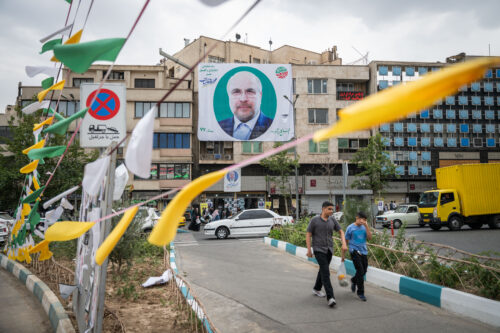
The latest twist in Mohammad Bagher Ghalibaf’s long career says a great deal about the man and the system that made him. When reports surfaced this week that he was being floated as a possible US partner akin to Delcy Rodriguez in Venezuela, Ghalibaf moved quickly to deny them. There had been no talks with the United States, he insisted. The reports were “fake news,” designed to manipulate oil and financial markets and distract from the trap in which America and Israel had found themselves.
Even more telling was the line pushed by Iranian outlets close to the system: attaching Ghalibaf’s name to such a story was not just false, but malicious—an effort to discredit him at home, sow division inside the regime, and perhaps even set him up for physical elimination.
That reaction was revealing. In today’s Iran, to be portrayed as a man open to a deal with Washington is not necessarily an asset. It can just as easily become a liability, especially in wartime.
(Photo by Arne Immanuel Bänsch/picture alliance via Getty Images)
The Middle East Institute (MEI) is an independent, non-partisan, not-for-profit, educational organization. It does not engage in advocacy and its scholars’ opinions are their own. MEI welcomes financial donations, but retains sole editorial control over its work and its publications reflect only the authors’ views. For a listing of MEI donors, please click here.