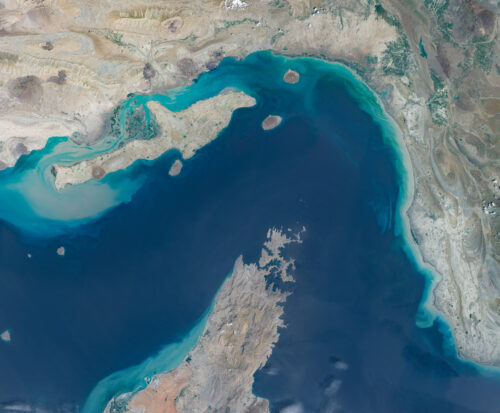
As the Trump administration continues to send mixed signals on the war — vacillating between escalatory military threats and allusions to diplomatic progress — global markets are reacting sharply, while anxious US allies face growing uncertainty about their short- and longer-term security. Ongoing Iranian retaliatory strikes in the Gulf, reports of Russian intelligence sharing with Tehran, and a potential US invasion of Kharg Island all illustrate the increasingly damaging consequences of prolonging the war with Iran. But the prospects of a diplomatic resolution to the conflict remain unclear and fraught with their own challenges.
For a discussion of what negotiations may or should be taking place, Washington’s and Tehran’s calculations, as well as what a US ground invasion of Iran could entail if talks fail to arrest the war, the Middle East Institute invites you to a webinar this Thursday, April 2, at 2:30 PM EDT. The virtual expert panel will include MEI Distinguished Military Fellow General Joseph L. Votel, former US CENTCOM commander, and MEI Senior Fellow Alex Vatanka. The institute’s Vice President for Policy, Dr. Ken Pollack, will moderate.
Speakers
General Joseph L. Votel, USA (ret.) is a Distinguished Military Fellow at MEI. He retired as a four-star general in the United States Army after a nearly 40-year career, during which he held a variety of commands in positions of leadership, including most recently as commander of US Central Command (CENTCOM) from March 2016 to March 2019.
Alex Vatanka is a Senior Fellow at the Middle East Institute, specializing in Middle Eastern regional security with a particular focus on Iran. Born in Tehran, he is the author of The Battle of the Ayatollahs in Iran: The United States, Foreign Policy and Political Rivalry Since 1979 (2021) and Iran and Pakistan: Security, Diplomacy, and American Influence (2015). He is currently working on his third book, Grand Contest: The Rivalry of Iran, America, and Israel in the Arab World.
Dr. Kenneth M. Pollack (Moderator) is Vice President for Policy at the Middle East Institute. Dr. Pollack began his career as a Persian Gulf military analyst at the CIA and served twice on the National Security Council, first as Director for Near East and South Asian affairs and then as Director for Persian Gulf affairs.

Jordan’s Economy Weathers Iran War’s Shocks and Finds New Opportunities