This individual is a guest contributor. MEI is not able to assist with contact requests.
Ragui Assaad is Professor at the Humphrey Institute of Public Affairs at the University of Minnesota. He has written extensively on labor market and youth issues in the Middle East and North Africa. The author acknowledges the able research assistance of Stefan Johansson in the preparation of this essay.
Introduction to The Artesh: Iran's Marginalized Regular Military
As the US-Iran showdown continues, among Western analysts there is an infinite desire for more data and analysis relating to the workings of the Islamic Republic. From a US standpoint, a better understanding of the various organs and players in the Iranian regime setup is imperative as Washington weighs its options and sets out to formulate its policies.
This Opinion first appeared in the Huffington Post on November 11, 2011
On November 28th, millions of Egyptians will finally breathe a deep sigh of relief as they gather at the polls to vote in the first phase of parliamentary elections following the ousting of the Mubarak regime.
Center for Turkish Studies Second Annual Conference on Turkey
The 2011 Second Annual Conference on Turkey, entitled “Change Within and Beyond and Borders: Turkey’s Domestic and Foreign Policy Agenda,” was organized by the Center for Turkish Studies at the Middle East Institute on June 23rd, 2011 at the University Club. As the Conference coincided with recent important developments in Turkey, especially the general elections, about 300 participants from think tanks, universities, U.S. and foreign government officials as well as private sectors attended the Conference.
This Commentary was first published as an op-ed in Politico on October 21, 2011
Defense Secretary Leon Panetta asserted recently that critics of the Libyan mission “have been proven wrong.” Now, with the death of dictator Muammar Qadhafi, the secretary’s view is supported by the overwhelming majority of Washington’s foreign policy establishment.
Troubled Triangle: The US, Turkey, and Israel in the New Middle East
The trilateral relationship between Turkey, Israel and the United States has deteriorated in recent years as Israel's and Turkey's foreign policy goals in the Middle East continue to diverge. Despite repeated attempts, the United States has failed to reconcile these two important regional allies since the divisive Mavi Marmara incident in May 2010. MEI and The Stimson Center held a discussion of this critical yet troubled trilateral relationship in a time of unprecedented change in the Middle East featuring Prof. William B. Quandt, Edward R.
The Middle East Institute is proud to host Geoffrey Kemp, an expert in US policy in the greater Middle East, for a discussion of his new book The East Moves West: India, China, and Asia's Growing Presence in the Middle East. Professor Kemp will be discussing the manner in which the Asian presence in the Middle East is growing because of the economic outreach of India, China, Japan, South Korea and other Asian countries. He will also address the place of American military power in this new regional alignment.
Join MEI Scholar and Levant expert Randa Slim for a discussion about Hezbollah and its reaction to shifting regional dynamics in the wake of the Arab Spring. Although Lebanon has not experienced the same levels of unrest as its neighbors, Hezbollah is not immune from the regional instability resulting from the revolutions roiling the Middle East. Currently, Hezbollah is the principal orchestrator of a new governing coalition in Lebanon that is rife with internal divisions.
MEI scholar Randa Slim led a discussion about Hezbollah and its reaction to shifting regional dynamics in the wake of the Arab Spring. Although Lebanon has not experienced the same levels of unrest as its neighbors, Hezbollah is not immune from the regional instability resulting from the revolutions roiling the Middle East. Hezbollah is currently the principal orchestrator of a new governing coalition that is rife with internal divisions.
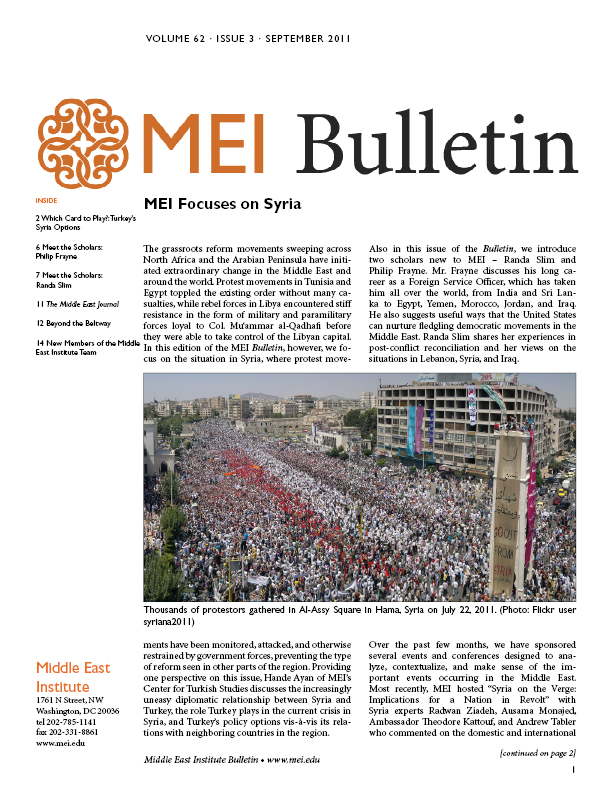
Amidst ongoing violence against protestors in Syria, Hande Ayan of the Center for Turkish Studies discusses the uneasy diplomatic relationship between Turkey and Syria and Turkey’s role in the political situation there. The September 2011 Bulletin also introduces MEI scholars Philip Frayne, who speaks on his Foreign Service career and offers his insights on how the US can support democratic transitions in the Middle East, and Randa Slim, who is interviewed on her experience in post-conflict reconciliation.
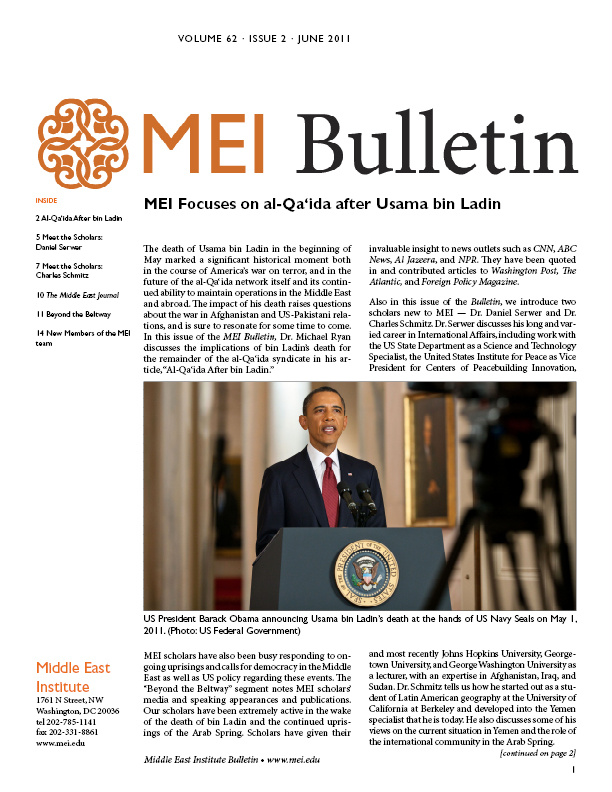
In the June 2011 Bulletin, Dr. Michael Ryan discusses the implications of bin Ladin’s death for the remainder of the al-Qa’ida network. It also introduces new MEI scholars Dr. Daniel Serwer, who is interviewed on his career in technology and peacebuilding, and Dr. Charles Schmitz, who speaks about his work on Yemen.
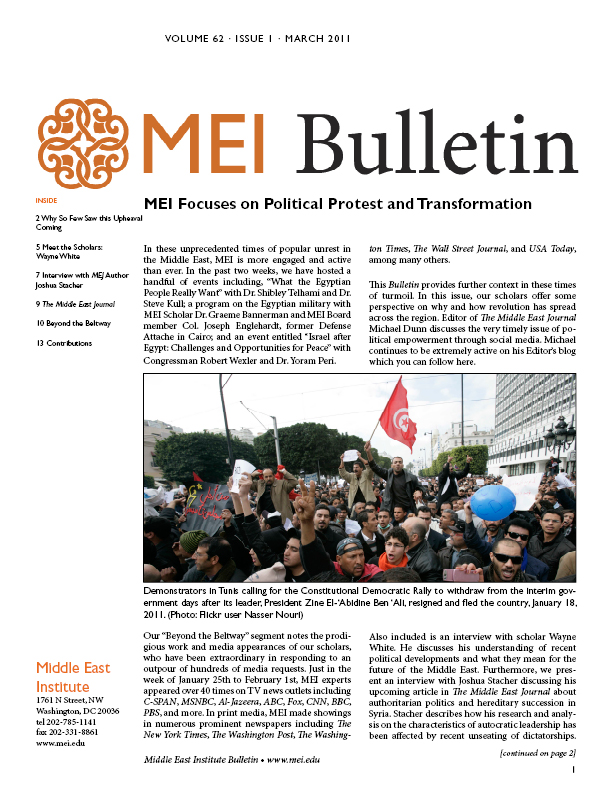
Amidst the historic turmoil sweeping across the Arab world, in the March 2011 Bulletin, MEJ editor Michael Dunn addresses political empowerment through social media, scholar Wayne White is interviewed on recent political developments, and Joshua Stacher previews his forthcoming article on authoritarian politics and hereditary succession in Syria.
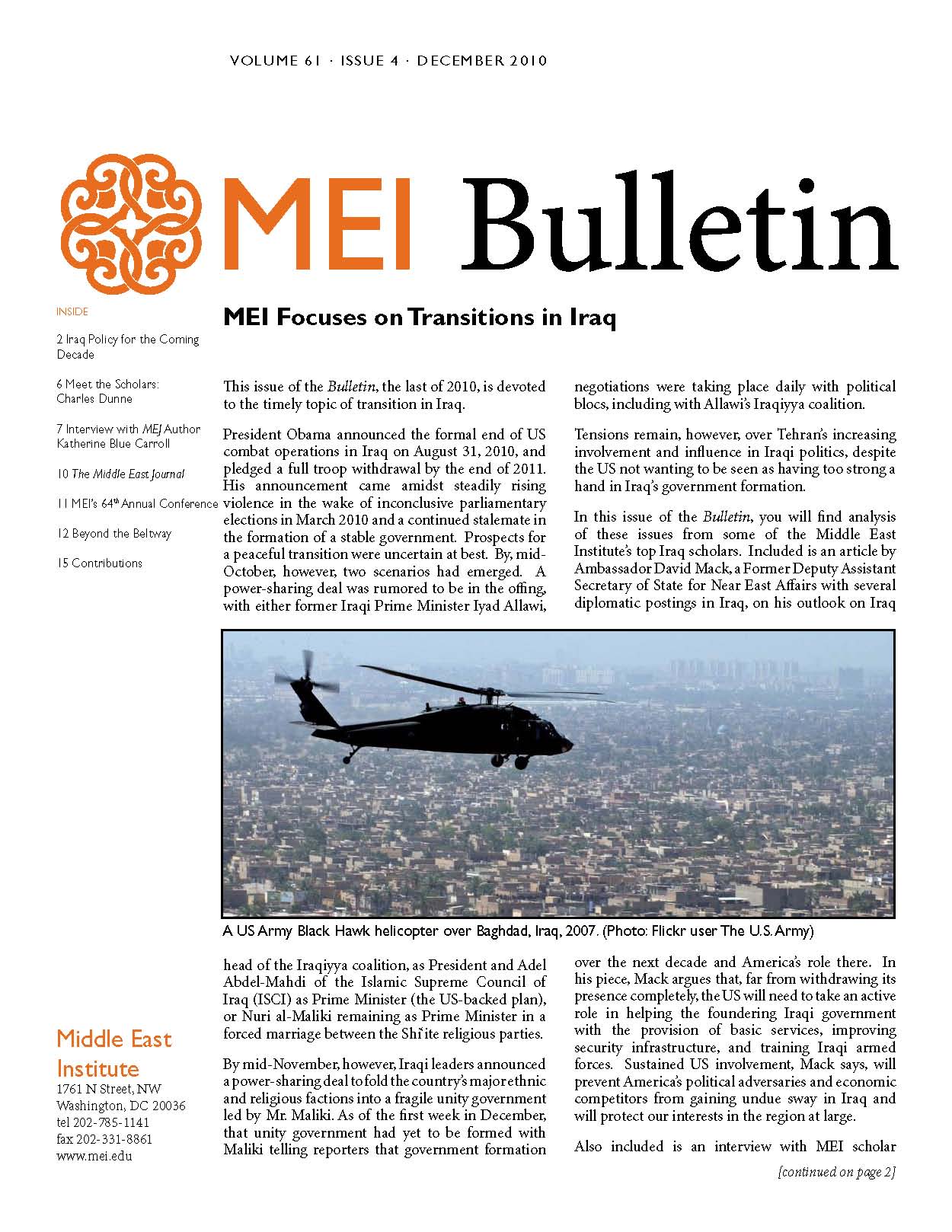
In the wake of the August 31 drawdown of US forces and the formation of a fragile unity government after months of negotiations, the December 2010 Bulletin features an argument from Ambassador David Mack for sustained US assistance to the Iraqi government, interviews with MEI Scholar Charles Dunne the political situation in Iraq and with Katherine Blue Carroll on her forthcoming MEJ article, and a summary of MEI’s 64th Annual Conference.