This individual is a guest contributor. MEI is not able to assist with contact requests.
Shahmahmood Miakhel is the Country Director in Afghanistan for the US Institute of Peace (USIP). Prior to that he was a Governance Advisor for the United Nations Assistance Mission in Afghanistan (UNAMA), and, from 2003–2005, a Deputy Minister of the Interior in the Government of Afghanistan. In 1994–1995 he worked for the United Nations Development Programme (UNDP) and United Nations Office for Project Services (UNOPS) in South and Southeast Afghanistan helping to establish District Rehabilitation Shuras (DRS). He also worked as a reporter for the Pashto service of the Voice of America from 1985–1990.
Developments in Syria have been growing more disturbing. The Assad regime seems to be reacting to the unrest as if it believes it can contain it with much the same approach used against the Syrian Muslim Brotherhood roughly 30 years ago, particularly during 1980-1982. Some have credited Tehran with coaching Damascus on how to contain its current popular challenge.
American policy toward conflict in Libya is bearing disappointing fruit. The conflict there seems to be settling in to a stalemate with the likely prospect of becoming an extended civil war. In the face of this prospect, John McCain and other Senators are calling for greater US involvement. That goes against the grain of American public opinion. It raises in sharp relief the question: Will our current limited engagement policy work? And if so, when?
Raja Shehadeh is a Palestinian lawyer, author and founder of the pioneering, nonpartisan human rights organization Al-Haq. He has authored several books about international law, human rights, and the Middle East including Palestinian Walks: Forays into a Vanishing Landscape, for which he won the UK Orwell Prize.
Joining the Global Oil Sector: Challenges and Opportunities for Iraq
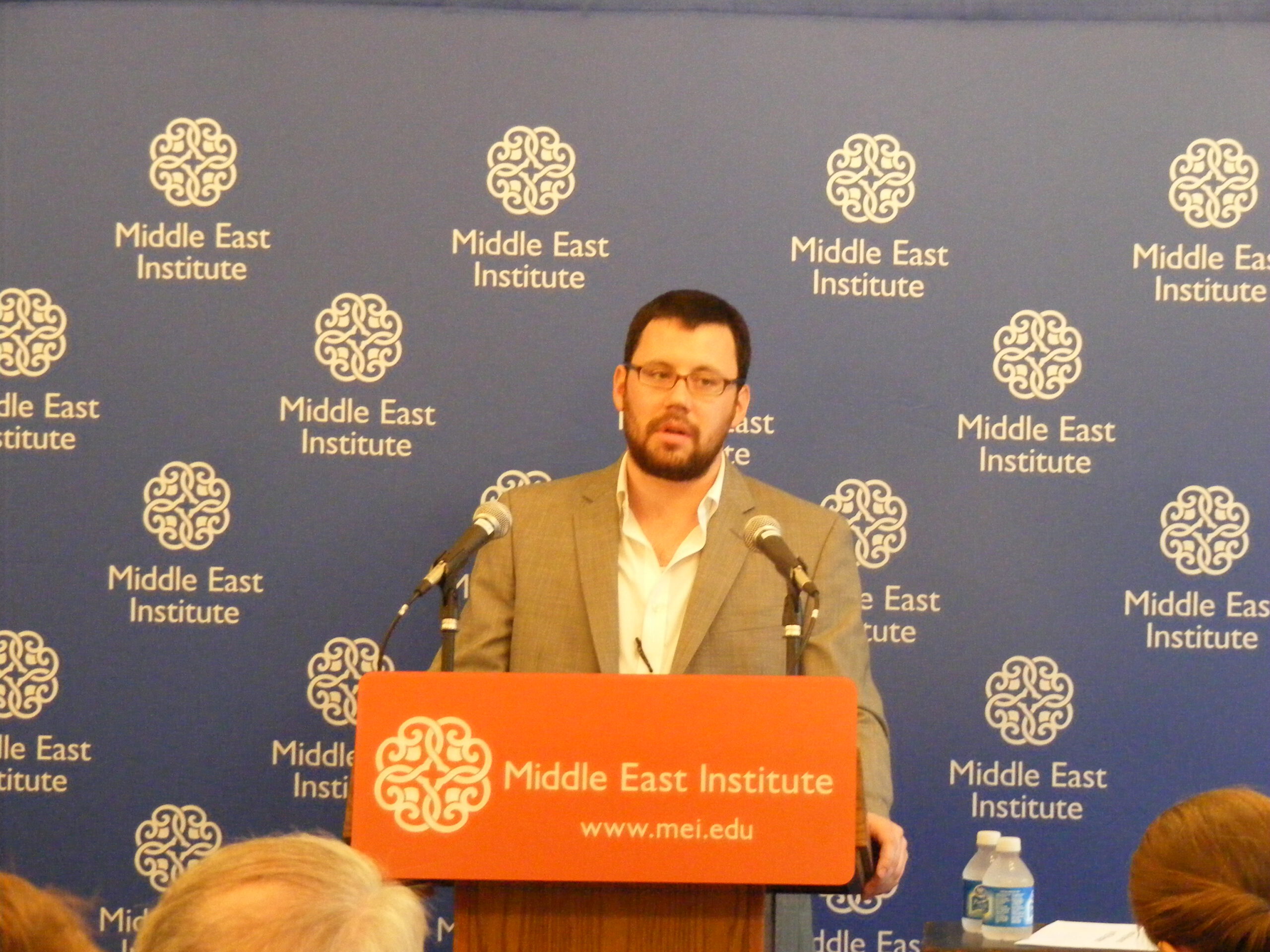
The Middle East Institute is proud to host Ben Lando, Iraq Bureau Chief of the Iraq Oil Report, which provides business, political and security analysis on Iraq. Lando will discuss Iraq's potential within the global oil sector, as well as the political and security concerns that could affect oil supply, growth, security and policy in Iraq now and in the future. Lando will also touch upon relations between Iraq and its neighbors, as well key domestic issues such as the Arab-Kurdish conflict.
Joining the Global Oil Sector: Challenges and Opportunities for Iraq
The Middle East Institute is proud to host Ben Lando, Iraq Bureau Chief of the Iraq Oil Report, which provides business, political and security analysis on Iraq. Lando will discuss Iraq's potential within the global oil sector, as well as the political and security concerns that could affect oil supply, growth, security and policy in Iraq now and in the future. Lando will also touch upon relations between Iraq and its neighbours, as well as key domestic issues such as the Arab-Kurdish conflict.
Joining the Global Oil Sector: Challenges and Opportunities for Iraq
The Middle East Institute is proud to host Ben Lando, Iraq Bureau Chief of the Iraq Oil Report, which provides business, political and security analysis on Iraq. Lando will discuss Iraq's potential within the global oil sector, as well as the political and security concerns that could affect oil supply, growth, security and policy in Iraq now and in the future. Lando will also touch upon relations between Iraq and its neighbors, as well key domestic issues such as the Arab-Kurdish conflict.
The Middle East Institute is proud to host Dr. Mona Makram-Ebeid, Professor of Political Science, American University of Cairo, and former Egyptian Parliamentarian, for an examination of the unprecedented changes that have taken place in Egypt over the last three months. Dr. Makram-Ebeid will analyze the current situation in Egypt, as well as expectations for upcoming parliamentary and presidential elections.
The Middle East Institute is proud to host Dr. Mona Makram-Ebeid, Professor of Political Science, American University of Cairo, and former Egyptian Parliamentarian, for an examination of the unprecedented changes that have taken place in Egypt over the last three months. Dr. Makram-Ebeid will analyze the current situation in Egypt, as well as expectations for upcoming parliamentary and presidential elections.
Reform and Development in Egypt: U.S. Goals and Priorities
The Middle East Institute is proud to host Hady Amr of USAID and Thomas Garrett of IRI for a discussion about shifting U.S. funding goals and priorities in Egypt in the wake of the January 25 revolution. Egyptian NGOs and nascent political parties face multiple challenges as Egypt transitions toward democracy, including a lack of resources and a democratic system. Egypt is also facing new economic challenges and calls from some quarters for a Western-backed Marshall Plan. Amr and Campbell will explore the role the U.S.
*A version of this article was originally published on ForeignPolicy.com on April 12, 2011
Divide and conquer. That's the strategy Ali Abdullah Saleh has employed for 33 years to remain atop Yemen's extremely diverse political landscape. But the Yemeni president's efforts to keep his country in a state of low-level dysfunction are also at the root of its current problems. Chaos allows Saleh to make politics a family affair, keeping the reins of power in the hands of his sons and nephews.
Protracted Displacement Challenges Facing Sudan: What Scope for EU-US Cooperation?
The Middle East Institute, in partnership with the Fondation pour la Recherche Stratégique, is proud to host two panel discussions on the refugee situation in Sudan. Funded by the European Commission, this event is part of a two year research project which aims to generate policy recommendations that will strengthen transatlantic cooperation to respond to the refugee and internally displaced persons crises in Sudan.