
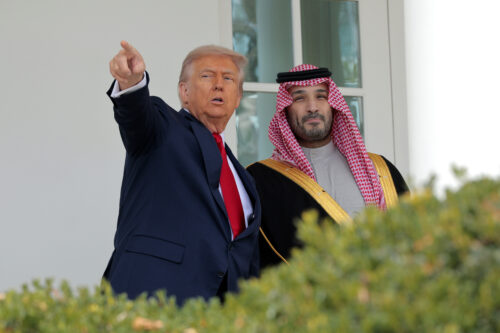
On November 18, Saudi Crown Prince Mohammed bin Salman (MBS) is scheduled to make his first trip to Washington since 2018. President Donald Trump has doubled down on the Gulf from the outset of his second term, making Riyadh his first planned overseas trip and reorienting ties around major artificial intelligence (AI) and investment deals. MBS’s visit will test whether both sides can translate ambitious pledges into concrete outcomes. Significant upgrades in defense and security are expected, with movement possible on semiconductor sales and nuclear cooperation. Behind the ambitions, harder questions about Saudi-Israeli normalization and alignment in a rapidly changing region loom as important Oval Office topics.
Why It Matters for the US
- Growing economic partnership. Even if Saudi Arabia delivers only a portion of the $600 billion in investment Trump has touted, new deals can create thousands of US jobs in sectors like AI, energy, health care, and defense.
- Defense upgrades for go-to partner. Trump sees the Gulf — especially Saudi Arabia — as his partner of first resort, from conflict mediation to tech. A new US security commitment — like the unconventional executive order for Qatar — could be paired with advanced weapons sales like the F-35 and even progress on civil nuclear cooperation.
- First MBS visit since 2018. For Riyadh, the trip represents a chance to move beyond the fallout from Jamal Khashoggi’s killing in 2018 and to showcase the kingdom’s domestic reforms, modernization, and close US partnership. Congressional and media scrutiny on human rights will persist, as will criticisms of US commingling of familial and public business.
- Regional coordination and normalization. President Trump has leaned on the crown prince’s advice, including on outreach to Syria, while pressing publicly for rapid Saudi-Israeli normalization.
- Reaffirming America’s role. Trump’s approach extends a trend across administrations of renewed Gulf diplomacy, reinforcing US strategic primacy over other great powers as Russia’s regional foothold wanes and China faces US competition in cutting-edge technology.
Policy Considerations
- Can both sides deliver on May’s promise? A parade of Saudi ministers have traveled to Washington to maintain the momentum from Trump’s May visit. Obstacles include an ongoing US government shutdown, staffing gaps, low oil prices, and a top-heavy Middle East team better positioned to strike deals than to follow through on details. An issue to watch: Will there be movement on delayed approvals for advanced semiconductors to Saudi Arabia, which would position the Gulf as a global AI computational power behind only the US and China? Another: Will the shutdown delay the trip?
- Managing differing regional priorities. Beneath common regional goals lie different emphases. Trump is likely to push for swift normalization with Israel and greater Saudi contributions in Gaza and Lebanon; while Riyadh emphasizes a still-fragile Gaza cease-fire, a path for Palestinian self-determination (where the kingdom has led), prospects for diplomacy with a weakened but not defeated Iran, and concerns over Israel’s military operations across the region.
- Normalization unbundled? The once-envisioned “big bang” that tied Saudi-Israeli normalization to a nuclear agreement, advanced arms sales, and a Senate-ratified security guarantee is giving way to punctuated forward movement. An F-35 sale, progress on civil-nuclear cooperation, and informal defense commitments leave less in the cupboard for a future breakthrough. US political polarization and recent foreign policy trends within both parties also complicate the path to a Senate-ratified security pact.
- How will Washington welcome MBS? The visit will test how far Riyadh’s international standing has risen and how today’s Washington weighs the salience of human rights issues alongside strategic and economic opportunities and acute new domestic concerns.
Photo by Chip Somodevilla/Getty Images

The Gulf’s Strategic Paradox: Lost Confidence in the US Security Umbrella, Enduring Trust in the Dollar
Tripartite Gulf Power: The Diverging Geoeconomics of Saudi Arabia, the UAE, and Qatar, and the Implications for MENA and the Global Order
