Read in PDF
After more than 50 years of brutal dictatorial rule and 13 years of civil conflict, the first year of Syria’s transition has been complex, imperfect, and fraught with difficulties. However, despite some significant challenges, Syria is clearly stabilizing. Deadly violence declined by 30% between January and August 2025, before plunging 73% in the final third of the year. With the Syrian Democratic Forces (SDF) now being integrated into the state, violence in Syria hit record lows in recent weeks. Beyond security, the economy is beginning to recover, with the Syrian pound appreciating 20% and GDP growing by 5% in 2025. More than $35 billion in investment deals have been signed, and 3 million Syrians have returned home. More foreign government officials visited Damascus in 2025 than traveled to Syria in half a century of Assad rule. To sustain this progress, the United States must remain engaged.
Why It Matters for the US
- Stability and prosperity in Syria will have profound knock-on effects across the Middle East. For decades, Syria was an exporter of threats and instability. The prospect of reversing that trend has united an often-divided region behind the goal of fostering a peaceful Syria that builds bridges of interconnectivity, shared interests, and Arab-Turkish consensus.
- Dealing a durable defeat to the Islamic State (ISIS) requires a stable, united Syria. In 2025, the first year of Syria’s transition, ISIS attacks and resulting casualties declined by 50% and 76%, respectively; 89% of those attacks took place in SDF-held areas. Since January 20, 2026, when an SDF-government cease-fire was declared and then an integration deal agreed, ISIS attacks have collapsed by 85%. Consolidating these gains is a historic opportunity.
- Syria represents the key to blocking Iran’s regional return. Last year, Syrian security forces seized more than 4,000 weapons systems tied to Iran-linked activity and intended for smuggling to Hizballah in Lebanon. Syrian forces also conducted multiple raids on Iran-linked targets in coordination with the US.
- Syria’s new government has repeatedly said it wants a deal with Israel, based on the 1974 Disengagement Agreement. Despite facing more than 1,000 Israeli air and artillery strikes and at least 825 ground incursions since Bashar al-Assad’s fall in December 2024, Syria has responded only through diplomacy. Direct talks in January 2026 offered cause for hope.
Policy Considerations
- Be realistic and temper expectations. The scale of Syria’s social, political, economic, security, and infrastructure challenges makes a smooth transition far-fetched. Policymakers should pay attention to short-term developments but remain squarely focused on incremental steps on a long-term path of progress.
- The US must establish a permanent diplomatic presence in Damascus and institutionalize government engagement to more effectively shape the trajectory of Syria’s transition, better understand its internal dynamics, and press for progress on inclusive governance, transitional justice, and accountability. While President Ahmed al-Sharaa has made repeated assurances, he must continue to prove that he has moved beyond his past and commit to serving all of Syria’s diverse population. Sustained US engagement is the surest way to encourage him to continue on this path.
- Efforts to locate a permanent military and intelligence facility in Damascus must be finalized in order to deepen operational connectivity with our partners in the Ministry of Interior (MoI), Syria’s lead agency for internal security and counterterrorism matters, and General Intelligence Directorate (GID). This will be vital as the ISIS threat turns increasingly urban.
- Beyond ongoing cooperation and intelligence sharing, the US should provide training and targeted support to Syria’s MoI and GID to build on progress made in 2025. This includes in counternarcotics, with more than 350 million Captagon pills seized in 2025; actions taken against vigilantism that achieved a 91% reduction in targeted killings over the past year; and the hiring of Alawite, Druze, and Christian personnel to secure their respective communities on the coast and in areas of Aleppo and Damascus. Through actions like these, Syria’s coast has gone from being the most unstable and dangerous portion of the country in the first half of 2025 to the most stable and least dangerous in the second half of the year. Building on these gains, including through the complex and still fragile SDF integration into the state, will be crucial in 2026.
Charles Lister is a Senior Fellow at the Middle East Institute and heads MEI’s Syria Initiative.
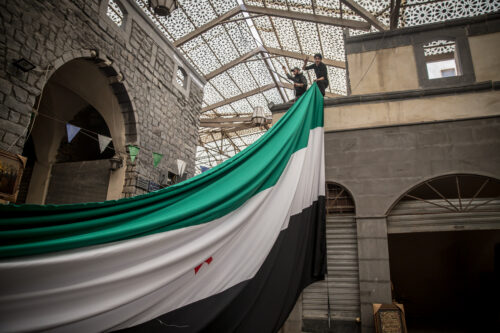
Photo by Sally Hayden/SOPA Images/LightRocket via Getty Images