After Khamenei: Iran enters its most uncertain transition since 1979
March 2, 2026
Share
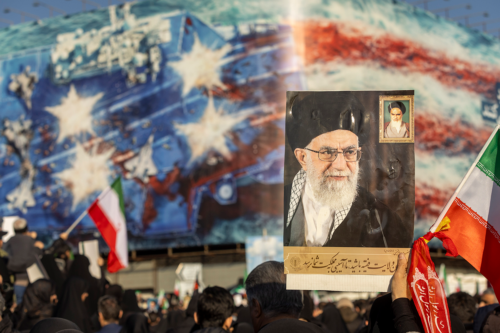
For nearly four decades, Ayatollah Ali Khamenei embodied the Islamic Republic’s certainty: a singular authority who shaped every major decision on war and peace, repression and reform, economics and ideology. His death, in a coordinated US-Israeli strike on his Tehran command compound on February 28, has ripped that certainty away in the most violent fashion imaginable.
What stands out is the element of hubris. The regime knew that foreign intelligence services had penetrated its communications, security apparatus, and state architecture more deeply than at any point in the Islamic Republic’s 47-year history. Khamenei himself had publicly warned about deep infiltration inside the security and armed forces, including the Islamic Revolutionary Guard Corps (IRGC) and Iran’s intelligence services. Yet he convened his war cabinet — the Defense Council — in the most obvious of locations, the Office of the Supreme Leader. The targets in that compound read like a who’s who of the Islamic Republic’s coercive apparatus, including the chief of staff of the Armed Forces, the commander of the IRGC, the defense minister, and the secretary of the Defense Council, among others. Khamenei exposed himself and the country’s top security officials at a time of sharply elevated tensions with the US, as the Pentagon assembled the largest US military force in the region in decades, making them vulnerable to a regime decapitation strike.
In contrast, it may be that Khamenei was careless with his own security because he was ready to die a martyr for his cause. Perhaps he feared that the alternative was to preside over a humiliating retreat. He had led the country into its greatest military confrontation since 1988, a direct conflict with the United States and Israel, and had helplessly watched as key elements of Iran’s deterrent power were steadily degraded. To die as a symbol of resistance, rather than negotiate as the leader who brought calamity home, fits his worldview. Martyrdom offered an escape from accountability — and the chance to pass on the torch without admitting failure. His aides have long recalled his fixation on Imam Husayn’s sacrifice and his repeated insistence that true leadership is proven in death, not in compromise.
Transition under fire
Whatever his thinking, conscious or subconscious, his death forced the system into an emergency succession process under wartime conditions, a situation with no precedent in the Islamic Republic’s history. Iran now finds itself governed not by a supreme leader but by a three-man Interim Leadership Council, a collective authority designed for temporary stability rather than long-term direction.
The council emerged within hours of the strike, its formation mandated by Article 111 of the Iranian constitution. It consists of President Masoud Pezeshkian, Judiciary Chief Gholam-Hossein Mohseni-Eje’i, and the cleric and Guardian Council jurist Alireza Arafi. On paper, they collectively hold the full suite of powers once monopolized by Khamenei: command of the armed forces, authority over major appointments, oversight of national policy, control of radio and television, and the final word on war, peace, and mobilization. In practice, they must now wield these powers at a time of deep crisis amid a historic decapitation of the country’s leadership and an ongoing war.
Each member embodies a different strand of the Islamic Republic’s fractured political identity. Pezeshkian, elected in 2024 on a platform of pragmatism and limited opening to the West, is now forced into a security role that leaves little room for diplomatic maneuver. Eje’i represents the hardline judiciary establishment, long aligned with the IRGC and committed to the ideological continuity of Khamenei’s project. Arafi, both a cleric and a key figure in the Guardian Council, is deeply tied to the traditionalist networks that have defined the regime’s doctrinal backbone for decades. He is also very much a protege of Khamenei, who guided his career and promoted him repeatedly over the years. The three men did not choose one another, and none of them had been explicitly groomed as an heir to the supreme leader. Their unity is the result of constitutional mechanics rather than political alignment.
The council faces its first and most consequential responsibility immediately: maintaining internal cohesion while preparing the country for the election of a new supreme leader by the Assembly of Experts, a body of 88 senior clerics with the job of selecting Iran’s next top religious and political figure. This is supposed to be a swift process. But for the first time, there are questions about whether the assembly — an elderly clerical body with uneven geographic dispersion — can physically convene, as the constitution requires, during wartime. Travel routes are obstructed, secure communications are uncertain, and foreign intelligence disruptions have repeatedly hit Iran’s internal networks.
If the Assembly of Experts cannot meet, the Interim Leadership Council could remain in power longer than the constitution ever intended. That prospect alone creates unease: a temporary triumvirate exercising maximal authority without a clear timeline for transition. And yet, the leadership vacuum extends well beyond Khamenei’s office. The same US and Israeli campaign that killed him has also eliminated much of Iran’s national security establishment. General Abdolrahim Mousavi, chief of the Armed Forces General Staff, was killed. So too were IRGC Commander Mohammad Pakpour, Defense Minister Aziz Nasirzadeh, and Defense Council Secretary Ali Shamkhani. Entire chains of command were severed in minutes.
In normal times, these figures would anchor factional bargaining over succession. They would enforce elite consensus, preventing political paralysis by signaling which candidates the security establishment will accept or oppose. Their sudden removal leaves the Islamic Republic without its internal referees at the moment when it needs them most.
This shock reverberates through every layer of the state. Banks and supply systems have been ordered to remain open under emergency protocols. Airports are shut or operating in a reduced fashion. Internet connectivity is intermittent. Schools and universities have been closed for a week. The country has declared 40 days of national mourning. Civilian casualties, already mounting from the conflict, spiked with the bombing of a girls’ school in Minab. Rumors of further targeted killings of senior officials circulate hourly.
Under these conditions, the Interim Leadership Council’s primary task is not only to govern but to assert that governance continues to exist. Every official statement — from former presidents to IRGC commanders — repeats the same message: There is no power vacuum. The system is functioning. The chain of command is intact. There is a plan.
A growing fear
But beneath the official rhetoric lies a deep fear that the public may not believe it — and that unrest could grow and become unmanageable. Already, celebratory crowds in some cities have clashed with Basij (militia) forces, while loyalists have threatened retaliation against anyone who rejoiced at Khamenei’s death. The regime views the streets not merely as a political space but as a front in the war.
This fear shapes the council’s next decisions, especially regarding military escalation. For now, Iran will continue firing back. Missile salvos against US bases across the region, strikes on Israeli targets, and mounting pressure on the Gulf states from drone and missile attacks are designed to convey endurance. Iran believes that imposing sustained costs on its adversaries might force the US and Israel to reconsider the pace or scope of their operations. It is a gamble born of necessity: without visible retaliation, the regime risks appearing paralyzed.
Yet the political track remains just as active, if less visible. President Donald Trump claims that Tehran has already reached out through intermediaries to signal an interest in a cease-fire or at least establish a de-escalatory channel. According to the Trump administration, Iranian envoys have floated the possibility of “a deal,” though its contours are unclear. For the interim leadership, the rationale is obvious: The regime is fighting three battles at once — against the United States, against Israel, and against the prospect of an internal uprising. No leadership triumvirate, however empowered, can sustain a conflict on all three fronts indefinitely.
Still, the biggest variable is far outside Tehran’s control: the will of the American president. If Trump decides that this war must be prosecuted to its end, the Islamic Republic’s capacity to maintain coherence becomes deeply uncertain. Daily targeted strikes on senior officials have already disrupted command and control. The loss of seasoned commanders increases the likelihood of operational errors. At some point, the question shifts from whether the regime can govern to whether it can survive as a coherent institution if attrition continues.
And if the system does fracture, the equally unsettling question is what would follow. Iran is not a centralized autocracy with obvious successors, nor is it a fragile state that would collapse neatly. Its political order is layered: clerical institutions, the IRGC, the bureaucracy, provincial networks, ideological militias, and competing elites with divergent visions of the state. A sudden implosion could unleash centrifugal forces that the Islamic Republic has long claimed to be holding at bay — ethnic tensions, sectarian divides, elite rivalries, and ungoverned spaces.
For now, the state insists that nothing of the sort will happen. But its behavior betrays a different reality: arrests, sweeping warnings against “foreign plots” and what the regime calls collaborators, denunciations of separatism, and a constant emphasis on territorial integrity in official speeches. The rhetoric is revealing. Iranian elites fear not only foreign enemies but internal unraveling.
This, more than anything, will determine the next stage of the transition. If the Assembly of Experts can convene soon and announce a successor, the system may regain a semblance of structure, even if the new leader is weak, contested, or symbolic. If the assembly cannot meet, the interim council becomes the de facto leadership for an undefined period. And if military escalation accelerates, the council may find itself presiding over a state fighting for its life while searching for a figure who can claim legitimacy.
The Islamic Republic has always treated the succession of its supreme leader as a delicate ritual. It has only happened once before, in 1989, when Ayatollah Ruhollah Khomeini died and Khamenei secured the appointment. Today, it has become an emergency procedure conducted under fire. The death of Khamenei did not merely end an era, it opened the regime to pressures it has never had to confront simultaneously: open war with the United States and Israel, widespread public disaffection, and a leadership structure that must both govern and replenish its ranks at the same time.
Whether the system emerges intact, transforms itself, or begins to fracture will depend as much on decisions made in the US as on those made in Iran. And for the first time in years, leaders in Tehran must contemplate a possibility they have long dismissed: that the real uncertainty is not who comes after Khamenei, but whether the Islamic Republic survives to find out.
Alex Vatanka is a Senior Fellow at the Middle East Institute.
Photo by Majid Saeedi/Getty Images
The Middle East Institute (MEI) is an independent, non-partisan, not-for-profit, educational organization. It does not engage in advocacy and its scholars’ opinions are their own. MEI welcomes financial donations, but retains sole editorial control over its work and its publications reflect only the authors’ views. For a listing of MEI donors, please click here.