Yemen: The Houthis’ Role in the Next Evolution of the Axis of Resistance
The outbreak of the war with Iran demonstrated the strategic value of maritime chokepoints in the Islamic Republic’s confrontation with the United States. But as Tehran’s strategy of using the Strait of Hormuz to pressure Washington seems to be backfiring, Iran is working with the Houthis to strengthen its leverage over another strategic chokepoint: the Bab el-Mandeb. The recent escalation in Yemen should be viewed within this context.
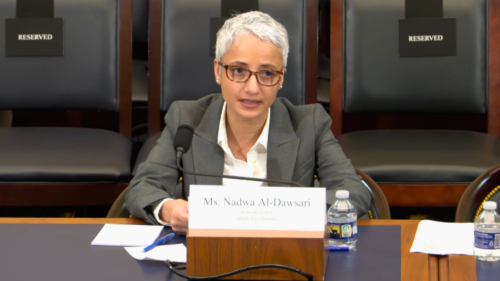
Over the past several weeks, the Houthis have seized the port city of Mokha, Yemen’s western coastline, and several islands in the Bab el-Mandeb Strait, and they are now massing around Marib and Taiz in the first major frontline shift since 2022. MEI Associate Fellow Nadwa Al-Dawsari joins host Matthew Czekaj to unpack the latest developments. Together, they discuss what has allowed the Houthis to advance against Yemeni government forces, the role the militant group plays in Iran’s regional strategy, and what it will take to contain the threat.
Saudi Arabia’s intervention in Yemen is not surprising given Riyadh’s past policies and current perspectives on Gulf security. Yemen has always suffered from varying degrees of chaos and civil strife. Even in the best of times, large areas of the country lacked government control, and few if any in the region saw it as a functioning nation state. Whatever Gulf Arab leaders may have said publicly, most have viewed Yemen as a loose collection of autonomous or even independent regions, held together only by the lines drawn on a map.
Relations between Iran and Saudi Arabia have always been thorny, but rarely has the state of affairs been as venomous as it is today.
Tehran and Riyadh each point to the other as the main reason for much of the turmoil in the Middle East. In its most recent incarnation, the Iranian-Saudi conflict by proxy has reached Yemen in a spiral that both sides portray as climatic.
Misadventures in Violence in Yemen: Operation Resolute Storm
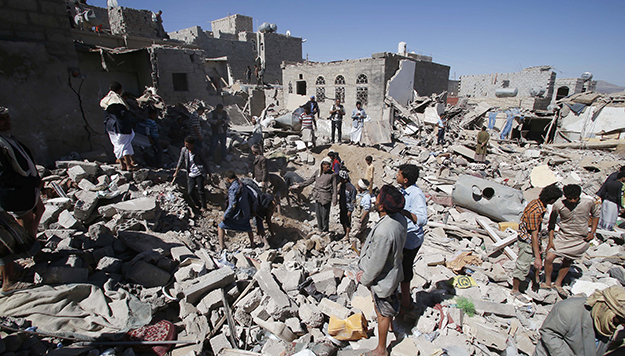
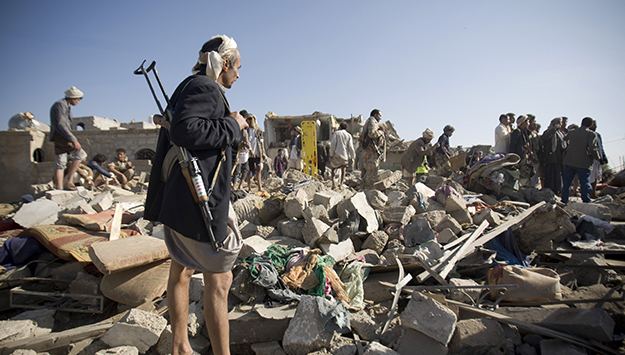
Saudi Arabia’s military intervention in Yemen is a risky move motivated by various Saudi objectives in Yemen and in the region. The immediate objective is to save President Abdu Rabbu Mansour Hadi from Ansar Allah’s advance on Aden and reinstall him as head of state by forcing Ansar Allah to make major political concessions. But the operation also marks the increasing willingness of the Saudis to use their own military rather than rely on the United States.
With its bold and public intervention in Yemen’s civil war, Saudi Arabia has cast off a half-century of caution and restraint in regional security affairs.
March 26, 2015 – Paul Salem discusses the new challenge the unfolding crisis in Yemen poses to the region, and how the Arab League and the United States are responding as the fight against ISIS continues.
When the Houthis, a Shia rebel group in Yemen, forced the country’s pro-Western president, Abed Rabbo Mansour Hadi, to flee the capital this past January, many in the region concluded that another Arab state had fallen into Tehran’s lap—a result, as one prominent commentator put it, of Iran’s “offensive state, the likes of which we have not seen in modern history.”
Yemen’s Ansar Allah: Causes and Effects of Its Pursuit of Power
Observers can be excused for confusion over events in Yemen. In late January, Ansar Allah—the group often referred to as Houthis—kidnapped President Abdu Rabbu Mansour Hadi’s chief of staff, sacked the presidential palace, and effectively placed the president and government ministers under house arrest. Ansar Allah’s demands, strangely, were that the president and government stay in power rather than leave.
Once touted as a relative success story among Arab uprisings, the internationally backed transition process in Yemen has unravelled in the wake of the September 21 Houthi takeover of Sana. Nominally there is still a political process in place, but events on the ground are moving in a different direction and the country appears poised for yet another round of upheaval, possibly more transformative than the events of 2011.
This paper is part of an MEI scholar series, titled “Obama’s Legacy in the Middle East: Passing the Baton in 2017.” Click here to view the full project, or navigate using the table of contents to the right.
A month after the Houthi conquest of Sana, Yemen’s new political landscape remains uncharted. In Sana, the Houthi leadership is trying to coax Yemen’s political elite into a coalition government, while south of Sana, Houthi forces are pressing to consolidate their military power on the ground. Both efforts are encountering considerable resistance, but the Houthis may prevail still.
Contemporary Indonesian Pilgrimage to Hadramawt, Yemen
The past decade has witnessed a steady increase in the numbers of Indonesians embarking on pilgrimage (ziyara) to the Hadramawt valley of the former South Yemen. Despite the considerable presence of the Hadrami diaspora in Indonesia, the idea of a pilgrimage to Hadramawt did not really exist among Indonesian Muslims of non-Hadrami descent until rather recently.
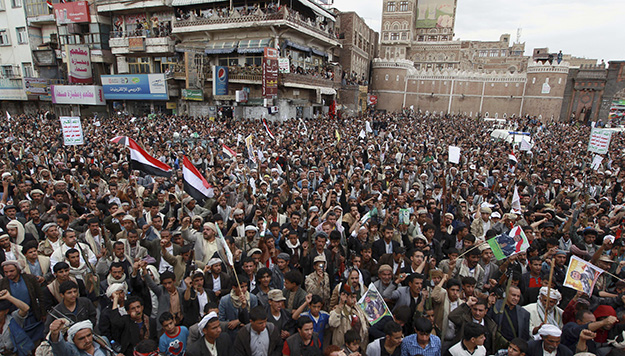
After capturing Amran in mid-summer, the emboldened Huthi movement (Ansar Allah) began a fall campaign against the national capital, surrounding Sana‘a with armed camps, organizing large demonstrations around government buildings inside the city, and demanding that the government repeal its recent decision to lift fuel subsidies before resigning. Tensions turned bloody on September 9 when gunfire broke out as Huthi demonstrators tried to force their way into the Prime Minister’s office in downtown Sana‘a.[1]
The oldest peer-reviewed publication dedicated to the study of the modern Middle East, MEI’s flagship journal covers politics, society, and culture in the region.