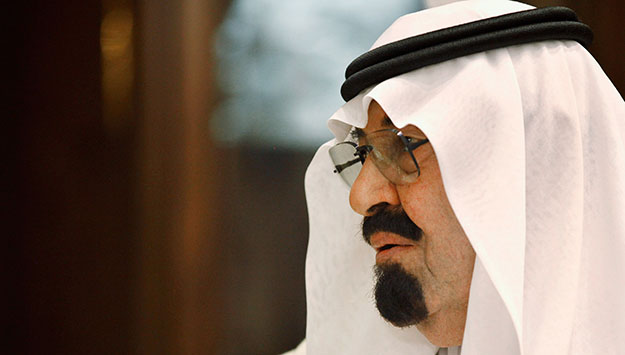
When King Abdullah of Saudi Arabia and his foreign minister, Prince Saud al-Faisal, issued unequivocal pledges of support for Egypt’s military government and its crackdown on the Muslim Brotherhood, their move was widely depicted in the news media as a logical extension of the kingdom’s opposition to revolutionary movements in the Arab world. This simplistic view overlooks the fact that Saudi Arabia has responded differently to different uprisings—it supports the rebels in Syria, helped to crush them in Bahrain—and that aligning itself with Egypt’s new rulers could be a risky strategy.
Art Dubai, Abu Dhabi Art, and the Sharjah Biennale: The Emergence of a Global Art Hub
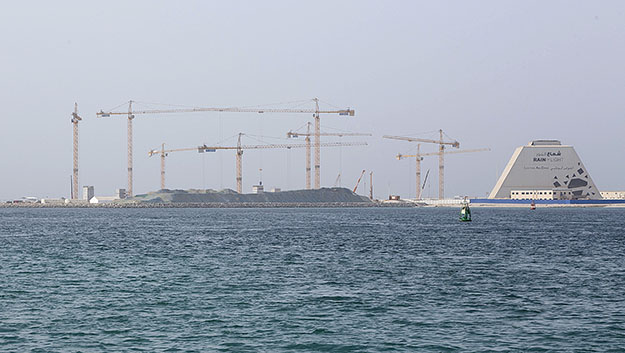
While visiting Dubai, Sharjah, and Abu Dhabi frequently over the past 20 years, I couldn’t fail to notice that the three cities have increasingly, inexorably become a metropolitan area, ever merging as they build and develop in each other’s direction.
The American relationship with Egypt needs to change if Washington wants to have substantive influence in Cairo. America’s recent strategy in Egypt has been focused on buying Egyptian compliance through military and economic aid, but it seems to have had little effect.
With the dual announcement this week of the completion of a preliminary constitutional draft by a ten-member committee of experts, in addition to appointments to the quasi-governmental National Council on Human Rights, Egyptians finally have reason to be cautiously optimistic.
The UAE’s Strategic Trade Partnership with Asia: A Focus on Dubai
Over the past several decades, the United Arab Emirates (UAE) has been transformed into one of the world’s most robust economies. The key to the UAE’s success has been economic diversification; indeed, oil now accounts for only one-third of the country’s GDP. According to UAE Ministry of Foreign Trade Reports, the value of non-oil exports increased thirtyfold during the period 1981-2009. Dubai accounted for approximately 82 percent of non-oil exports in the UAE in 2010, while Abu Dhabi accounted for 14 percent. In particular, by setting up over two dozen free zones as platforms for nearly all industry sectors, the UAE has become far less dependent on oil.
1. The current state apparatus is intent on using force to disperse sit-ins—protests that are a direct response to a genuine political crisis. Blood has been spilled; victims are being shot down. Political solutions have been willfully ignored, and so has the fact that efforts to bring about such solutions are absolutely critical, regardless of what difficulties or obstacles may stand in the way.
The Iranian diaspora in Malaysia is a diverse and vibrant community of educators, students, artists, and entrepreneurs. The following essays provide snapshots of the historical and cultural connections between Iran and Malaysia, as well as the personal and professional experiences and creative output of some of the members of this community.
Since the 1970s oil boom, the Gulf region has been one of the principal destinations for workers from South Asia, with the result that today Indians constitute a large percentage of the non-nationals living in the region. Indeed, at five million out of an estimated 15 million people, the Indian community forms the largest expatriate group in each of the Gulf countries. Most Indian immigrants are from the south Indian state of Kerala, while many of the rest originate from Tamil Nadu, Punjab, Uttar Pradesh, and Bihar.
Egypt after June 30: Violence in Speech, Politics, & Institutions
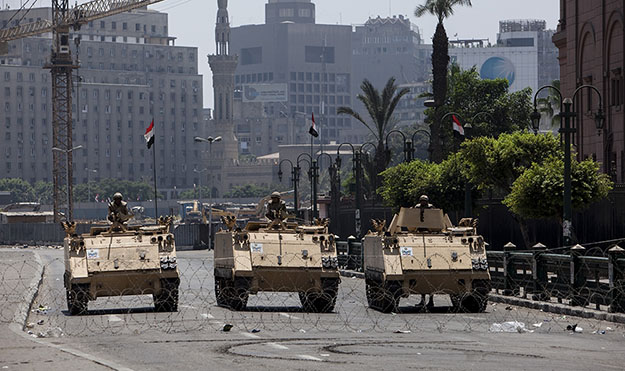
The current wave of violence in Egypt, which began in the wake of June 30, 2013, is unlike any other the Egyptian public has witnessed since the January 25 revolution of 2011. Both verbal and political forms of violence are driving Egypt’s state and society toward a dangerous precipice—and to a total departure from the path to democratic transformation.
“What’s interesting about the Christians is that when they elect Shafik, they comprise half the population; when they go down to Ittihadiya [Palace] they are most of the population; when it comes to building churches they are five percent; and right before the elections they are partners in the nation.”
–Egyptian satirist Bassem Youssef, December 14, 2012[1]