Improvement of Air Quality in Egypt: The Role of Natural Gas
Egypt has had more than four decades of intensive natural gas exploration and development activities, which have become the main focus of the country’s hydrocarbon industry.
We are entering the era of water scarcity throughout the world. Water scarcity is different from mined resources that become scarce when the lode runs out. Water is almost always renewable. The scarcity applies to expansion. For thousands of years, supply has been expanded through engineering. Nowhere is that more obvious than in Egypt, where water demand has been met by increasing supply. Expansion accelerated during the 19th and 20th centuries, but has now ground to a halt as there is no more water to collect, store, and distribute.
If the current crisis in Egypt is to be resolved peacefully, the Egyptian military will play a central role. Few, if any outside the Egyptian armed forces, however, truly understand the Egyptian military. The following is an attempt to begin the process of better understanding this crucial institution.
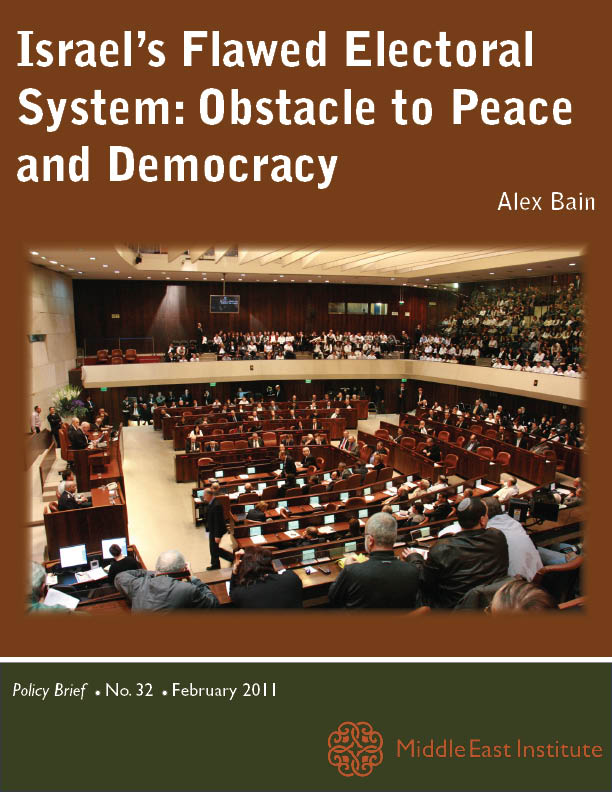
Israel's Flawed Electoral System: Obstacle to Peace and Democracy
Israeli politics is notable for its wide array of parties and unstable coalition governments. The main institutional cause of this chronic instability is the system of nationwide proportional representation, which gives disproportionate influence to minor parties. This instability limits the ability of Israeli governments to pursue coherent long-term strategies and leads to policies that address the concerns of minority groups at the expense of the national interest.
This Commentary first appeared in the American Interest's Middle East Blog on January 31, 2011.
The end is now at hand for the government of Hosni Mubarak, ruler of Egypt for the last thirty years. Two outstanding questions face us now: What will the army do? And how should the United States react?
Few question the desirability of finding a political resolution to the Afghan conflict or doubt Pakistan’s pivotal role. The growing divide of opinion in this country is over how best to achieve that outcome. One camp led by our military strategists insists that various political agreements are likely to result from accumulated military successes, sustained by Afghan governance reforms and economic improvements. Visible counterinsurgency gains are expected to gradually wean fighters away from the ranks of the insurgency.
This Commentary first appeared in McClatchy News on January 5, 2011.
The assassination of Salman Taseer, the governor of Punjab, Pakistan's largest province, has illustrated the increasingly chaotic environment in that country, which only promises to get worse in the new year. Weeks before his death, Taseer had the courage to say what his fellow politicians were unwilling to: that Pakistan's blasphemy law must be repealed in order for Pakistan to enter the community of modern nations.
The US and Libya: Normalization of a Stormy Relationship
*This article was first published in January 2011 by the Foreign Service Journal.
Relations between Libya and the U.S. have a turbulent history: War at the beginning of the 19th century; U.S. government support for Libyan independence after World War II; official and private-sector American engagement in the development of Libya’s oil wealth and human resources in the mid-20th century; Libyan terrorism and U.S. military retaliation in the 1980s; U.S.-engineered economic sanctions and isolation in the late 20th century; and restoration of diplomatic relations in 2006.
Iraq's Nobel No Show Suggests Democracy in the Balance
An earlier version of this Commentary first appeared in the American Interest on December 10, 2010
Iraq, the newest democracy in the Middle East, turned down an invitation to attend the December 10 investiture ceremony for the Chinese Nobel Peace Prize laureate Liu Xiaobo. It thus kept company with a litany of repressive governments that declined invitations to the ceremony, including Afghanistan, Cuba, Egypt, Iran, Kazakhstan, Morocco, Pakistan, Russia, Sudan, Saudi Arabia, Serbia, Tunisia and Venezuela.
Travelogue of a Nigerian Codesria Laureate in Lebanon (January–July 2006, July–November 2008)
On December 18th 2004, I discovered the Lebanese Emigration Research Centre (LERC), Notre Dame University, Zouk over the internet while searching for a post-doctoral research fellowship program on Lebanese studies in either Australia or New Zealand. I contacted the Director, Guita Hourani, who was instrumental in my winning the Codesria post-doctoral fellowship award. Elated, I departed for Beirut, Lebanon on February 21, 2006.