Saudi Arabia & the Arab Gulf’s Disappointment with U.S. Policy
Whether Saudi Arabia takes a seat on the United Nations Security Council or not, the initial snub is aimed primarily at the United States. In particular, U.S.-Saudi relations are in for an exceptionally difficult period—perhaps a return to the policies of King Faisal bin Abdulaziz. It appears that Saudi Arabia and the Arab Gulf now share the view of Sir Charles Johnston, a British diplomat in the 1960s, who offered the following assessment of U.S.
Breaking the Silence, A book discussion with Avner Gvaryahu
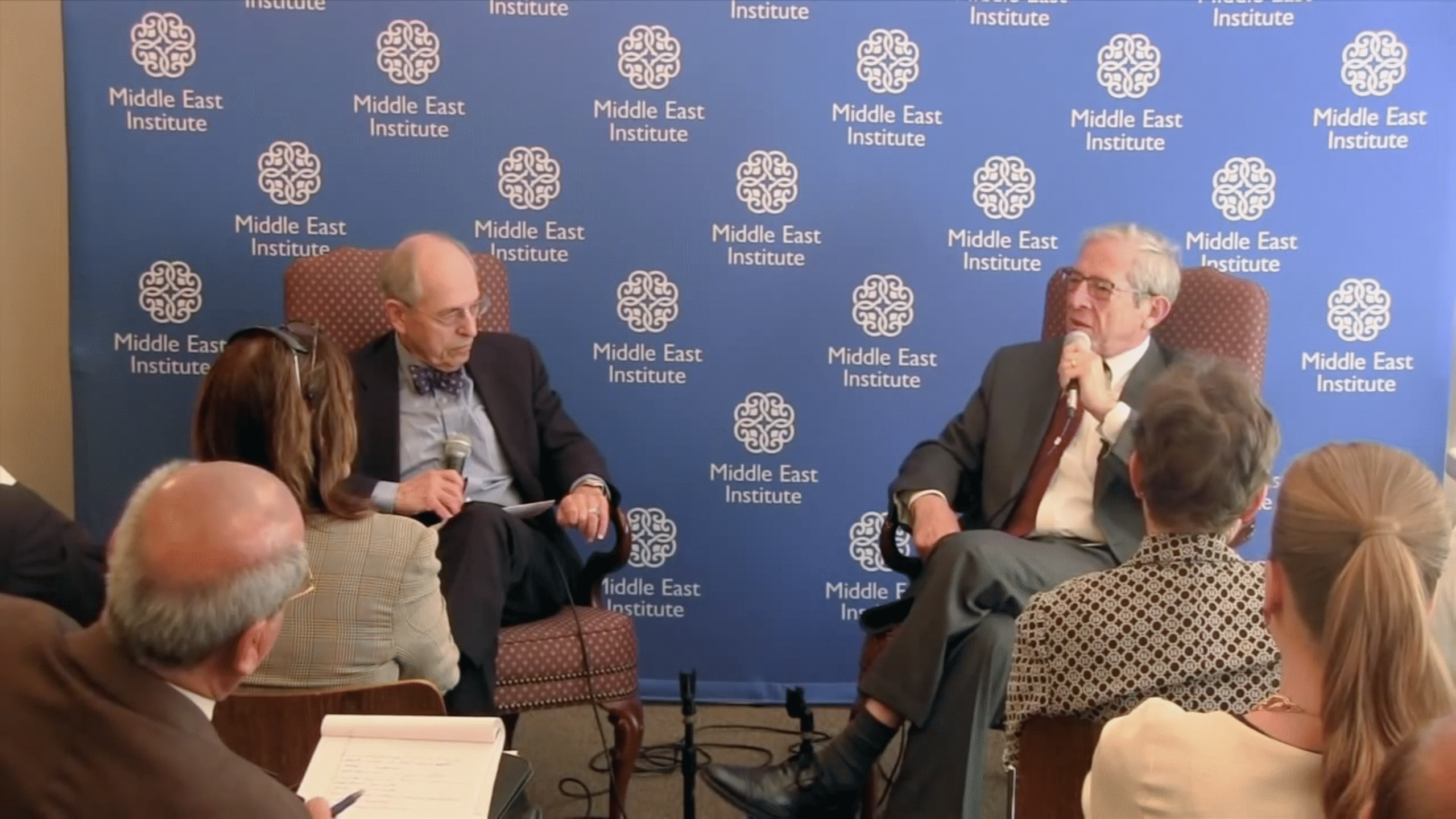
The Middle East Institute, The Foundation for Middle East Peace, Churches for Middle East Peace, and Americans for Peace Now Present Breaking the Silence, A book discussion with Avner Gvaryahu Author of Our Harsh Logic: Israeli Soldiers’ Testimonies from the Occupied Territories, 2000-2010 Moderated byAmb.
Author Stephen Cohen on the India-Pakistan Conundrum
The Middle East Institute is proud to host author and Brookings senior fellow Stephen P. Cohen for a reading and discussion of his book, Shooting for a Century: The India-Pakistan Conundrum (Brookings Institution Press, 2013). In his latest book, Dr. Cohen explores one of the most intractable conflicts in modern history and examines the parallels with the ongoing Israeli-Palestinian conflict, observing how nuclear weapons, minority and victim psychology, and outside powers come into play in both regions. Widely regarded as one of America’s foremost experts on South Asian affairs, Dr.
Over the past two decades, Dubai has risen to become a global financial, commercial shipping, aviation, and art hub. These essays examine Dubai’s key role in revitalizing the historic ties between the countries of the Middle East and Asia-Pacific regions.
Gulf Governments Offer Financing for U.S. Strike on Syria
Like pieces fitting together in a jigsaw puzzle, Arab governments – presumably from the oil-rich Gulf Cooperation Council – offered to finance a U.S. military strike on Syria, according to comments made by Secretary of State John Kerry during testimony September 4 with the House Foreign Affairs Committee. In an exchange with Representative Ileana Ros-Lehtinen (R-FL) on the potential cost of U.S. military action in Syria, Kerry said,
Since the 1970s oil boom, the Gulf region has been one of the principal destinations for workers from South Asia, with the result that today Indians constitute a large percentage of the non-nationals living in the region. Indeed, at five million out of an estimated 15 million people, the Indian community forms the largest expatriate group in each of the Gulf countries. Most Indian immigrants are from the south Indian state of Kerala, while many of the rest originate from Tamil Nadu, Punjab, Uttar Pradesh, and Bihar.
The dramatic events of July 3, which saw the unseating of Egypt’s first and only democratically-elected government by a military coup stimulated by enormous popular demonstrations, has created a huge question mark as to the future governance of the Arab world’s largest and most important country. The ramifications and repercussions will be playing out for months and years, whatever steps are taken in the next days and weeks. However, two parties acutely affected by these events are watching with particular concern.
Malaysia and the GCC Countries: Fertile Ground for Further Expansion of the Takaful Industry
The Takaful industry has expanded rapidly in recent years.[1] In 2011, the industry recorded 19% higher growth than in the previous year. Takaful is generally regarded as a profitable product with ample growth potential. With strong support from industry players, government institutions and increasing awareness among customers, the Takaful industry is expected to develop further in the coming years.
Asia-Gulf Economic Relations in the 21st Century: The Local to Global Transformation
Asia constitutes the hub of the transformation of global economic power today. The Gulf, itself part of Asia, is of increasing importance in this transformation. This book documents the growing interactions between the economies of the Gulf states and those of the rest of Asia. These relationships are critical to how the world economy develops over the next decade, and how economic (and perhaps strategic) power is distributed.
Malaysia: A Base for the Growing Asia-Middle East Market?
With the shift in the direction of Gulf Cooperation Council (GCC) countries’ trade from the West to Asia and the emphasis on the “Islamic connection” by Malaysia and many of its Middle Eastern counterparts, Malaysia-GCC economic cooperation appears to be gaining momentum. Malaysia’s strategic location at the center of Southeast Asia and the need for as well as the apparent determination of Malaysia and the GCC countries to diversify their export markets could provide the impetus for this partnership to flourish.
Security Challenges in a Two-State Solution: Is an International Role the Key?
…in any peace agreement, the Palestinian area must be demilitarized. No army, no control of air space. Real effective measures to prevent arms coming in, not what’s going on now in Gaza. Israel must govern its own fate and security. (Prime Minister Benjamin Netanyahu, June 14, 2009)[1]