
Cultural Body Maps, Schemata, and the Art & Essay Contest
Originally posted June 2011
If there is a Horizontal Line that runs from the MAP off your body straight through the Land shooting up right through my heart Will this Horizontal Line when asked know how to find Where you end where I begin
— Tori Amos[1]
Turkish Policy towards Iran: What is at Stake?
In the wake of the recent Nuclear Security Summit in Washington DC, Turkish-Iranian relations once again came under scrutiny. As the US and the EU have intensified their efforts to impose sanctions on Iran through the UN Security Council, Turkey’s role in this issue has come into question. Notwithstanding Turkish temporary membership in the Security Council, the Turkish position will be critical for any effective implementation of sanctions.
Turkey and the Arab Spring
*This article originally appeared in the Project Syndicate online on May 23, 2011.
As the Arab Spring enters its fourth month, it faces challenges but also presents opportunities. Despite setbacks in Libya, Yemen, and Syria, the democratic wave has already begun to change the Middle East’s political landscape.
The Upcoming Turkish Elections: Implications for Domestic and Foreign Policy
The Middle East Institute's Center for Turkish Studies is proud to host Mr.Taha Ozhan, Director General of the Foundation for Political, Economic and Social Research (SETA Ankara), for a discussion on Turkey's upcoming elections on June 12.
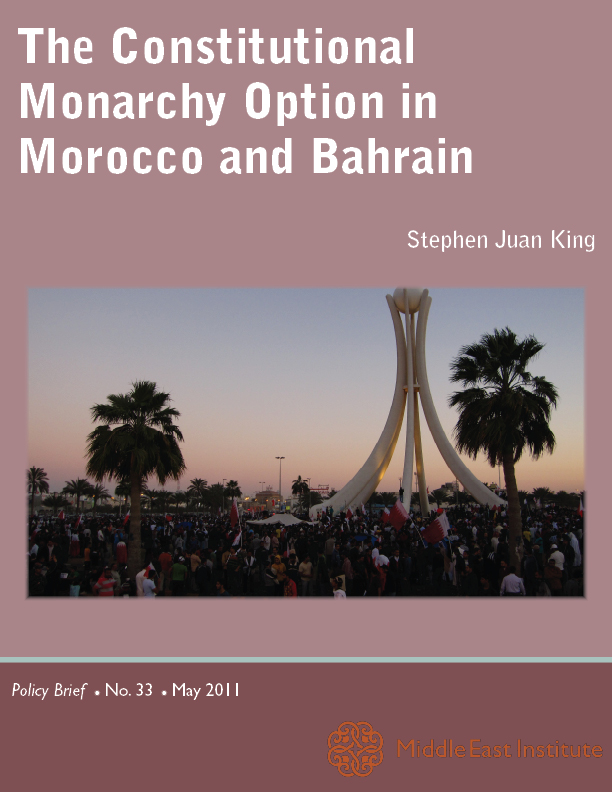
The Constitutional Monarchy Option in Morocco and Bahrain
Originally posted May 2011
Turkey as an Alternative Democratization Model for the Middle East
The popular uprisings against authoritarian regimes in Tunisia, Yemen, Jordan and Egypt herald the beginning of a new political era in the Middle East. At the center of this new political order is a generation of young Arabs, educated, highly marginalized, and numerous. The members of the so-called Arab “youth bulge” are demanding neither the unification of the Arab world as espoused by the pan-Arabists of the 1960s, nor an Islamic state of the 1980s, but rather a dignified life, social justice, and freedom.
Why Turkey Is Not Turning Islamist
This Commentary first appeared as an op-ed in Foreign Policy's Middle East Channel on December 21, 2010
Kān Yāmā Kān: Curriculum Development in the GCC – Adopting (Adapting) Models of Higher Education
Once upon a time in the land where the light of creation first shone, the fertile grounds around Baghdad nurtured the House of Wisdom.[1] Even as Europeans were looking for the light at the end of the Dark Ages, Caliph Haroon al-Rasheed and his son Caliph al-Mamoon had made Baghdad a center of learning. In Baghdad, scholars put words on “real” paper. They preserved Aristotle, Plato, Hippocrates, Euclid, Ptolemy, Pythagoras, and Brahmagupta and translated Greek, Persian, and Indian manuscripts.
Creating a Legacy of Understanding: The Istanbul Center of Atlanta's Art and Essay Contest
Originally posted December, 2010

Turkey's Dual Track Approach Toward the Kurdistan Regional Government
Turkey’s policy toward the Kurdistan Regional Government (KRG) in northern Iraq has undergone an important shift since 2009. Only a few years ago, Turkey did not recognize Iraq’s Kurdish Regional Government and refused to meet with its representatives in any official capacity due to its fear that recognition would embolden Turkey's own Kurdish minority to demand similar home-rule status.
Women’s Education in the GCC — The Road Ahead
Women’s education in the Arab world has increased substantially in the last several decades, both in absolute terms and relative to men. However, when looking at the Arab world, understanding that there are vast differences culturally, politically, and socially among the countries is essential. This essay looks at the Gulf Cooperation Council (GCC) countries, where women share a similar cultural and socio-economic context.
Rebuilding Security in the Persian Gulf
The Middle East Institute is proud to host Ambassador Robert E. Hunter, Senior Adviser at the RAND Corporation, to present a new study that lays out the criteria and parameters for a new security structure for the Persian Gulf region. His recent study, Building Security in the Persian Gulf, makes recommendations for a new security structure for the region in order to promote long-term stability while also reducing
Turkey's Chance for Reconciliation
This piece first appeared as a op-ed in Foreign Policy's Middle East Channel on September 9, 2010