This Opinion first appeared in the Huffington Post on November 11, 2011
On November 28th, millions of Egyptians will finally breathe a deep sigh of relief as they gather at the polls to vote in the first phase of parliamentary elections following the ousting of the Mubarak regime.
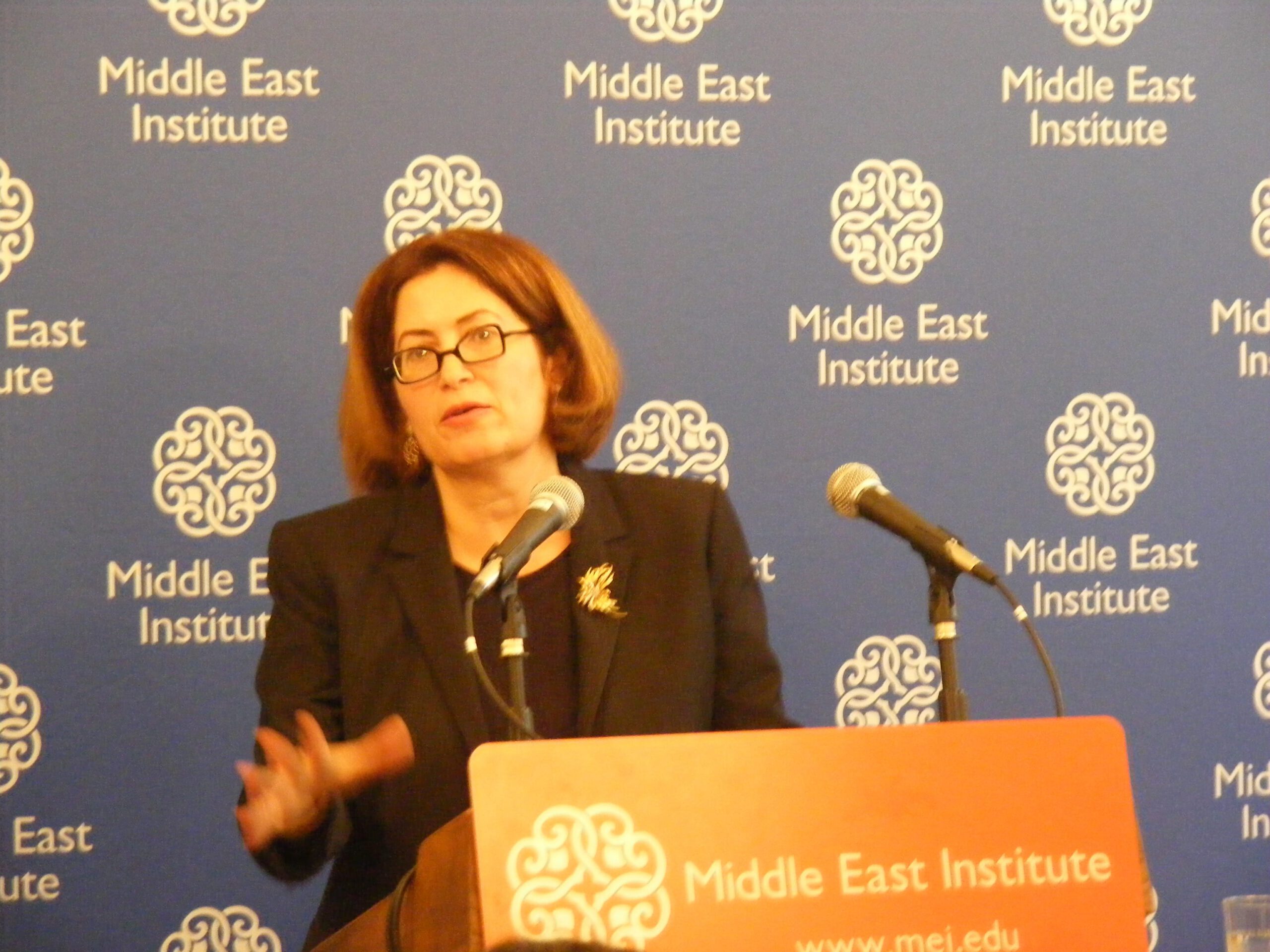
MEI scholar Randa Slim led a discussion about Hezbollah and its reaction to shifting regional dynamics in the wake of the Arab Spring. Although Lebanon has not experienced the same levels of unrest as its neighbors, Hezbollah is not immune from the regional instability resulting from the revolutions roiling the Middle East. Hezbollah is currently the principal orchestrator of a new governing coalition that is rife with internal divisions.
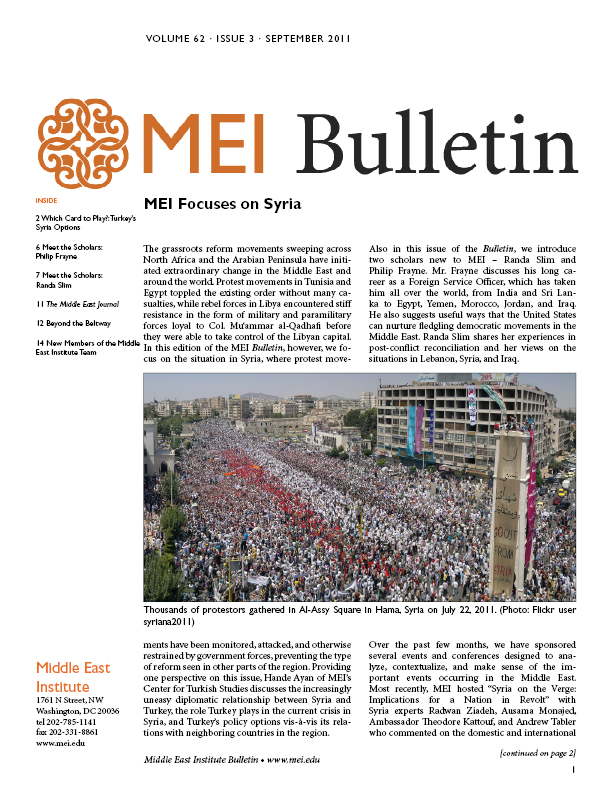
Amidst ongoing violence against protestors in Syria, Hande Ayan of the Center for Turkish Studies discusses the uneasy diplomatic relationship between Turkey and Syria and Turkey’s role in the political situation there. The September 2011 Bulletin also introduces MEI scholars Philip Frayne, who speaks on his Foreign Service career and offers his insights on how the US can support democratic transitions in the Middle East, and Randa Slim, who is interviewed on her experience in post-conflict reconciliation.
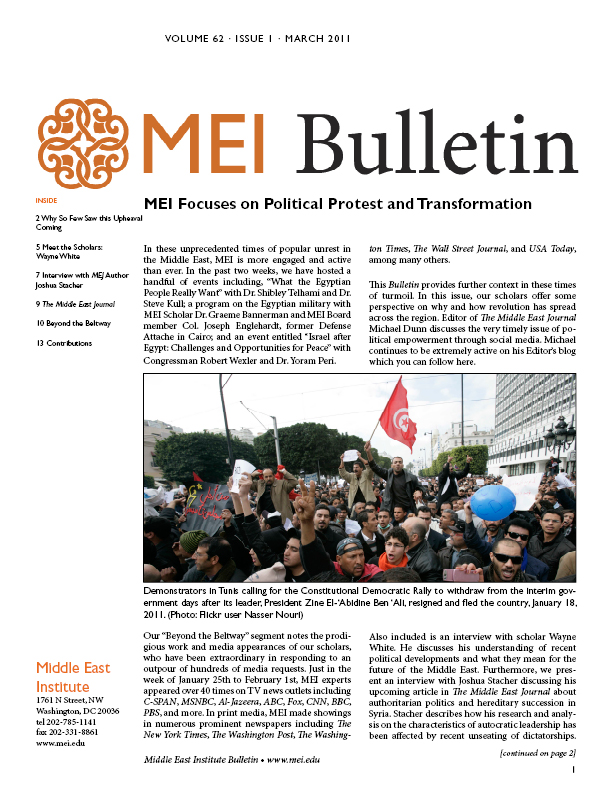
Amidst the historic turmoil sweeping across the Arab world, in the March 2011 Bulletin, MEJ editor Michael Dunn addresses political empowerment through social media, scholar Wayne White is interviewed on recent political developments, and Joshua Stacher previews his forthcoming article on authoritarian politics and hereditary succession in Syria.
Women, Shari‘a, and Personal Status Law Reform in Egypt after the Revolution
Like almost everything else during the uncertain period of the transitional government, the future of personal status law reform is at a crossroads in Egypt. The new constitution (assuming one will exist)[1] may technically have little direct impact on how the country’s laws affect women’s lives, but the legislative process that emerges thereafter most certainly will.
Governments in the Middle East and North Africa have long relied on repression to intimidate, harass, and punish political opponents. During the Arab uprisings, dictators under threat have all ordered and used violence against peaceful protestors as a way to maintain power. But this repression has had widely divergent effects on the course of the different conflicts.
Building an Addiction Workforce in the Middle East: A Counselor Training Program Partnership Between Kasr Al-Ainy and UCLA
Drug and alcohol problems know no borders. Annually, the United Nations World Drug Report documents that heroin, methamphetamine, cocaine, alcohol, and prescription drugs negatively impact public health, public safety, and social institutions in countries around the world.[1] In many parts of the Middle East, there is limited data on the nature and extent of alcohol and drug problems.
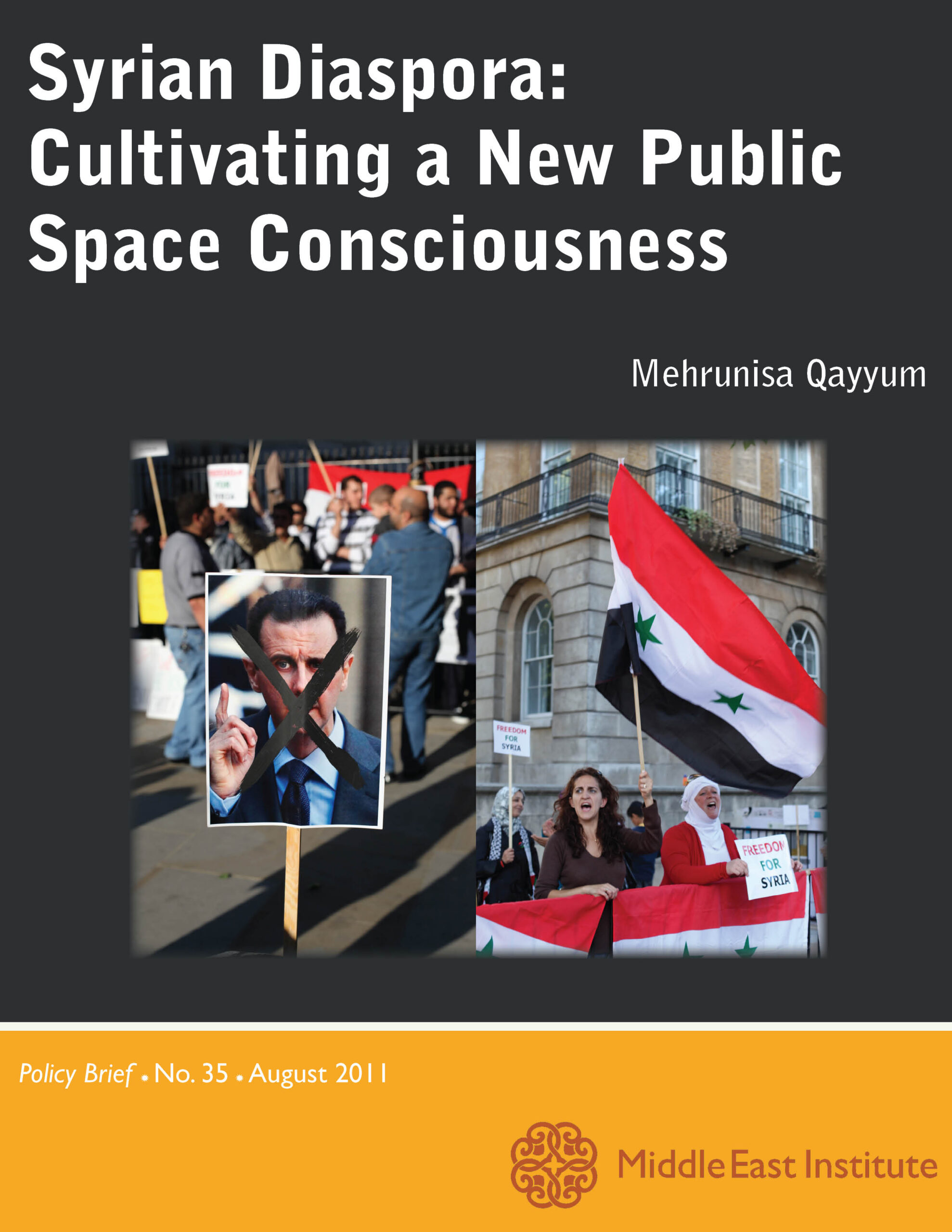
Syrian Diaspora: Cultivating a New Public Space Consciousness
The Syrian government under both Hafiz and Bashar al-Asad has long pursued a strategy of intimidation and violence against political dissidents, while imposing legal and security structures that inhibit the growth of civil society. The resulting profound vacuum of civil society has made organizing for political change, both inside and outside of Syria, extremely difficult. Furthermore, this overall strategy of intimidation has led to “brain drain” as large numbers of highly educated Syrians flee to other countries.
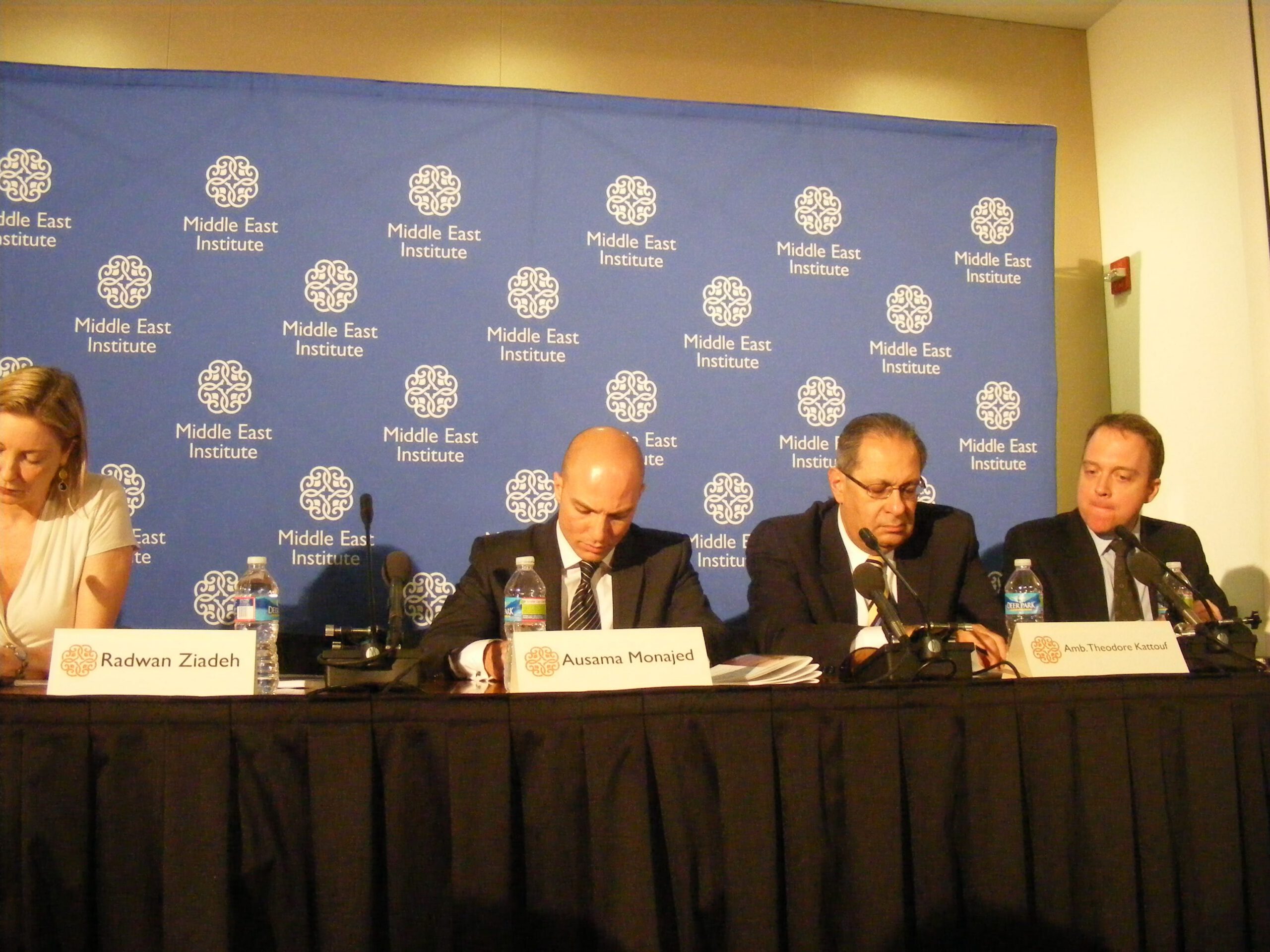
Syria on the Verge: Implications for a Nation in Revolt
The Middle East Institute is honored to host Syria experts Radwan Ziadeh, Ausama Monajed, Amb. Theodore Kattouf, and Andrew Tabler for a panel discussion about the domestic and regional implications of the ongoing political unrest and violence in Syria. With protests continuing to rock Syria for the sixth month, the Assad government recently introduced a law allowing the formation of independent parties. But protesters say it's too little too late and point to the government's ongoing crackdown.
Supporting Democratic Movements in the Arab World: An Economist's Perspective
The global community was surprised by the suddenness and intensity of democratic movements in the Arab countries. While universally welcomed, the global response in support of these movements has so far been reactive, uncertain, and slow to build up. The only coherent rendering of such an initiative is the declaration of Deauville Partnership by the Group of 8 countries on May26-27, 2011.
Egypt's Revolutionary Elite and the Silent Majority
It was a small group that set out on January 25, marching on National Police Day to decry the quotidian indignities they suffered at the hands of Husni Mubarak’s abusive police. Public protest in Egypt had long been a minority practice, rarely mustering more than a few hundred, or at best a few thousand, core movement activists. The organizers of the January 25 march expected the same base of dedicated demonstrators, and were shocked when the crowd swelled to more than 10,000.
Looking across the Middle East and North Africa (MENA), there is a real fear that both reform movements and revolutions risk snatching defeat from the jaws of victory. The momentum that made so many inspirational gains a few months ago is slowing, and the forces of conservatism remain in control. The only hope is that stamina, vigilance, and strategy will lead to a complete transition to democracy in at least one of the region’s countries. Not one revolution has yet been completed. If such a success is to happen soon, I hope it will be in Egypt.