More than three decades after the Revolution of 1979, the Islamic Republic of Iran Army [Artesh-e Jomhouri-ye Eslami-ye Iran] and the Islamic Revolutionary Guard Corps [Sepah-e Pasdaran-e Enqelab-e Eslami] (IRGC), remain entangled in a state of fierce rivalry.
Much attention has been given to the IRGC’s asymmetric defense capabilities, its role in Iraq’s post-2003 insurgency, and its alleged hold over the Strait of Hormuz, but there is little scrutiny in open source literature on the significance of the Iranian Army (Artesh) to Iran’s national security.
Since its inception in 1979, the Islamic Republic of Iran (IRI) has duplicated almost all state institutions. It retained the institutions that existed under the old regime while creating new Islamic agencies to perform the same tasks. The Iranian armed forces did not escape this process. Under the monarchy, the armed forces were called the Artesh Shahanshahi or Imperial Army. Although called the “Army,” or Artesh, the force consisted of the three main services (army, navy, and air force) plus the Imperial Guard Divisions (Gard-e Javidan) and the Army Aviation Command (Hawa Nirouz).
In an official gathering in December 2010, Major General Attollah Salehi, Commander-in-Chief of the Iranian Army said that during his visits to Army barracks, he would see the pictures of the leaders of the “sedition” (The Islamic Republic’s present hard-line leadership refers to opposition leaders and 2009 presidential candidates Mir Hossein Moussavi and Mehdi Karrubi as leaders of sedition) hanging on the walls.
Along with Egypt and Turkey, Iran is one of the most populous countries in the Middle East. Aware of its strategic significance and millennium-long civilization, Iranian leaders have always aspired to assume a leadership role on regional and international issues and pursued an assertive policy to reach their country’s potential. This ambitious strategy requires, among other things, strong military forces.
The Artesh: Iran’s Marginalized and Under-Armed Conventional Military
Originally posted November, 2011
Ravaged, intimidated, and gutted to the core in a series of purges after the 1979 Revolution, the remnant of the Shah’s military, renamed the Army of the Islamic Republic of Iran, known generally in Persian as the Artesh, put itself together as best as it could to face invading Iraqi forces at the beginning of the Iran-Iraq war.
Iran’s conventional military forces — ground, air, and naval — once stood tall as the best armed military forces in the Middle East aside from those of Israel. The United States lavished the most sophisticated military hardware on the Shah, who was willing and able to tap his financial resources from Iran’s oil wealth to buy modern conventional arms. The Shah had the ambition, the financial means, and the political-military backing of the United States to turn Iran into the Persian Gulf’s most formidable military power.
A United States Marine's View of the Artesh and IRGC
United States military forces use standard procedures for planning operations against other militaries. These procedures differentiate between different branches, or units, of an opposing force depending on their capabilities and limitations. This article presents one such analysis of the Iranian Military, where there are vast differences between the Islamic Revolutionary Guard Corps (IRGC)and the Artesh, or the regular Iranian armed forces. The article then draws parallels to the planning for Operation Iraqi Freedom that led to the defeat of the Iraqi Republican Guard and regular Iraqi
As the United States and its allies have tightened sanctions on Iran, they have sought in particular to isolate the Islamic Revolutionary Guard Corps, the regime’s most aggressive institution. The IRGC, known in Persian as the Pasdaran, fields its own army, navy, and air force, and dominate a large and increasing share of Iran’s national economy.
Iran’s regular military, the Artesh, receives virtually no attention from international media or scholars on Iran. By contrast, its political rival, the Islamic Revolutionary Guard Corps (IRGC, also known in Persian as the Pasdaran), is scrutinized constantly by analysts for its visible, high-profile role in Iran’s political system, its economic resources and corporate activities, and its role as a spearhead of Iran’s regional policies.
Introduction to The Artesh: Iran's Marginalized Regular Military
As the US-Iran showdown continues, among Western analysts there is an infinite desire for more data and analysis relating to the workings of the Islamic Republic. From a US standpoint, a better understanding of the various organs and players in the Iranian regime setup is imperative as Washington weighs its options and sets out to formulate its policies.
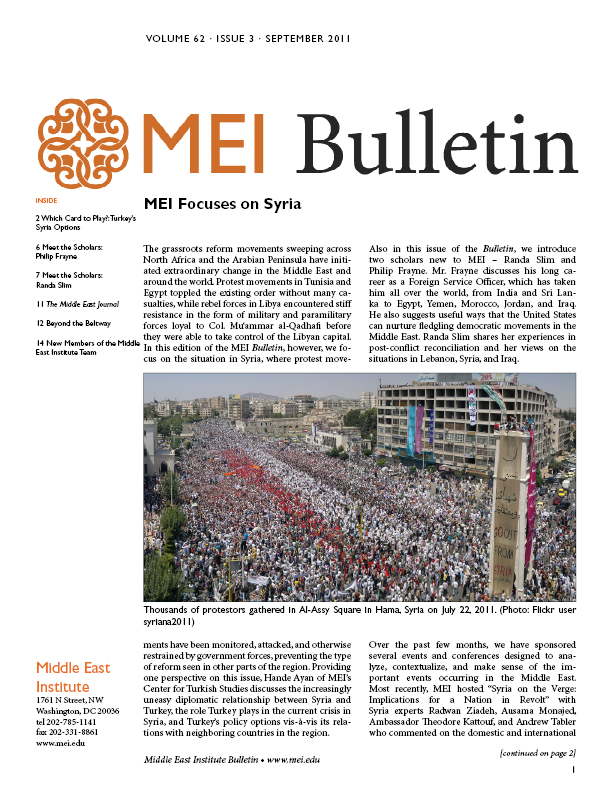
MEI scholar Randa Slim led a discussion about Hezbollah and its reaction to shifting regional dynamics in the wake of the Arab Spring. Although Lebanon has not experienced the same levels of unrest as its neighbors, Hezbollah is not immune from the regional instability resulting from the revolutions roiling the Middle East. Hezbollah is currently the principal orchestrator of a new governing coalition that is rife with internal divisions.
Amidst ongoing violence against protestors in Syria, Hande Ayan of the Center for Turkish Studies discusses the uneasy diplomatic relationship between Turkey and Syria and Turkey’s role in the political situation there. The September 2011 Bulletin also introduces MEI scholars Philip Frayne, who speaks on his Foreign Service career and offers his insights on how the US can support democratic transitions in the Middle East, and Randa Slim, who is interviewed on her experience in post-conflict reconciliation.