Iran's Foreign Policy and the Iran-Pakistan-India Gas Pipeline
Shortly after the revolution in 1979, Iran somewhat irrationally distanced itself from the international community. Partly because of revolutionary fervor, Iran initially made itself vulnerable. The American hostage crisis and the eight-year war with Iraq exposed Iran to economic hardship and international isolation.
European governments initially reacted to Iran’s Islamic revolution by a careful testing of the ground with the new regime. But relations deteriorated quickly, as Iran accused some European countries of siding with Iraq in the Iran-Iraq War and Iranian agents killed Iranian opposition figures in European capitals.
Almost immediately after the triumph of the Islamic revolution, Ayatollah Khomeini and the new Iranian leadership turned against Saudi Arabia and its ruling family.
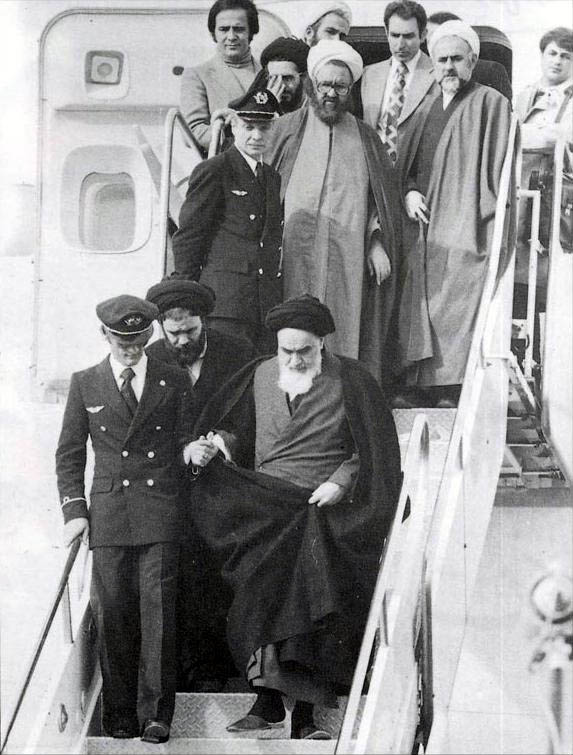
When Iran’s 1979 revolution took place, many Iranians predicted that relations between Iran and France would improve in an unprecedented way. Ayatollah Ruhollah Khomeini, the founder of the Islamic Republic, spent the last four months of his 14-year in exile in France. The revolutionaries in Tehran lauded French leaders for being hospitable toward their spiritual leader. They had no hatred of France, which lacked colonialist aspirations regarding Iran.
The Spectrum of Perceptions in Iran's Nuclear Issue
The relationship between Iran and the West has been marked by mutual mistrust and confrontation for the past 30 years. Iran’s nuclear standoff with Western countries is currently regarded as the main symbol of that confrontational relationship. Iran insists that its nuclear program is exclusively peaceful, while Western countries are suspicious of Tehran’s intentions. There are polarized and incompatible views about this complicated and multidimensional issue. The main source of incompatibility is that this issue is seen from different perspectives.
As one of the most important events of the past three decades in the Middle East, the Islamic Revolution not only has sustained itself, but the Islamic Republic which it spawned celebrated its 30th anniversary in February 2009.
The revolution of February 1979 was a revolt of the society against the state. In some of its basic characteristics, the revolution did not conform to the usual norms of Western revolutions, because the state did not represent just an ordinary dictatorship but an absolute and arbitrary system that lacked political legitimacy and a social base virtually across the whole of the society.
How the New Arab Media Challenges the Arab Militaries: The Case of the War between Israel and Hizbullah in 2006
One, Two / the Arab army where are you?/ The Arab army where are you?/The Egyptian Arab Army/ resides in an-Nasr [victory] compound/ Wakes up in the afternoon/ to drink its tea/ The Gulf Arab army/ can do absolutely nothing/ “Strategic silence” indeed/ “cut us some slack, man!”/ The Tunisian Arab army/ is green like parsley/ But ‘Aziza loves Yunis/ the wars can wait/ The Sudanese Arab army/ I can hear its clamor in my ears/ “Damn it!
The Jordan Valley is a lush, wetland ecosystem that is the biological heart of the Middle East region at large. As the meeting point of the Asian, African, and European continents, the valley is at the crossroads of biodiversity. In addition to the unique flora and fauna, the valley is one of the world’s most important migratory pathways for birds. Over 500 million birds migrate from Europe to Africa twice a year, dependent on the Jordan Valley as a stopping ground on their long journey.
Within a mere few years after World War II the Middle East was remade. The creation of the State of Israel in 1948 and its consequences helped propel that part of the world to what seems to be a permanent and unenviable spot on any list of world crises.
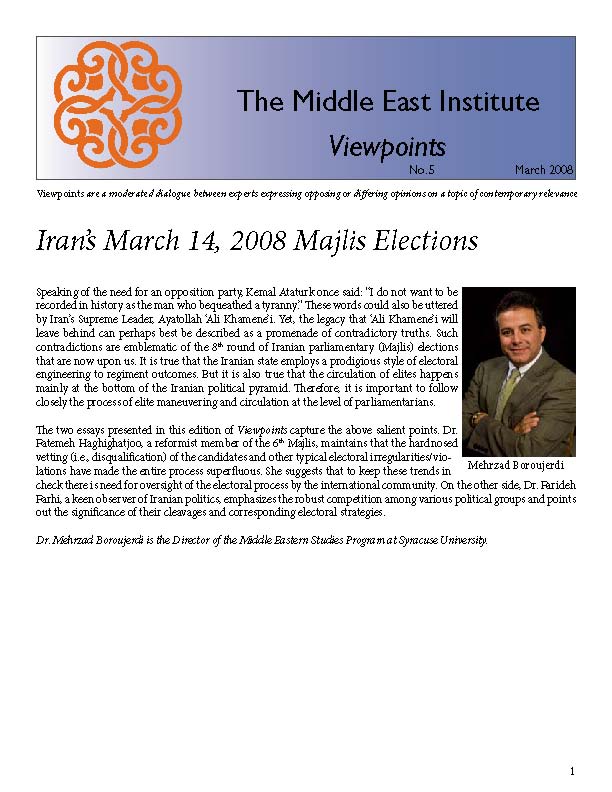
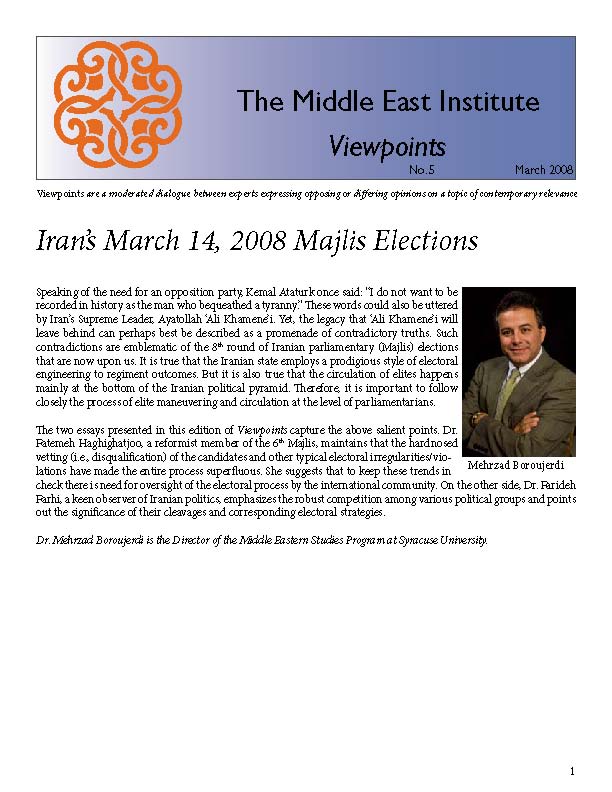
One of the strangest features of contemporary Iranian politics must surely be the reality that despite the concerted and successful effort to narrow the range of candidates allowed to run for various political offices, competition among individuals and groups has not only remained unabated, it has intensified. The elite jockeying that has taken place in the past few months, leading to the upcoming March 14 Majlis elections, is a good example of the competitive intensity that had come to characterize Iranian politics.