The Middle East Institute Remembers Anthony Shadid
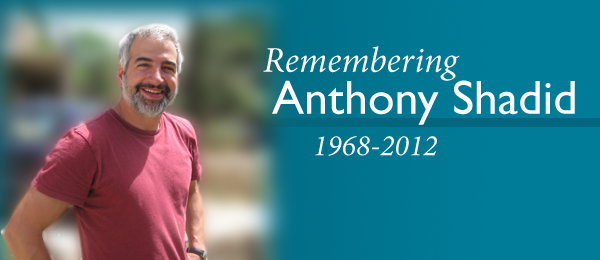
The Middle East Institute is deeply saddened by the untimely death of Anthony Shadid, the Pulitzer Prize-winning journalist who covered the Middle East for the Boston Globe, Washington Post, and most recently the New York Times. Shadid died of an apparent asthma attack while on assignment in Syria. His insightful, humane reporting on the Middle East painted an uncommonly nuanced portrait of a region and people in turmoil, and will be sorely missed. Shadid's death is a terrible loss for journalism and the Middle East community.
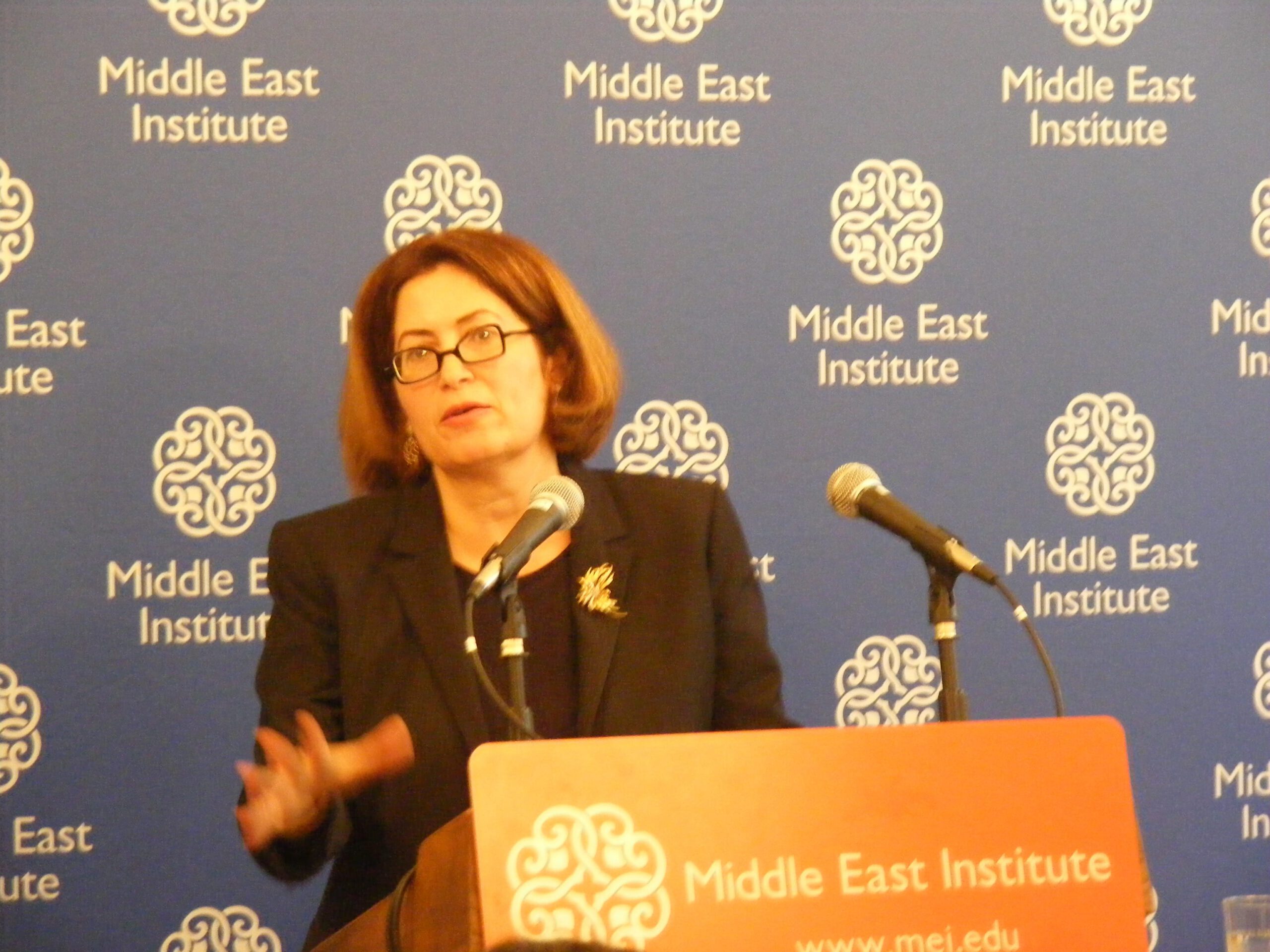
MEI scholar Randa Slim led a discussion about Hezbollah and its reaction to shifting regional dynamics in the wake of the Arab Spring. Although Lebanon has not experienced the same levels of unrest as its neighbors, Hezbollah is not immune from the regional instability resulting from the revolutions roiling the Middle East. Hezbollah is currently the principal orchestrator of a new governing coalition that is rife with internal divisions.
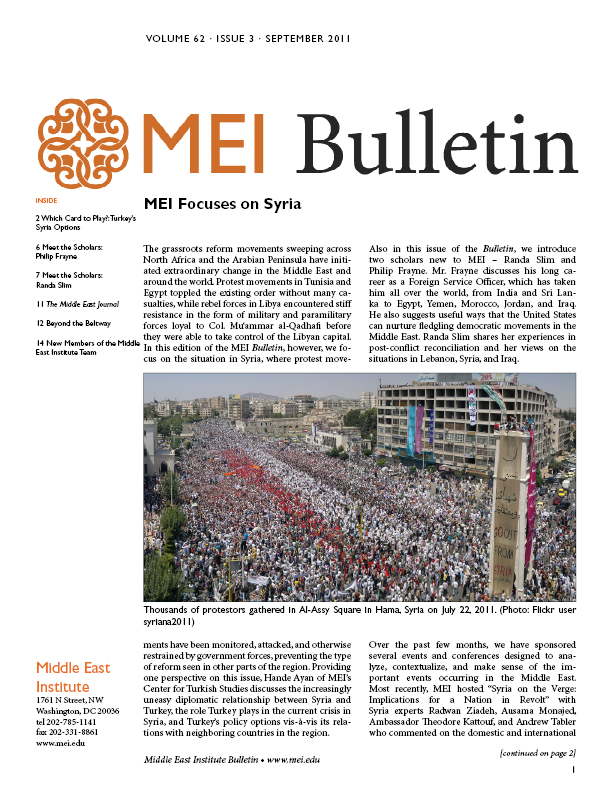
Amidst ongoing violence against protestors in Syria, Hande Ayan of the Center for Turkish Studies discusses the uneasy diplomatic relationship between Turkey and Syria and Turkey’s role in the political situation there. The September 2011 Bulletin also introduces MEI scholars Philip Frayne, who speaks on his Foreign Service career and offers his insights on how the US can support democratic transitions in the Middle East, and Randa Slim, who is interviewed on her experience in post-conflict reconciliation.
This Burning Land: Lessons from the Front Lines of the Transformed Israeli-Palestinian Conflict
The Middle East Institute is proud to host Greg Myre and Jennifer Griffin for a discussion about the ongoing challenges in the Israeli-Palestinian conflict based on their knowledge and experiences recounted in their new book, This Burning Land: Lessons from the Front Lines of the Transformed Israeli-Palestinian Conflict. Myre and Griffin, journalists who are husband and wife, traveled to Jerusalem in 1999 in hopes of finally seeing Middle East peace. Instead, the pair watched as violence in the area escalated and the peace process disintegrated.
The Obama administration's efforts to win a settlement freeze as a confidence-building measure have failed, and the U.S.has not presented a new vision for resuming the moribund peace process. Nevertheless, many analysts now recommend shifting the diplomatic focus to negotiations to define the border between Israel and the future state of Palestine. Resolving the border would address the issues of settlements and Jerusalem as well as potential land swaps between the two states.
Travelogue of a Nigerian Codesria Laureate in Lebanon (January–July 2006, July–November 2008)
On December 18th 2004, I discovered the Lebanese Emigration Research Centre (LERC), Notre Dame University, Zouk over the internet while searching for a post-doctoral research fellowship program on Lebanese studies in either Australia or New Zealand. I contacted the Director, Guita Hourani, who was instrumental in my winning the Codesria post-doctoral fellowship award. Elated, I departed for Beirut, Lebanon on February 21, 2006.
A Generation in Crisis: Lebanon's Jobless University Graduates
Unemployment is one of the major manifestations of the global economic crisis that began to plague many countries around the globe, beginning in 2007. Developing nations with weak economies and fragile political states were among the hardest hit. In Egypt, one can find PhDs driving taxies. No country can afford, either politically or economically, such well-educated traffic guides. Higher education graduate unemployment rates in Lebanon are high and are unlikely to be reduced soon.