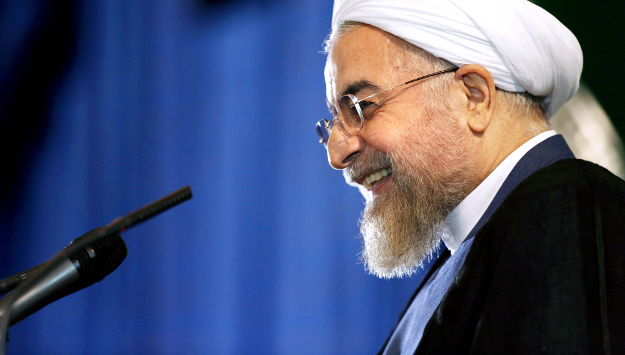
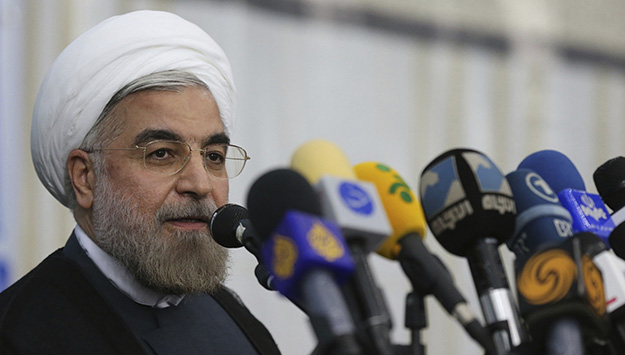
After a year of hesitation, Iranian president Hassan Rouhani is signaling his readiness to reach out to Tehran’s chief regional rival—Saudi Arabia. Last week, a top official was sent to Riyadh; he was the most senior Iranian visitor to the country since Rouhani’s election in June 2013.
This week’s visit to Tehran by the Kuwaiti emir, Sheik Sabah al-Ahmad al-Sabah, is about more than Iranian-Kuwaiti relations. It might even be a pivotal moment in the shaping of Iran’s ties with the Arab countries across the Gulf. Kuwait, which currently holds the rotating presidency of the Gulf Cooperation Council (GCC), is acting as a conduit for the collective unease that the GCC’s six member states, particularly Saudi Arabia, have about Iran’s regional policies.
Geography alone should make the Arab world Iran’s key foreign policy focus. Of Iran’s 13 immediate neighbors, seven are Arab countries.[1] But Tehran’s approach to the Arab world, with its 22 states extending from North Africa to the Arabian Peninsula, varies widely in intensity, and Iran’s objectives are equally varied depending on the country in question.
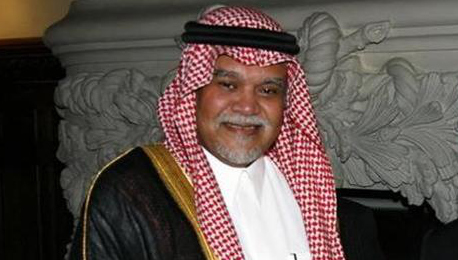
It might be a mistake to jump to conclusions about the removal of Prince Bandar bin Sultan from his post as chief of Saudi Arabian intelligence. When it comes to senior jobs held by the royals, the Kingdom’s decision-making process is entirely opaque and there is no way to know at this point whether the flamboyant former ambassador to the United States was pushed out or bailed out.
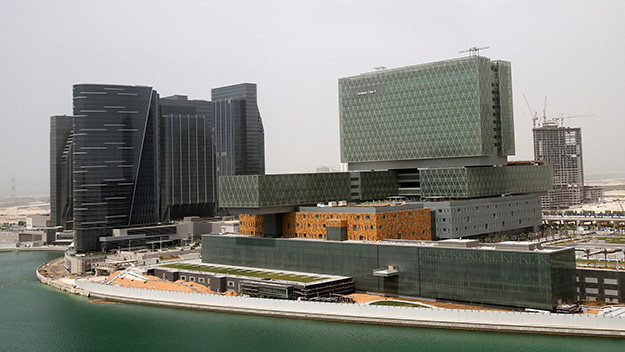
Most outsiders know the United Arab Emirates from Dubai’s accomplishments in international commerce, tourism, and indoor skiing. What is less known is that Abu Dhabi is investing a great deal of money in education, medicine, art, and music as a new kind of cultural diplomacy.
Osama bin Laden may be dead, but his ghost was in Riyadh the other day, hovering over Saudi Arabia’s King Abdullah as he issued a decree making it a crime for any Saudi citizen to take part in a war outside the kingdom.
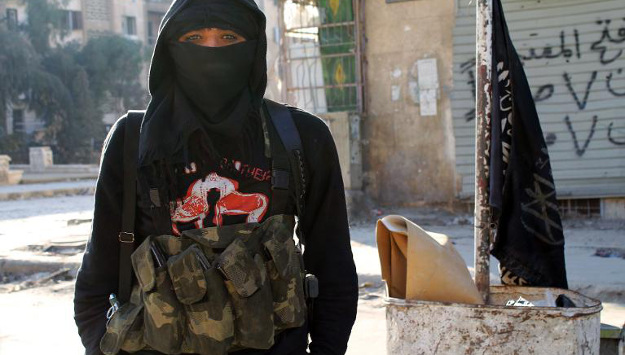
The obvious motivator was the civil war in Syria, where hundreds of young Saudis have been spotted in the ranks of the most radical jihadi groups battling both the government and other less extreme rebels. But the roots of the king’s action, and the problem it was designed to address, can be traced to the 1980s war against the Soviet occupation of Afghanistan.
Saudi Arabia & the Arab Gulf’s Disappointment with U.S. Policy
Whether Saudi Arabia takes a seat on the United Nations Security Council or not, the initial snub is aimed primarily at the United States. In particular, U.S.-Saudi relations are in for an exceptionally difficult period—perhaps a return to the policies of King Faisal bin Abdulaziz. It appears that Saudi Arabia and the Arab Gulf now share the view of Sir Charles Johnston, a British diplomat in the 1960s, who offered the following assessment of U.S.
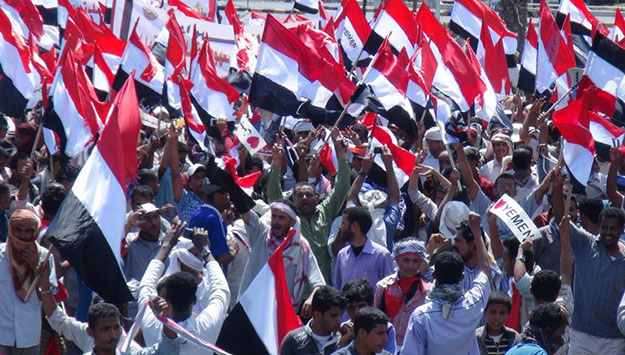
Last week, MEI scholars Allen Keiswetter, a retired Foreign Service officer, David Newton, former ambassador to Yemen, and Roby Barrett, author of Yemen: A Different Political Paradigm in Context(2011), gathered for an informal discussion about Yemen’s National Dialogue Conference (NDC), which began in March.
The openly difficult relationship between Saudi Arabia and Muslim Brotherhood chapters across the region has become a salient feature of Middle East politics since the advent of the “Arab Spring.” This mutual mistrust has increased in the wake of the Kingdom’s recent support for the military takeover in Cairo and the generals’ subsequent repression of the Brotherhood there. But how is the Islamist organization affected by this dynamic in Syria, where the Muslim Brothers and the Saudis both battle against Bashar al-Assad?
Over the past two decades, Dubai has risen to become a global financial, commercial shipping, aviation, and art hub. These essays examine Dubai’s key role in revitalizing the historic ties between the countries of the Middle East and Asia-Pacific regions.
Whenever a Saudi Arabian king or senior prince publicly criticizes U.S. policy, they inevitably touch off speculation about how the Saudis may be rethinking their security alliance with the United States.
After the Financial Crisis: Dubai-China Economic Relations
Dubai is strategically located at a junction between Europe, Africa, and the Far East. For China, an emerging global leader in trade and international business, Dubai is a promising place in which to conduct business. Exploring Dubai-Sino economic relations beckons a more comprehensive understanding of both the level of Dubai’s economic diversification and the impact of the global financial crisis. Dubai’s private sector is extensively engaged in foreign trade, with an emphasis on the service industry. The service industry has three subsectors—tourism, finance, and real estate. Assessing the trajectory of China’s involvement in these three sectors of Dubai’s economy sheds light on how Dubai-Sino economic relations have been affected by the global financial crisis.
Gulf Governments Offer Financing for U.S. Strike on Syria
Like pieces fitting together in a jigsaw puzzle, Arab governments – presumably from the oil-rich Gulf Cooperation Council – offered to finance a U.S. military strike on Syria, according to comments made by Secretary of State John Kerry during testimony September 4 with the House Foreign Affairs Committee. In an exchange with Representative Ileana Ros-Lehtinen (R-FL) on the potential cost of U.S. military action in Syria, Kerry said,
“Open Doors; Open Minds”—the tagline of the Sheikh Mohammed Center for Cultural Understanding (SMCCU), a non-profit organization advocating awareness and understanding among the various cultures that live in Dubai—epitomizes Dubai’s emergence as an international trade and transit hub as well as a place of cultural symbiosis that hosts diverse nationalities from almost all corners of the globe.