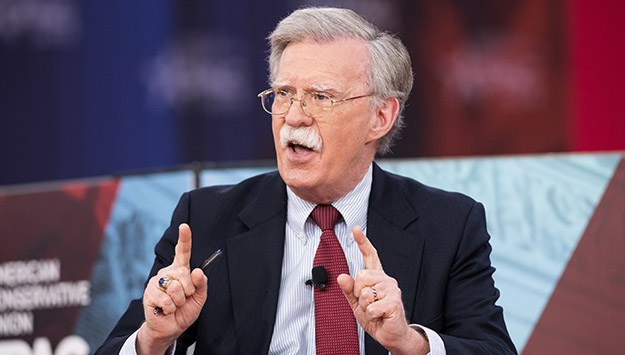
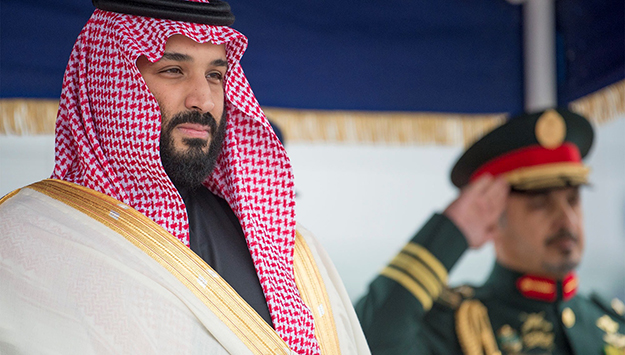
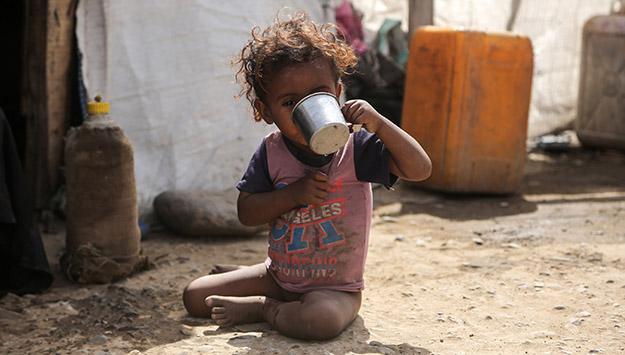
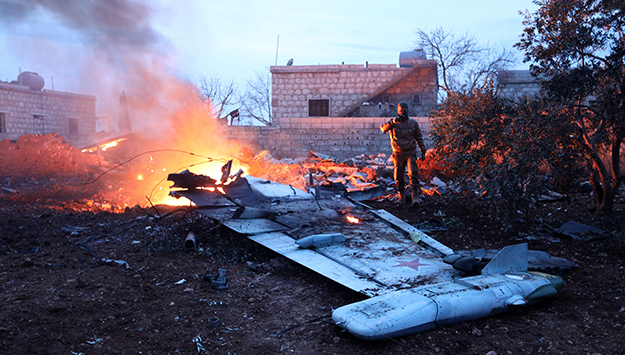
In this week’s Monday Briefing, MEI experts Paul Salem, Bilal Y. Saab, Gerald Feierstein, Gonul Tol, and Ibrahim al-Assil provide analysis on recent and upcoming events including the appointment of John Bolton to national security advisor, the Houthi missile attack on Riyadh, Egypt’s regressive referendum, the Yemeni war’s third anniversary, EU-Turkey diplomacy, and the worsening crisis in Ghouta.
Monday Briefing: Mohammed bin Salman’s American charm offensive
In this week’s Monday Briefing, MEI experts Gerald Feierstein, Paul Salem, Charles Lister, Jean-François Seznec, and Jonathan M. Winer provide analysis on recent and upcoming events including the shaping of U.S.-Saudi relations, Pompeo’s appointment to secretary of state, Turkey’s capture of Afrin, the future of Saudi energy, and Egypt’s efforts to unite the Libyan military.
Monday Briefing: Senate moves to end US engagement in Yemen conflict
In this week’s Monday Briefing, MEI experts Gerald Feierstein, Alex Vatanka, Nathan Stock, and Randa Slim provide analysis on recent and upcoming events including the Senate’s decision to pull out of Yemen, enduring Iran-Pakistan political strain, Egypt’s role in Palestinian reconciliation, and America’s dissolving influence in Syria.
The way forward for Palestine: Fatah, Hamas and Dahlan
As Palestinians confront U.S. President Donald Trump’s “deal of the century,” the debilitating effect of endemic, internal division within their ranks continues to define their domestic political landscape.
Sub-Saharan Africa must respect North Africa's water rights
The Middle East is the world’s most arid region and the one most dependent on renewable freshwater resources that originate outside its territories. These resources are largely contained in the Nile, Euphrates-Tigris, and Jordan river basins. An international law-based approach to transboundary watercourse development and management is vital for human security and regional stability. Applying legal principles in the Nile Basin is imperative, as unilateral actions by upstream countries can harm livelihoods on a large scale in downstream countries and destabilize their economies.
Reevaluating U.S. security assistance to the Middle East
Since 9/11, American security strategy has focused on building the military capabilities of global allies in order to advance shared goals and address joint threats. In the Middle East, the results of this approach have been mixed at best. Frustration over U.S. security assistance to the region has grown in Washington, as funding and arms transfers to various state and non-state partners have led to unintended consequences, prompting the Trump administration to reevaluate U.S. aid to Egypt, Pakistan, and the Palestinians.
Israel-Egypt gas deal: politics, or business as usual?
On Feb. 19, a consortium of oil companies led by the U.S.’s Noble Oil and Israel’s Delek signed a contract to supply the Egyptian energy company Dolphinus with up to 32 billion cubic meters of Israeli gas over ten years.
In January, President Donald Trump announced a major cut–$300 million–to the United Nations Relief and Works Agency (UNRWA). Since 1949, UNRWA has provided a critical lifeline to Palestinians displaced by war. Today, UNRWA supports 5 million Palestinian refugees.
Envisioning Palestine: strategies for Palestinian self-determination
Relations between the U.S. and the Palestinians are in free-fall. The Trump administration’s decisions to recognize Jerusalem as Israel’s capital and then cut funding to UNRWA to force the Palestinians back to the negotiating table have been met with mass protests and official recriminations. Meanwhile, peace has never seemed more distant, with a recent poll showing support for a two-state solution at a historic low among both Israelis and Palestinians.
China, Jerusalem and the Israeli-Palestinian Conflict
On the surface, the Chinese reaction to the US decision to effectively recognize Jerusalem as the capital of Israel was clear. Following President Trump’s announcement to transfer the US embassy to the Holy City on December 6, 2017. Several days later, China voted with every other member on the UN Security Council (UNSC) to uphold the international consensus and previous UN decisions on Jerusalem. By going against world opinion, the US arguably looked out of step in relation to the conflict. By contrast, China’s alignment with international public opinion gave it the aura of a potential mediator. This essay considers whether Beijing has the political will and capacity to make a significant positive impact on the Israeli-Palestinian conflict.
“Abbas needs a crisis,” a veteran Palestinian analyst told me, circa 2012. Sitting in his East Jerusalem office, surrounded by photos chronicling Palestinian history in sepia, the respected academic was commenting on the inertia that has long characterized the policy decisions of Palestinian President Mahmoud Abbas.
In the wake of his announcement to relocate the U.S. embassy in Israel to Jerusalem, President Trump has also vowed to cut funding to the United Nations Relief and Works Agency for Palestine Refugees (UNRWA) by 83 percent, in a stated effort to bring the Palestinian Authority to the negotiating table. International governments and NGOs swiftly condemned these funding cuts by the United States, citing the critical role UNRWA plays in promoting security and stability in the region through health, education, and assistance programs for Palestinian refugees.
In this week’s Monday Briefing, MEI experts Charles Lister, Bilal Y. Saab, Marvin G. Weinbaum, and Gonul Tol provide analysis on recent and upcoming events including the unrelenting violence in Syria, President Trump’s “Buy American” plan, the Taliban’s anti-U.S. propaganda, and Erdogan’s meeting with the Vatican.
Donald Trump’s promise of “a deal of the century” to end the conflict between Israel and the Arabs is getting legs. After a year of discussions led by Trump’s son-in-law Jared Kushner, the main elements of the president’s design are coming into view. But it’s not exactly what the Palestinians want to see.
As the slow wheels of government inch toward policies that lead to cleaner air, Egyptian drivers could be provided with faster results by an unlikely partner—Chinese auto companies.