Partnerships, Collaborations, and International Education in the UAE: The Question of Context and Relevancy
Education reform is essential for the continued social and educational development of the United Arab Emirates (UAE).[1] The country has grown considerably over the past decade, and opportunities for business and professional opportunities have expanded. Educational development has been deemed necessary for the citizens of the country to take advantage of such opportunities.
Empowering Under-served and Vulnerable Populations: Bidoon and Beyond
Since the very inception of the United Arab Emirates (UAE) in 1972, education has been viewed as a primary tool for building a knowledge-age economy for this young desert nation.
Introduction to The State of the Arts in the Middle East: Volume VI: Creative Arab Women
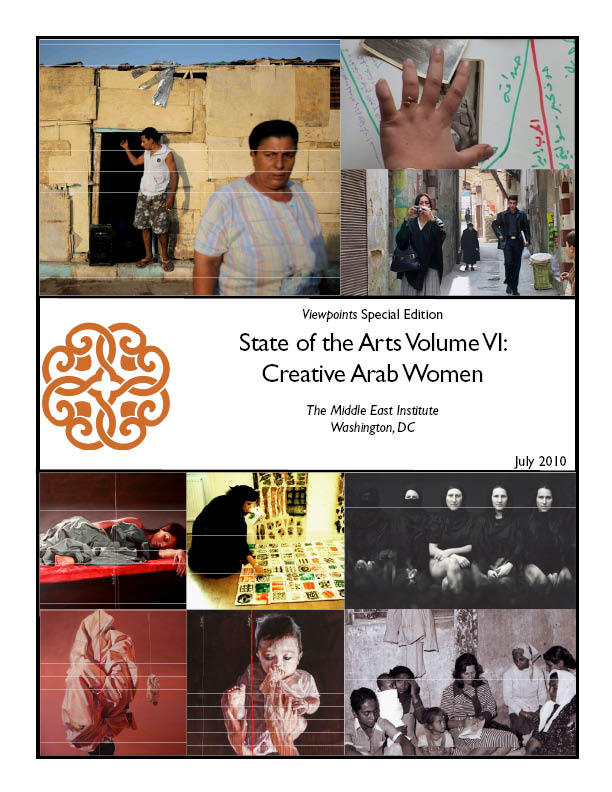
Creative Arab Women is the sixth edition of the MEI Viewpoints series on the State of the Arts in the Middle East. The 14 essays in this collection offer a glimpse into the rich and varied cultural output of Arab women in the region and the diaspora. Partly reminiscences and partly calls to action, they are essays of survival and empowerment that add a deeply personal dimension to the subject of the role of Arab women as cultural producers. MEI is grateful to Dr.
Writing on Culture: The Missing Factor in Discussions on the Middle East
The Middle East Institute is proud to host MEI scholar Andrea Rugh for a discussion about Middle Eastern culture and her most recent book, Simple Gestures: A Cultural Journey Into the Middle East. Since US involvement in Iraq and Afghanistan, the importance of culture has become all too clear. Yet, although most scholars agree on its importance, few address culture in ways that provide better understanding to audiences who might benefit, such as policy makers, the media and the American public.
A Lexicon of Migrants in the United Arab Emirates (UAE)
The millions of foreign nationals working in the Gulf are often lumped together as “migrant workers,” but this is misleading. The population of foreign workers in the UAE, for example, is complex and heterogeneous. One layer of that complexity is manifested by the lexicon used by migrants to identify other migrants.
Business Elites, Unofficial Citizenship, and Privatized Governance in Dubai
Several scholars of citizenship and migration in the oil-rich Gulf Arab states have noted the divisions between citizens and non-citizens in terms of mobility, access, geographic location, job prospects, and rights (or lack thereof) in these countries.[1]These “rentier” states, such as the United Arab Emirates (UAE), which rely on oil for the majority of their income, highly police the boundaries of citizenshi
Westerners in the United Arab Emirates: A View from Abu Dhabi
It is not hyperbole to say that Emirati nationals (al-muwatinin) are vastly outnumbered by foreigners in their country at a ratio higher than almost anywhere else on earth. And, while a growing ethnographic literature documents late 20th century trends among South Asian migrant workers in the Gulf states, few have examined the less populous though highly visible and influential Westerners who work and live there. They deserve our attention.
Over the past decade, migration to the wealthy states of the Arabian Peninsula has emerged as an increasingly central facet of scholarly attention to the region. This attention has resulted in the exponential expansion of our collective knowledge, and the near future promises even more nuanced and microcosmic analyses as recent and current fieldwork in the region bears fruit. Nevertheless, there has been little discussion of the “labor camps” in which many of the unskilled migrants dwell during their sojourn in the Gulf states.
Liberal Enclaves: A Royal Attempt to Bypass Clerical Power
Within the first months of ‘Abdullah’s term as King, the Saudi government pursued a number of policies to improve the Kingdom’s economic profile. Saudi Arabia became a member of the World Trade Organization (WTO) and the limits were raised on foreign stakes in sectors such as banking, telecommunications services, wholesale, retail, and franchising. These reforms were intended to answer the economic priorities of diversifying from dependence on oil revenues, finding jobs for young Saudis, and opening up foreign investment.
Even Saudi film production has revived recently, following the move of Saudi Television empires such as Rotana and ART to cinematic production. This comes after more than two decades of suppression by conservative Islamist groups who prohibited film screenings to Saudi citizens. In 2005, the Kingdom saw the opening of the first movie theatre in Riyadh, followed by the release of a couple of Saudi films with Saudi actors. The first Saudi production was Zelal Assamt (2006), followed by the film Keif al Hal.
It was in the summer of 1979 that Islam in Saudi Arabia became all about women. At the urging of ‘Abd al-‘Aziz bin Baz, then chair of the Department of Religious Guidance, Legal Rulings, and Propagation of the Faith, Interior Minister Prince Nayf sent a letter to government offices asking for cooperation in curbing practices offensive to Islamic principles. At the top of the list of condemnable behaviors were unsuitably dressed foreign women shopping or eating out in public.