Ten months after a young fruit seller set himself alight in a small, marginalized town in central Tunisia, his compatriots will be voting in what many are hoping will be the country’s first free and fair elections. In the poll set for October 23, Tunisians will be electing a national constituent assembly that will be charged with writing the rules of the new political era. That assembly will spend up to a year writing a new constitution and deciding which form of government the country will have.
Join us for a discussion with Adel Abdellatif who, in his capacity as Chief of the UNDP's Regional Programme Division of the Regional Bureau for Arab States, oversees its flagship Arab Human Development Reports. Mr. Abdellatif will be discussing the dynamics of change in an Arab world undergoing seismic political transformations.
When President Obama met with Turkish Prime Minister Recep Tayyip Erdogan on Tuesday, the two discussed cooperation on Syria, counter-terrorism and supporting the Arab spring. But a central theme of the talks, and what most concerns the U.S. at the moment, is a sharply deteriorating Turkish relationship with Israel that the U.S. hopes to reverse. Conversely, this deterioration was the source of much acclaim when Erdogan visited Arab spring countries last week.
This article first appeared as an Op-Ed on Politico.com on September 19, 2011
Palestinian President Mahmoud Abbas early this week will likely fulfill his longstanding vow to introduce in the U.N. Security Council a resolution to recognize Palestine as the 194th member state. No one should be the least bit surprised.
A View From the Gulf: A Discussion of Gulf Politics and Security
The Middle East Institute is proud to host Gulf Research Center experts Abdulaziz Sager, Mustafa Alani, and Christian Koch for an examination of recent developments in the Gulf in the wake of the Arab Spring. The speakers will address the crises in Yemen and Bahrain, US-Gulf relations and the question of reform in the region.
Speakers: Dr. Abdulaziz Sager, Dr. Mustafa Alani, Dr. Christian Koch, Amb. David Mack
A View From the Gulf: A Discussion of Gulf Politics and Security
Dr. Abdelaziz Sager, Dr. Mustafa Alani, and Dr. Christian Koch of the Gulf Research Center share their perspectives on regional events and the Arab Spring.
The release of last week’s UN Palmer Report, assessing Israel’s attack on the Mavi Marmara and five other ships carrying aid to Gaza, sparked outrage in Turkey. Many criticized the report’s alleged bias, and claimed it failed to provide a credible legal analysis of the Mavi Marmara incident in which nine Turkish citizens were shot to death by Israeli commandos, some at close range and from behind.
Rebuilding Libya: A Status Report on the Humanitarian Situation on the Ground
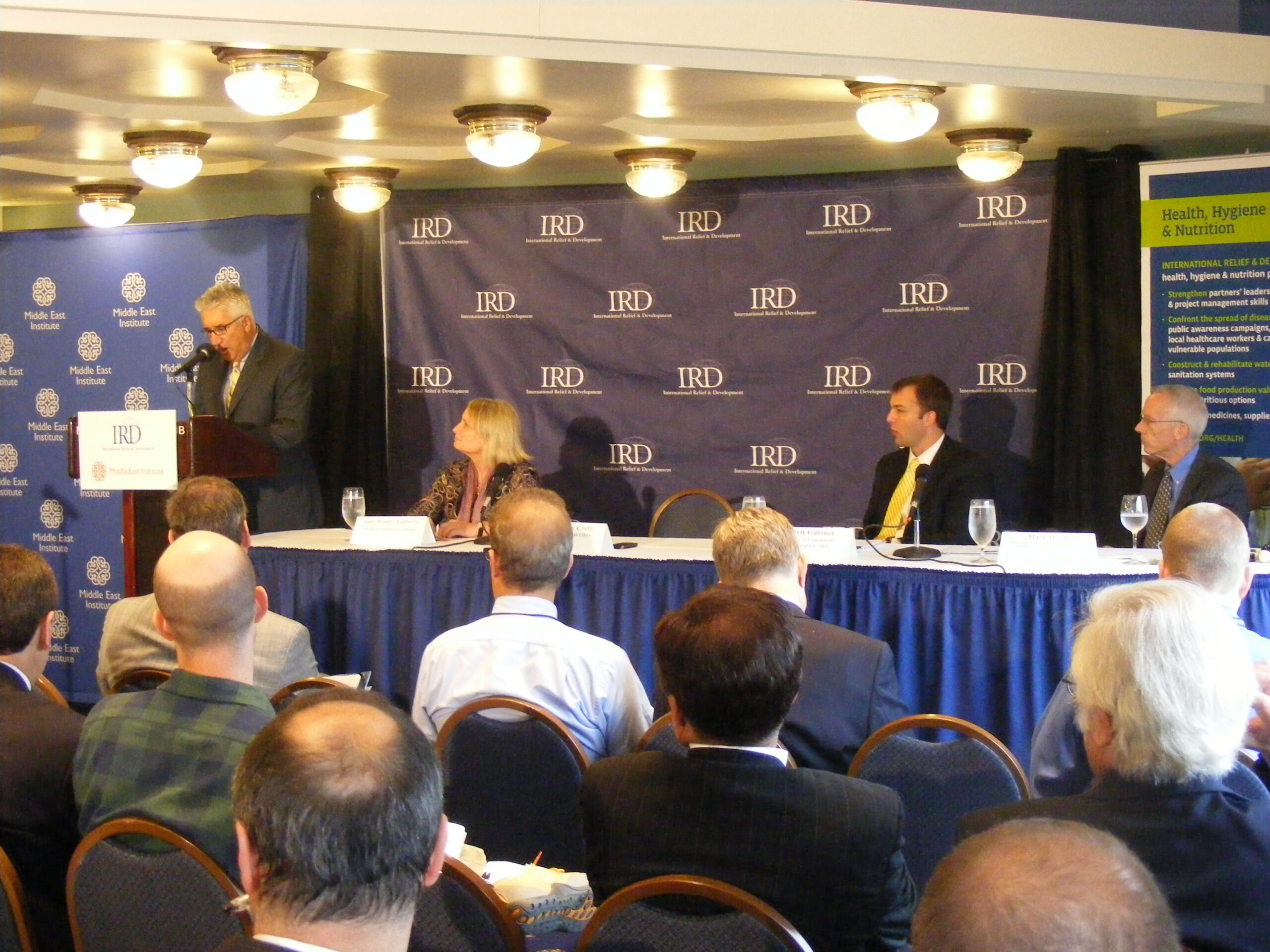
The Middle East Institute (MEI) and International Relief and Development will jointly host a discussion on the reconstruction of Libya following the fall of the Qaddhafi regime and the humanitarian dimensions of the rebuilding efforts. As the rebels root out the last of Qaddhafi royalists and regime strongholds, the question of Libya's future looms large.
This Commentary was first published as an op-ed in the Daily Beast on September 7, 2011
The events of that day were so jarring that they are recorded in our memories as if they had taken place last week. But it has been a long decade, one in which we have made as many mistakes as we have had successes. Now, and not after we suffer another major terrorist attack, is good time to pause, look back, learn lessons, and begin to chart a path away from the past.
Rebuilding Libya: A Status Report on the Humanitarian Situation on the Ground
Speakers: Amb. Wendy Chamberlin, MEI President
Amb. Gene Cretz, US Ambassador to Libya
Mark Ward, Deputy Assistant Administrator for the Bureau of Democracy, Conflict, and Humanitarian Assistance, USAID
Travis Gartner, Director of Community Stabilization, IRD
Community based-Health Initiatives: Healthy Villages in Jordan
Health for All — First Principles to Action
The International Conference on Primary Health Care was held in Almaty, Kazakhstan in 1978. Nearly all of the members of the World Health Organization (WHO) and the United Nations Children’s Fund (UNICEF) were in attendance. The conference culminated in the issuing of the Almaty Declaration — a major landmark in the field of public health.