Skip to Content

Research & Commentary Results

Filter by
1381 Results
Egypt’s Muslim Brotherhood: Politically Down and Out?
Middle East Institute
  • Analysis
  • Egypt’s Muslim Brotherhood: Politically Down and Out?

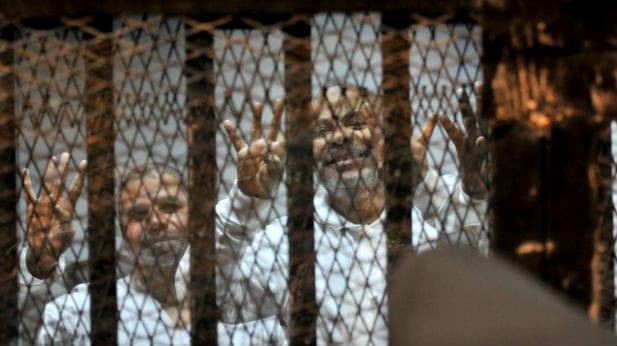
    On August 9, 2014, the Muslim Brotherhood in Egypt began another chapter in its besieged political life.  The highest administrative court in Egypt, the Supreme Administrative Court, dissolved the Freedom and Justice Party (FJP), the political arm of the Muslim Brotherhood.  The Court also liquidated all of the FJP’s assets in an effort to quash any further political ambitions and activities that the Brotherhood might have in Egypt.  The ruling—a calculated move conducted prior to upcoming parliamentary elections, scheduled for later this year—was an attempt

    September 3, 2014

    The Road Not Taken
  • Analysis
  • The Road Not Taken

    Within four months of the military’s ouster of Mohamed Morsi, one of the icons of liberalism serving in the new cabinet, Ziad Bahaa-Eldin, admitted to CNN that those who called for political reconciliation, like himself, were alienated by the political mood, where the very concept of reconciliation has become “a dirty word” in Egypt.

    September 2, 2014

    Ending Gaza’s Race to the Bottom
  • Analysis
  • Ending Gaza’s Race to the Bottom

    The August 26 permanent cease-fire crafted by Egypt between Israel and Hamas and Islamic Jihad forces in the Gaza Strip offers the best opportunity in years to take Palestinians off the “diet” imposed on them by Israel after Hamas ousted Fatah security forces from Gaza in June 2007.

    No sooner had that confrontation ended than Israel expanded an already draconian economic “siege” on the enclave of 1.8 million. It closed Gaza’s border with Israel—its only functioning trade link to the outside world—to all commercial activity.

    August 29, 2014

    Egypt's Emerging Libya Policy
  • Analysis
  • Egypt's Emerging Libya Policy

    Several weeks ago an Islamist and jihadist alliance led by Ansar al-Sharia–a group with ties to Islamic State (formerly ISIS)–took control of Benghazi and declared an “Islamic Emirate.” A few days ago, an Islamist alliance took control of Tripoli’s main airport. These developments have come as a shock to the Egyptian government, which considers an Islamic state on Egypt’s 720-mile long western border an immediate threat to Egypt’s national security. This helps explain Egypt’s alleged role in recent airstrikes inside Libya coordinated with the United Arab Emirates.

    August 27, 2014

    Alexandria Artists Make the City Their Canvas
  • Analysis
  • Alexandria Artists Make the City Their Canvas

    Alexandria, like Cairo, is a mismanaged city with little to offer by way of basic services, much less cultural activities. But unlike Egypt’s insular, desert capital, it is a Mediterranean city, cooler, less polluted or crowded than Cairo (with just six million inhabitants), no longer a cosmopolitan hub but open to the world in material and other ways. There are signs here of a trend toward “social transformation”—a focus on the immediate surroundings, the city itself, to explore and expand its possibilities.

    August 22, 2014

    Egypt’s Suez Canal Corridor Project
  • Analysis
  • Egypt’s Suez Canal Corridor Project

    If it manages to overcome some rather formidable obstacles, Egypt’s much touted “mega project of the century”—the Suez Canal Corridor Project (SCCP)—has the potential to transform the country into a world-class center for trade and industry.

    August 19, 2014

    Austerity without Protection: Egypt's 2014 Budget
  • Analysis
  • Austerity without Protection: Egypt's 2014 Budget

    As voters headed for the polling stations in late May to elect a president for the second time since Hosni Mubarak’s 2011 ouster, the interim authority announced the state budget for the 2014 financial year. The budget included austerity measures that were sure to be painful for ordinary Egyptians, and the timing of the announcement suggests that the interim authority wanted to shield the new president from responsibility.

    August 17, 2014

    An Egyptian Reset on Gaza
  • Analysis
  • An Egyptian Reset on Gaza

    The enormous costs exacted on Palestinians in Gaza by Israel’s Operation Protective Edge have sparked a rocky rehabilitation of Egyptian attitudes toward Palestinians among Egypt’s political class and the public at large. Consequently, the Sisi government may see the merits of moderating the hardline approach to Gaza that has characterized Egypt’s polices since the ousting of President Mohammad Morsi one year ago.

    Discussions between Egypt and Other Concerned Parties

    August 14, 2014

    Egypt Braces for Anniversary of Rabaa and Nahda Bloodshed
  • Analysis
  • Egypt Braces for Anniversary of Rabaa and Nahda Bloodshed

    Days before the first anniversary of the August 14 violent police crackdown on the Rabaa and Nahda squares in Cairo, Egypt’s High Administrative Court ordered the dissolution of the Muslim Brotherhood’s Freedom and Justice Party and the liquefaction of its assets.[1] Since the ouster of Mohamed Morsi in July 2013, the Muslim Brotherhood and its supporters have faced a state crackdown. Thousands are currently in prison and hundreds have been killed in clashes with security.

    August 12, 2014

    Collection Spotlight: Pens and Swords: How the American Mainstream Media Report the Israeli-Palestinian Conflict By Marda Dunsky
    Middle East Institute
  • Analysis
  • Collection Spotlight: Pens and Swords: How the American Mainstream Media Report the Israeli-Palestinian Conflict By Marda Dunsky

    Free media in a democratic society allows people to evaluate and challenge, to scrutinize honestly and debate accurately. But what happens when mainstream media unknowingly fails the public? Marda Dunsky argues that, when it comes to the Israeli-Palestinian conflict, a decade-old conflict at the center of U.S. interests in the Middle East, the American mainstream media has failed the public and even perpetuated violence.

    August 7, 2014

    The Cruel War in Gaza Calls for a New Approach to Peace
  • Analysis
  • The Cruel War in Gaza Calls for a New Approach to Peace

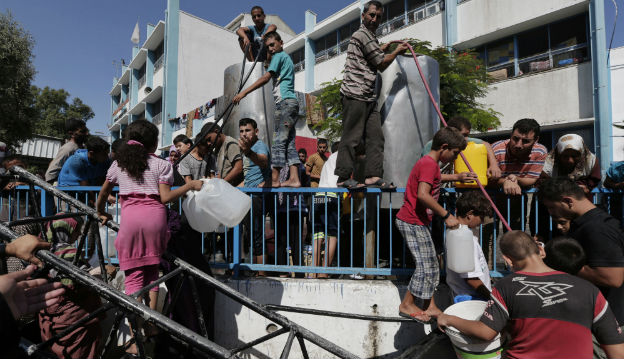
    The terrible war in Gaza, the third and worst of its kind in the last decade, is a product of Palestinian political disarray, Arab disunity, and division in Israel. Washington’s policy of “no direct talks” with Hamas and bitter partisanship between the White House and Congress have also limited effective U.S. intervention.  As such, this latest tragedy is yet another symptom of decades of failure to resolve the larger Israel-Palestine conflict, which, without major policy changes, will surely drag on regardless of the latest cease-fire.

    August 5, 2014

    War in Gaza: A chance for Iran, Hamas to turn a page?
  • Analysis
  • War in Gaza: A chance for Iran, Hamas to turn a page?

    Read full article on CNN.

    Israel’s ongoing military operation in Gaza — Protective Edge — has animated the Shia Islamist leadership in Tehran.

    The bloody conflict, and the global Muslim outrage it has provoked, is held by the Iranian regime as a chance to redeem itself in the eyes of the Sunni Muslim majority in the world.

    El-Sisi’s Predicament with the Gaza Crisis
    Middle East Institute
  • Analysis
  • El-Sisi’s Predicament with the Gaza Crisis

    The current crisis in Gaza represents the first real foreign policy test for Egyptian president Abdel Fattah el-Sisi.  Hamas’s rejection of the Egyptian initiative to end hostilities calls into question Egypt’s ability to maintain its decades-long special status as mediator, a role it assumed by virtue of its relations with all parties – Israel and the United States on one hand, and the PLO and Hamas on the other.

    July 30, 2014

    Egypt’s Least Bad Option for Addressing Energy Troubles
    Middle East Institute
  • Analysis
  • Egypt’s Least Bad Option for Addressing Energy Troubles

    A proposed deal to export Israeli natural gas through Egypt has the potential to enable Israel’s entry into its first major export markets, help Egypt escape a deepening energy crisis, and welcome the first European players into Israel’s natural gas industry. However, the deal is complicated by political realities and a history of deeply rooted grievances between the two countries, made worse by the recent violence between Israel and Hamas in Gaza.

    July 24, 2014