Skip to Content

Research & Commentary Results

Filter by
1060 Results
Saudi Arabia & the Arab Gulf’s Disappointment with U.S. Policy
Middle East Institute
  • Analysis
  • Saudi Arabia & the Arab Gulf’s Disappointment with U.S. Policy

    Whether Saudi Arabia takes a seat on the United Nations Security Council or not, the initial snub is aimed primarily at the United States. In particular, U.S.-Saudi relations are in for an exceptionally difficult period—perhaps a return to the policies of King Faisal bin Abdulaziz. It appears that Saudi Arabia and the Arab Gulf now share the view of Sir Charles Johnston, a British diplomat in the 1960s, who offered the following assessment of U.S.

    October 28, 2013

    Yemen Achieves Steady Progress against the Odds
  • Analysis
  • Yemen Achieves Steady Progress against the Odds

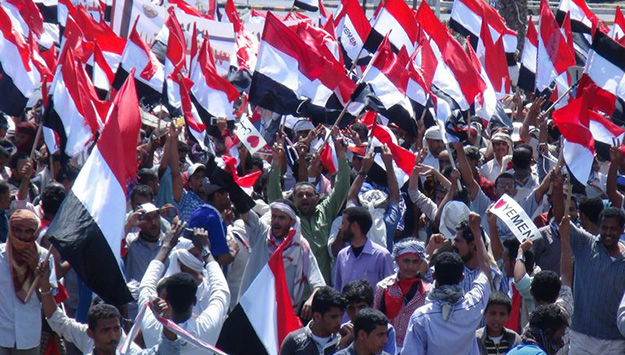
    The members of the Friends of Yemen, comprising over 30 governments and several international institutions, including the United Nations, World Bank, Arab League, and European Union, gathered for their sixth meeting September 25 in New York on the margins of the UN General Assembly. Chaired by the governments of Yemen, Saudi Arabia, and the United Kingdom, participants praised Yemen’s efforts to implement a political transition through inclusive and comprehensive dialogue and negotiation—a stark contrast to the course of events in better-known Syria and Egypt.

    September 27, 2013

    A Conversation on Yemen
  • Analysis
  • A Conversation on Yemen

    Last week, MEI scholars Allen Keiswetter, a retired Foreign Service officer, David Newton, former ambassador to Yemen, and Roby Barrett, author of Yemen: A Different Political Paradigm in Context (2011), gathered for an informal discussion about Yemen’s National Dialogue Conference (NDC), which began in March.

    September 27, 2013

    Dubai — The Middle East-Asia Hub
    Middle East Institute
  • Analysis
  • Dubai — The Middle East-Asia Hub

    Over the past two decades, Dubai has risen to become a global financial, commercial shipping, aviation, and art hub. These essays examine Dubai’s key role in revitalizing the historic ties between the countries of the Middle East and Asia-Pacific regions.

    September 17, 2013

    Gulf Governments Offer Financing for U.S. Strike on Syria
    Middle East Institute
  • Analysis
  • Gulf Governments Offer Financing for U.S. Strike on Syria

    Like pieces fitting together in a jigsaw puzzle, Arab governments – presumably from the oil-rich Gulf Cooperation Council – offered to finance a U.S. military strike on Syria, according to comments made by Secretary of State John Kerry during testimony September 4 with the House Foreign Affairs Committee. In an exchange with Representative Ileana Ros-Lehtinen (R-FL) on the potential cost of U.S. military action in Syria, Kerry said,

    September 11, 2013

    “Invisible” White-Collar Indians in the Gulf
    Middle East Institute
  • Analysis
  • “Invisible” White-Collar Indians in the Gulf

    Since the 1970s oil boom, the Gulf region has been one of the principal destinations for workers from South Asia, with the result that today Indians constitute a large percentage of the non-nationals living in the region. Indeed, at five million out of an estimated 15 million people, the Indian community forms the largest expatriate group in each of the Gulf countries. Most Indian immigrants are from the south Indian state of Kerala, while many of the rest originate from Tamil Nadu, Punjab, Uttar Pradesh, and Bihar.

    August 14, 2013

    Collection Spotlight: The Arab Awakening
    Middle East Institute
  • Analysis
  • Collection Spotlight: The Arab Awakening

    The Arab Awakening: America and the Transformation of the Middle East, by Kenneth Pollack and Daniel Byman et al., 2011

    July 1, 2013

    Obama, Guantanamo, and the Devil in the Details
    Middle East Institute
  • Analysis
  • Obama, Guantanamo, and the Devil in the Details

    In a speech on 23 May 2013, President Obama declared the war on terror over. “We must define our effort not as a boundless ‘global war on terror,’” he said, “but rather as a series of persistent, targeted efforts to dismantle specific networks of violent extremists that threaten America.”[1] He argued that al-Qa`ida is on the run in Afghanistan and Pakistan and no longer threatens the U.S. homeland.

    June 25, 2013

    Malaysia and the GCC Countries: Fertile Ground for Further Expansion of the Takaful Industry
    Middle East Institute
  • Analysis
  • Malaysia and the GCC Countries: Fertile Ground for Further Expansion of the Takaful Industry

    The Takaful industry has expanded rapidly in recent years.[1] In 2011, the industry recorded 19% higher growth than in the previous year. Takaful is generally regarded as a profitable product with ample growth potential. With strong support from industry players, government institutions and increasing awareness among customers, the Takaful industry is expected to develop further in the coming years.

    June 16, 2013

    Asia-Gulf Economic Relations in the 21st Century: The Local to Global Transformation
    Middle East Institute
  • Analysis
  • Asia-Gulf Economic Relations in the 21st Century: The Local to Global Transformation

    Asia constitutes the hub of the transformation of global economic power today. The Gulf, itself part of Asia, is of increasing importance in this transformation. This book documents the growing interactions between the economies of the Gulf states and those of the rest of Asia. These relationships are critical to how the world economy develops over the next decade, and how economic (and perhaps strategic) power is distributed.

    June 10, 2013

    Malaysia: A Base for the Growing Asia-Middle East Market?
    Middle East Institute
  • Analysis
  • Malaysia: A Base for the Growing Asia-Middle East Market?

    With the shift in the direction of Gulf Cooperation Council (GCC) countries’ trade from the West to Asia and the emphasis on the “Islamic connection” by Malaysia and many of its Middle Eastern counterparts, Malaysia-GCC economic cooperation appears to be gaining momentum. Malaysia’s strategic location at the center of Southeast Asia and the need for as well as the apparent determination of Malaysia and the GCC countries to diversify their export markets could provide the impetus for this partnership to flourish.

    June 6, 2013

    Gulf Research Council April 2013 Gulf-Asia Bulletin
    Middle East Institute
  • Analysis
  • Gulf Research Council April 2013 Gulf-Asia Bulletin


    The GRC’s April 2013 Gulf-Asia Bulletin, edited by Noriko Suzuki, contains the following short pieces:

    • On OSIPP-GRC Academic Cooperation by Toshiya Hoshino |04
    • Japan-Gulf Relations in the Wider Gulf-Asia Context by Makio Yamada |06
    • Japan and the Gulf: Balanced Business Relationship, and Thereafter by Yoshio Minagi |10
    • A General History of Kuwait-Japan Economic Relations from the 1950s to the 1970s by Takumi Sato |14

    May 30, 2013

    The Asia Cooperation Dialogue (ACD): Progress and Potential
    Middle East Institute
  • Analysis
  • The Asia Cooperation Dialogue (ACD): Progress and Potential

    The Asia Cooperation Dialogue’s (ACD) future looks promising. The 11-year-old ACD has taken important steps in becoming a relevant, constructive pan-Asian body with a forward-looking agenda, concrete plans and projects underway, and some noteworthy accomplishments.

    May 22, 2013

    Gulf Arab Foreign Direct Investment (FDI): ASEAN Targets of Opportunity
    Middle East Institute
  • Analysis
  • Gulf Arab Foreign Direct Investment (FDI): ASEAN Targets of Opportunity

    Although China and India have been new favorable destinations for Arab investors, Southeast Asian countries offer distinctive and profitable investment markets, featuring high demand and relatively low labor costs. In recent years, investments from the Gulf Cooperation Council (GCC) to the Association of Southeast Asian Nations (ASEAN) have surged.

    March 20, 2013