
U.N. Palestine Vote: Time to Exhale
This article first appeared as an Op-Ed on Politico.com on September 19, 2011
Palestinian President Mahmoud Abbas early this week will likely fulfill his longstanding vow to introduce in the U.N. Security Council a resolution to recognize Palestine as the 194th member state. No one should be the least bit surprised.
Israel's Palestinians: The Conflict Within
The Middle East Institute is proud to host Ilan Peleg and Dov Waxman, authors of the book Israel's Palestinians:The Conflict Within (Cambridge, 2011), for a discussion about their findings. One in five citizens of Israel are Palestinian. Often overlooked by outside observers, the challenges facing the Palestinian minority in Israel are an inseparable part of the Israeli-Palestinian conflict. Resolving this conflict – a central concern of U.S. foreign policy and current international diplomacy – requires more than the establishment of a Palestinian state.
Uprising in Syria: Implications for US and Regional Policy
The Middle East Institute is proud to host Syria experts Ammar Abdulhamid, Helena Cobban, and Steven Heydemann for a discussion about the ongoing protests in Syria and the international and regional reactions to the shifting Syrian landscape. As the uprising continues into its third month, how sustainable is the protest movement? Are the Syrian government's tactics in crushing dissent succeeding? What impact has the violence had on the Assad regime's relationship with its neighbors like Turkey and close allies like Iran, Hezbollah and Hamas?
Palestinian Peace Strategy in a Changing Middle East
The Middle East Institute and The Foundation for Middle East Peace are proud to host Ziad Abu Zayyad a veteran journalist and the co-founder and editor of the Palestine/Israel Journal. In his talk, Mr. Abu Zayyad will address whether a rapprochement between Fatah and Hamas is possible, and will also discuss the main challenges facing the US-Palestinian bilateral relationship.
Speaker: Ziad Abu Zayyad
Palestinian Peace Strategy in a Changing Middle East: Prospects for Fatah-Hamas Reconciliation, and US-Palestinian Relations
The Middle East Institute and the Foundation for Middle East Peace are proud to host Ziad Abu Zayyad a veteran journalist and the co-founder and editor of the Palestine/Israel Journal. In his talk, Mr.Abu Zayyad will address whether a rapprochement between Fatah and Hamas is possible, and will also discuss the main challenges facing the US-Palestinian bilateral relationship.
Transboundary Conservation and Peacebuilding
Various Track Two approaches to peacebuilding in the Middle East have been pursued through ecumenical dialogue and educational programs such as The University of the Middle East Project.[1] Yet the direct use of environmental conservation as a mutually agreeable way to approach territorial conflict resolution has thus far not been seriously deliberated. Some “realists” might be dismissive of such a prospect, but the concept of “peace parks” has shown practical promise in resolving territorial disputes.
Environmental Peacebuilding in the Eastern Mediterranean
Environmental peacebuilding is both the theory and practice of identifying environmental initiatives that promote a sustainable peace between those who have previously been adversaries, and implementing those initiatives. Environmental peacebuilding combines two elements.
Arava Institute for Environmental Studies: Teaching Environment as a Bridge to Peace & Understanding in the Middle East
The Arava Institute for Environmental Studies (AIES) is the premier environmental studies institute in the Middle East and is accredited under the auspices of the Ben Gurion University (BGU) of the Negev. Since 1996, the Institute has been teaching environmental studies to university students from the Middle East and other parts of the world. The unique approach of the Institute is to teach the environment, in which all share, as a bridge to cooperation and peacebuilding in the Middle East.
This Burning Land: Lessons from the Front Lines of the Transformed Israeli-Palestinian Conflict
The Middle East Institute is proud to host Greg Myre and Jennifer Griffin for a discussion about the ongoing challenges in the Israeli-Palestinian conflict based on their knowledge and experiences recounted in their new book, This Burning Land: Lessons from the Front Lines of the Transformed Israeli-Palestinian Conflict. Myre and Griffin, journalists who are husband and wife, traveled to Jerusalem in 1999 in hopes of finally seeing Middle East peace. Instead, the pair watched as violence in the area escalated and the peace process disintegrated.
Israel's Flawed Electoral System: Obstacle to Peace and Democracy
Israeli politics is notable for its wide array of parties and unstable coalition governments. The main institutional cause of this chronic instability is the system of nationwide proportional representation, which gives disproportionate influence to minor parties. This instability limits the ability of Israeli governments to pursue coherent long-term strategies and leads to policies that address the concerns of minority groups at the expense of the national interest.
Struggling for the Center: Teacher-Centered vs. Learner-Centered Practices in Palestinian Higher Education
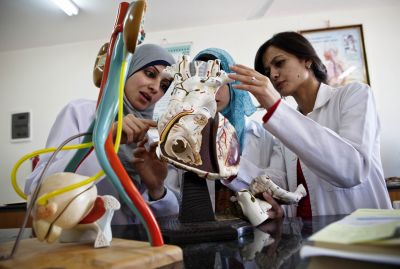
Alongside the struggle for an independent Palestine, not to mention the internal power struggles between the rival Fatah and Hamas movements, another struggle — largely absent from local news headlines and talk on the streets — is unfolding in classrooms in Palestinian higher education. Faculty are pushing back against the hegemony of teacher-centered instruction and embracing, in principle if not in practice, the global movement toward learner-centered pedagogy.
'Blockade' and 'Embargo' Have Different Meanings
This Commentary first appeared as an op-ed in McClatchy News, July 6, 2010.
The misuse and abuse of language is yet another obstacle to obtaining peace in the Middle East. In recent weeks the media, government officials and commentators have so garbled the use of the words “blockade” and “embargo” to describe events in Gaza that understanding what is occurring, the legal implications, and developing a reasonable policy are almost impossible.
Introduction to The State of the Arts in the Middle East: Volume VI: Creative Arab Women
Creative Arab Women is the sixth edition of the MEI Viewpoints series on the State of the Arts in the Middle East. The 14 essays in this collection offer a glimpse into the rich and varied cultural output of Arab women in the region and the diaspora. Partly reminiscences and partly calls to action, they are essays of survival and empowerment that add a deeply personal dimension to the subject of the role of Arab women as cultural producers. MEI is grateful to Dr.
Gaza, the Land of the Recurring Crisis
The last five years of the Israeli-Palestinian conflict could be summed up in one word: Gaza.
Israel’s lethal raid on the flotilla attempting to deliver aid to Gaza is part of a recurring theme that goes like this: Gaza wallows in dysfunction. Tensions steadily build. A confrontation erupts. Every major crisis between the Israelis and the Palestinians in recent years has revolved around Gaza—the overcrowded, impoverished strip of sand squeezed between Israel and the Mediterranean.