A View From the Gulf: A Discussion of Gulf Politics and Security
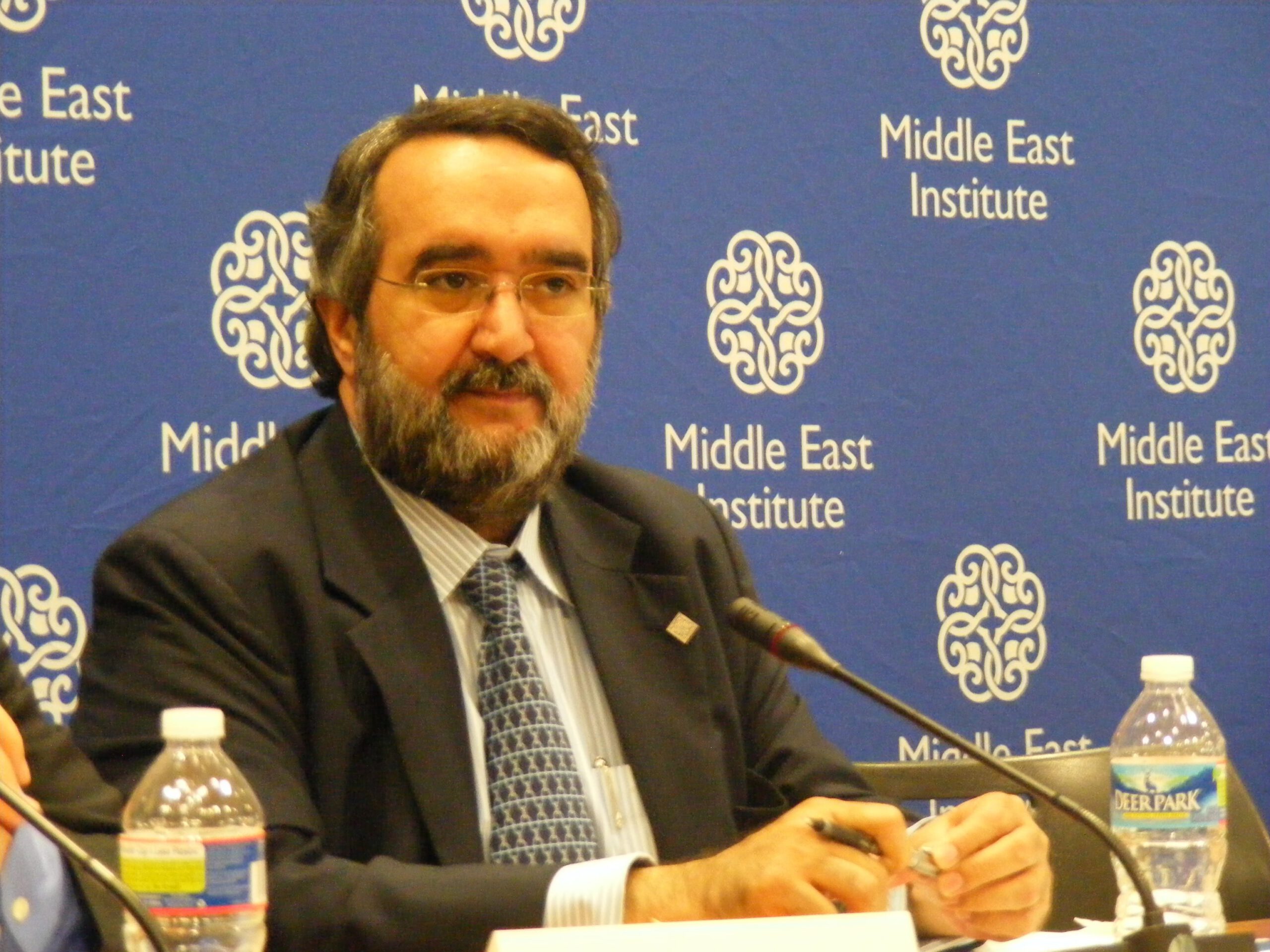
Dr. Abdelaziz Sager, Dr. Mustafa Alani, and Dr. Christian Koch of the Gulf Research Center share their perspectives on regional events and the Arab Spring.
After the Arab Spring: Toward Political & Economic Inclusion in the Arab World
The Middle East Institute and the UNDP are proud to host a discussion with UNDP Administrator Helen Clark, Under Secretary for Economic, Energy and Agricultural Affairs Robert D. Hormats, and Middle East Institute Scholar Amb. Edward Walker about how best to address political, economic and human development needs in the Arab world today.
The Middle East Insitute is proud to host Amb. Edmund J. Hull (retired) for for a discussion about his recent book High-Value Target: Countering Al Qaeda in Yemen. Hull's book tells the inside story of how al Qaeda's Yemeni safe haven was disrupted during Hull's tenure.
*A version of this article was originally published on ForeignPolicy.com on April 12, 2011
Divide and conquer. That's the strategy Ali Abdullah Saleh has employed for 33 years to remain atop Yemen's extremely diverse political landscape. But the Yemeni president's efforts to keep his country in a state of low-level dysfunction are also at the root of its current problems. Chaos allows Saleh to make politics a family affair, keeping the reins of power in the hands of his sons and nephews.
Popular Revolt in Yemen: Implications for Democracy and US Foreign Policy
The Middle East Institute is proud to host Janet Sanderson, Christopher Boucek and Charles Schmitz for a discussion about the challenges facing Yemeni President Abullah Ali Saleh as he confronts a third month of anti-government protests and growing calls for secession from southern separatists. Sanderson will examine US policy toward the Saleh government in the face of demands for reform, while Schmitz will examine the respective players in Yemen's protest movement and the government's response to their demands.
Kān Yāmā Kān: Curriculum Development in the GCC – Adopting (Adapting) Models of Higher Education
Once upon a time in the land where the light of creation first shone, the fertile grounds around Baghdad nurtured the House of Wisdom.[1] Even as Europeans were looking for the light at the end of the Dark Ages, Caliph Haroon al-Rasheed and his son Caliph al-Mamoon had made Baghdad a center of learning. In Baghdad, scholars put words on “real” paper. They preserved Aristotle, Plato, Hippocrates, Euclid, Ptolemy, Pythagoras, and Brahmagupta and translated Greek, Persian, and Indian manuscripts.
Women’s education in the Arab world has increased substantially in the last several decades, both in absolute terms and relative to men. However, when looking at the Arab world, understanding that there are vast differences culturally, politically, and socially among the countries is essential. This essay looks at the Gulf Cooperation Council (GCC) countries, where women share a similar cultural and socio-economic context.
The Middle East Institute is proud to host Ambassador Robert E. Hunter, Senior Adviser at the RAND Corporation, to present a new study that lays out the criteria and parameters for a new security structure for the Persian Gulf region. His recent study, Building Security in the Persian Gulf, makes recommendations for a new security structure for the region in order to promote long-term stability while also reducing
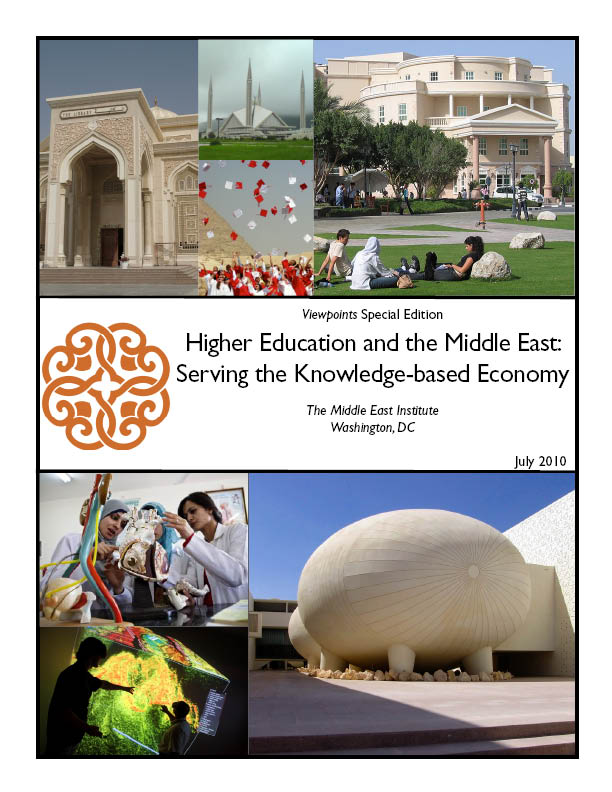
Higher Education and the Middle East: Serving the Knowledge-based Economy
This is the first of three volumes examining the internationalization of higher education and the Middle East. The 12 essays included in this volume explore some of the changes that are taking place and the challenges that lie ahead as Middle Eastern countries seek to build sustainable higher education systems and strengthen their economies. Within the dynamic global higher education landscape, is the Middle East a stagnant backwater or a center of creative initiative? What are, and should be the roles of foreign partners and providers?
The Middle East Institute is proud to host Justin Dargin, research fellow at the Dubai Initiative, for a discussion of greenhouse gas (GHG) emissions in the Gulf and the pursuit of an effective carbon trading plan. Dargin will also examine the effect which this hot-button issue has upon the region's geopolitical relations, energy efficiency, natural gas utilization, renewable energy, and conservation of natural resources.
The Republic of Yemen occupies the southwest corner of the Arabian Peninsula. Unlike its oil-rich neighbors, Yemen is the poorest country in the Arab world. Like other countries football (soccer) is Yemen’s most popular sport. Football has been played in parts of Yemen since before the turn of the 20th century, and since the 1970s, the game’s popularity has increased significantly.
The Middle East Institute is proud to host Sean Foley, author of The Arab States: Beyond Oil and Islam (Lynne Rienner, 2010), for a discussion about the politics of the Gulf states and their role in the global economy. In the book, Foley presents a fresh picture of these states as cosmopolitan and tolerant societies that face many of the same socio-economic problems that other states do – including those that lack oil.