The Upcoming Turkish Elections: Implications for Domestic and Foreign Policy
The Middle East Institute's Center for Turkish Studies is proud to host Mr.Taha Ozhan, Director General of the Foundation for Political, Economic and Social Research (SETA Ankara), for a discussion on Turkey's upcoming elections on June 12.
American policy toward conflict in Libya is bearing disappointing fruit. The conflict there seems to be settling in to a stalemate with the likely prospect of becoming an extended civil war. In the face of this prospect, John McCain and other Senators are calling for greater US involvement. That goes against the grain of American public opinion. It raises in sharp relief the question: Will our current limited engagement policy work? And if so, when?
Libyan Intervention: Justified By the Circumstances
It was absolutely predictable that Republicans would attack President Obama whatever he did in Libya, though Newt Gingrich, in his overeagerness, overreached by criticizing him for too explicitly opposite reasons. It was also likely that the anti-interventionist left, which sees (almost?) any use of American military power as imperialistic and unwarranted would likewise be opposed.
Rahm Emanuel famously quipped that a crisis should never go to waste. In his absence, the Administration seems determined not to take sufficient advantage of the ongoing and huge crisis in the Arab world. Its hesitant, uncertain, and (to date) completely ineffectual response to events in Libya sadly make this all too clear.
It now appears that the US finally has gotten serious about doing something meaningful to assist opposition forces in Libya. Exaggerated fears and an insufficient grasp of the adverse consequences of not taking such action previously paralyzed US (and most European) policymakers with respect to even an eastern no-fly zone, let alone more robust measures. Meanwhile, what is left of the organized Libyan opposition is increasingly hard-pressed.
The greatest threat to U.S. national security is Congress’s abdication of its constitutional responsibilities. Nothing could make this point more clear than the current discussion of whether Washington should bear the lion’s share of the costs and risks of a no-fly zone over Libya.
Turkey as an Alternative Democratization Model for the Middle East
The popular uprisings against authoritarian regimes in Tunisia, Yemen, Jordan and Egypt herald the beginning of a new political era in the Middle East. At the center of this new political order is a generation of young Arabs, educated, highly marginalized, and numerous. The members of the so-called Arab “youth bulge” are demanding neither the unification of the Arab world as espoused by the pan-Arabists of the 1960s, nor an Islamic state of the 1980s, but rather a dignified life, social justice, and freedom.
US-Libya Relations: Surviving the Wikileaks Controversy?
US-Libya Business Association Honorary Chairman Amb. David Mack and Executive Director Charles Dittrich traveled to Libya for five days in mid-December. They met with Libyan government officials, Libyan private business leaders and representatives of American companies working in the country. They will share impressions regarding the political and economic climate in Libya and the implications for both overall US-Libyan relations and the prospects for American business interests.
The US and Libya: Normalization of a Stormy Relationship
*This article was first published in January 2011 by the Foreign Service Journal.
Relations between Libya and the U.S. have a turbulent history: War at the beginning of the 19th century; U.S. government support for Libyan independence after World War II; official and private-sector American engagement in the development of Libya’s oil wealth and human resources in the mid-20th century; Libyan terrorism and U.S. military retaliation in the 1980s; U.S.-engineered economic sanctions and isolation in the late 20th century; and restoration of diplomatic relations in 2006.
Turkey's Dual Track Approach Toward the Kurdistan Regional Government
Turkey’s policy toward the Kurdistan Regional Government (KRG) in northern Iraq has undergone an important shift since 2009. Only a few years ago, Turkey did not recognize Iraq’s Kurdish Regional Government and refused to meet with its representatives in any official capacity due to its fear that recognition would embolden Turkey's own Kurdish minority to demand similar home-rule status.
Turkey’s professional military has been a force for modernization and progress throughout the nation’s history. As the constitutionally-appointed guardian of the Turkish Republic, however, the military has often intervened in political affairs, resulting in a constant, underlying tension between the government and the military establishment in Turkey.
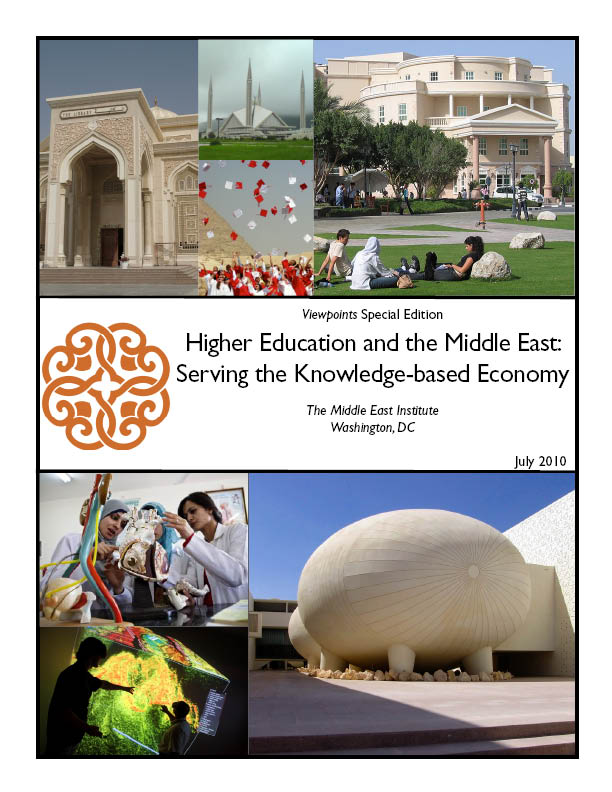
Higher Education and the Middle East: Serving the Knowledge-based Economy
This is the first of three volumes examining the internationalization of higher education and the Middle East. The 12 essays included in this volume explore some of the changes that are taking place and the challenges that lie ahead as Middle Eastern countries seek to build sustainable higher education systems and strengthen their economies. Within the dynamic global higher education landscape, is the Middle East a stagnant backwater or a center of creative initiative? What are, and should be the roles of foreign partners and providers?