Skip to Content

Research & Commentary Results

Filter by
1327 Results
The Shanghai Cooperation Organization: A New Alternative for Turkish Foreign Policy?
Middle East Institute
  • Analysis
  • The Shanghai Cooperation Organization: A New Alternative for Turkish Foreign Policy?

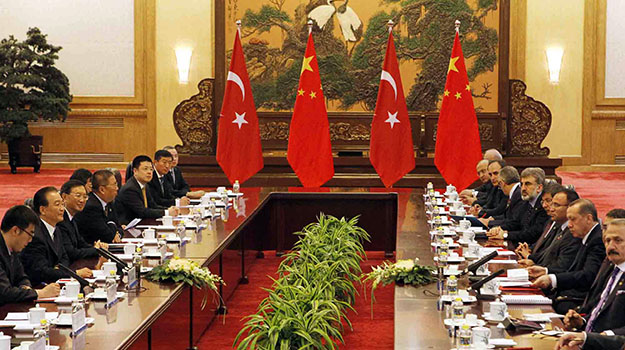
    In June 2012, Turkey was accepted as a “dialogue partner” at the Beijing Summit of the Shanghai Cooperation Organization (SCO). Although this decision did not completely satisfy the Turkish government, which apparently preferred the status of an observer, it still had a profound meaning, as Turkey is the first NATO member state to enjoy such a privileged institutional relationship with the SCO. This new relationship has become even more significant in light of Turkish Prime Minister Recep Tayyip Erdoğan’s declaration in a televised interview in January 2013 that membership in the SCO could become an alternative to Turkey’s stalled EU accession process. More recently, the brutal suppression of the Taksim Gezi Park demonstrations by Turkish security forces heightened concerns about the future of democracy in Turkey, giving rise to more frequent comparisons between the Turkish regime and the authoritarian political systems of the SCO member states.

    October 18, 2013

    Turkey and the Shanghai Cooperation Organization: Few Shared Values and No Common Destiny
    Middle East Institute
  • Analysis
  • Turkey and the Shanghai Cooperation Organization: Few Shared Values and No Common Destiny

    Almost every written piece on Turkey’s relations with Asia begins with a reference to the ancient Silk Road. When Turkish statesmen address Chinese audiences, they often use this metaphor to point out the “millennia-old cultural exchanges and neighborly relations” between the two countries. Inside Turkey, however, few can make sense of this anachronistic notion of shared identity. Asked about ancient Sino-Turkish ties, many will only recall how the Chinese built the “Great Wall” against the nomadic tribes of Central Asia—considered to be the forefathers of modern Turks.

    October 15, 2013

    The Turkish “Democratization Package”
    Middle East Institute
  • Analysis
  • The Turkish “Democratization Package”

    On September 30, 2013, Prime Minister Recep Tayyip Erdoğan announced his government’s long-awaited reform or “democratization” package. In Turkey’s highly polarized political atmosphere, responses ranged from describing the package as a historical victory for democracy that will finally free Turkey from heavy chains imposed upon it for decades, to an electoral ploy designed to polish the country’s badly damaged image as a result of the Gezi Park incidents, with no substantial improvements in democratic standards. As often is the case, the truth lies in the middle.

    October 15, 2013

    Helsinki and US-Russian Cooperation in the Middle East
    Middle East Institute
  • Podcast
  • Helsinki and US-Russian Cooperation in the Middle East

    Andrey Kortunov, director general of the Russian International Affairs Council, and Randa Slim, director of MEI’s program on Conflict Resolution and Track II Dialogues, join host Paul Salem to discuss the Helsinki Summit and takeaways from the latest meeting of the US-Russia Middle East Dialogue in Berlin, where participants outlined challenges and opportunities for US-Russian cooperation in Syria and elsewhere in the region.

    More episodes

    October 11, 2013

    Turkey: An Increasing Interest for Chinese Academia
    Middle East Institute
  • Analysis
  • Turkey: An Increasing Interest for Chinese Academia

    In recent years, Sino-Turkish relations have grown increasingly close. Sino-Turkish trade, for instance, saw a sharp rise from $4.87 billion in 2005 to $19 billion in 2012, a rise of 292.09 percent. In 2005, 44,077 Chinese citizens traveled to Turkey, and this number rose to 114,582 in 2012—a 159.96 percent increase. 2013 has seen such an overwhelming number of visits and travels to Turkey from China that the Chinese government has adopted some restrictive measures, such as limiting the number of delegations from various levels of government and universities that can make the trip.

    October 9, 2013

    Sino-Turkish Relations: An Overview
  • Analysis
  • Sino-Turkish Relations: An Overview

    Since the West’s economic crisis in 2008, Turkey has been less keen to join the EU, and many Turks have begun to discuss the advantages of being closer to Asia, including China, the pivotal Asian force. China has been Turkey’s third-largest trading partner for ten years now, and this standing even excludes energy imports such as oil and natural gas. While both sides are intent on deepening relations in all aspects, some obstacles must be overcome in the near future, such as the trade deficit between the two countries, which leaves Turkey indebted to the powerhouse that is China to the tune of more than $20 billion annually.

    October 4, 2013

    Turkey’s Changing Foreign Policy Stance: Getting Closer to Asia?
    Middle East Institute
  • Analysis
  • Turkey’s Changing Foreign Policy Stance: Getting Closer to Asia?

    Turkey’s foreign policy under the current Justice and Development Party (AKP) government continues to attract widespread attention by scholars and policy circles alike. Over the past decade, the way Turkey has formulated and implemented its policies toward the rest of the world has transformed from a traditionally status quo-ist and reactive stance that emphasizes maintaining close relations with the West to a more assertive, multidimensional, and proactive approach with a broader geographical scope. While the process of accession to the European Union (EU) remains the main axis of its foreign policy, Turkey is now showing greater interest in regions hitherto neglected, including Asia, and this interest is materializing in the form of greater dialogue between countries, expanding economic and commercial relations, and frequent exchanges between peoples.

    October 4, 2013

    Demography and Violence in Lebanon
    Middle East Institute
  • Analysis
  • Demography and Violence in Lebanon

    The sun is beating down and it isn’t even midday. Clutching the all-important paperwork that will get them coveted UN food vouchers, Syrian refugees look harried. The women pull at their children to hurry through the litter-filled yard of the sports club in the town of Bar Elias that serves as a distribution center for the UN’s hard-pressed World Food Program (WFP). Unlike their men, who head for the shade to smoke and exchange news, the women don’t dally, making for the snaking lines into a crowded hall where they will be called in groups by registration numbers.

    July 15, 2013

    Hezbollah's Plunge into the Syrian Abyss
  • Video
  • Hezbollah's Plunge into the Syrian Abyss

    Randa Slim, MEI Scholar and adjunct research fellow at the New America Foundation, discusses the implications of Hezbollah's growing role in Syria for Lebanese politics and Lebanon's Shiite community.

    June 28, 2013

    Hezbollah's Plunge into the Syrian Abyss
    Middle East Institute
  • Podcast
  • Hezbollah's Plunge into the Syrian Abyss

    The Middle East Institute is pleased to welcome MEI Scholar Randa Slim for a discussion on the implications of Hezbollah’s growing role in Syria for Lebanese politics and Lebanon’s Shiite community. Recently returned from a trip to the region, Slim will examine Hezbollah’s potential end game in Syria, and whether Lebanon will be able to resist being drawn into the conflict following Hezbollah’s plunge into the Syrian abyss.

    June 28, 2013

    Hezbollah's Plunge into the Syrian Abyss
    Middle East Institute
  • Podcast
  • Hezbollah's Plunge into the Syrian Abyss

    The Middle East Institute is pleased to welcome MEI Scholar Randa Slim for a discussion on the implications of Hezbollah’s growing role in Syria for Lebanese politics and Lebanon’s Shiite community. Recently returned from a trip to the region, Slim will examine Hezbollah’s potential end game in Syria, and whether Lebanon will be able to resist being drawn into the conflict following Hezbollah’s plunge into the Syrian abyss.

    June 28, 2013

    Hezbollah's Plunge into the Syrian Abyss
    Middle East Institute
  • Podcast
  • Hezbollah's Plunge into the Syrian Abyss

    The Middle East Institute is pleased to welcome MEI Scholar Randa Slim for a discussion on the implications of Hezbollah’s growing role in Syria for Lebanese politics and Lebanon’s Shiite community. Recently returned from a trip to the region, Slim will examine Hezbollah’s potential end game in Syria, and whether Lebanon will be able to resist being drawn into the conflict following Hezbollah’s plunge into the Syrian abyss.

    June 28, 2013

    Hezbollah's Plunge into the Syrian Abyss
    Middle East Institute
  • Podcast
  • Hezbollah's Plunge into the Syrian Abyss

    The Middle East Institute is pleased to welcome MEI Scholar Randa Slim for a discussion on the implications of Hezbollah’s growing role in Syria for Lebanese politics and Lebanon’s Shiite community. Recently returned from a trip to the region, Slim will examine Hezbollah’s potential end game in Syria, and whether Lebanon will be able to resist being drawn into the conflict following Hezbollah’s plunge into the Syrian abyss.

    June 28, 2013