Skip to Content

Research & Commentary Results

Filter by
1406 Results
Iraq’s protests: Durability and sustainability
Iraqi students, waving national flags, join anti-government protests in the Shiite shrine city of Najaf in central Iraq on January 28, 2020.
  • Analysis
  • Iraq’s protests: Durability and sustainability

    The protest movement in Iraq is now entering its fourth month. The protests raging across most of the south of the country have remained non-sectarian in their tone and message, and the movement is steadfast in its rejection of the political order, and all members of the political elite.

    January 31, 2020

    The Houthis are consolidating power
    Houthi followers hold their guns during a tribal gathering against the continued war and blockade on October 03, 2019 in Sana'a, Yemen
  • Analysis
  • The Houthis are consolidating power

    Absent international pressure, the Iran-backed Houthis have no reason to stop expanding

    January 30, 2020

    A tale of two partners: Comparing two approaches for partner force operations
    Fighters of the US-backed Kurdish-led Syrian Democratic Forces (SDF) take part in a parade to celebrate near the Omar oil field in the eastern Syrian Deir Ezzor province on March 23, 2019, after announcing the total elimination of the Islamic State (IS) group's last bastion in eastern Syria.
  • Analysis
  • A tale of two partners: Comparing two approaches for partner force operations

    The 2018 National Defense Strategy shapes the way the U.S. military competes with state and non-state adversaries. It specifically calls for improvements in partner force operations (PFO) — especially counter-terrorism (CT) — so that regional partners can keep up CT pressure while America’s special operators shift focus to help the nation gain and maintain an advantage over the near-peer competitors of Russia and China.

    Lebanon’s inconvenient truths
    BEIRUT, LEBANON - JANUARY 16: An anti-government protester bangs a pan as they demonstrate ahead of the expected naming of a new cabinet tomorrow by Prime Minister Designate Hassan Diab, on January 16, 2020 in Beirut, Lebanon.
  • Analysis
  • Lebanon’s inconvenient truths

    By any objective standard, the Lebanese protest movement has failed. This is not necessarily an indictment against it. Rather, it’s a reality one cannot and should not ignore. The responsible thing to do now is to try to understand why it has fallen flat, despite more than 100 days of demonstrations in various regions of the country including the capital, Beirut. 

    First, a word of solace. In the annals of history, the Lebanese are in good company as most uprisings and revolutions failed to attain their goals. And even when they did, success either didn’t last long or was completely reversed due to counterrevolutions and other spoilers, both foreign and domestic.

    January 29, 2020

    US-Iran escalation and its implications for the South Caucasus
     Iranian President Hassan Rouhani (L) meets President of Azerbaijan Ilham Aliyev (R) during his official visit in Baku, Azerbaijan on March 28, 2018.
  • Analysis
  • US-Iran escalation and its implications for the South Caucasus

    Over the past several weeks geopolitical experts have been talking a lot about what the surprise U.S. drone attack on Iranian Gen. Qassem Soleimani, head of the IRGC – Quds Force, on Jan. 3 means for the Middle East and relations between the major powers. What has received considerably less attention, however, is what Soleimani’s killing means for the South Caucasus, a region whose small size belies its strategic importance.

    January 28, 2020

    Sustainable development: An unavoidable path for Egypt’s future
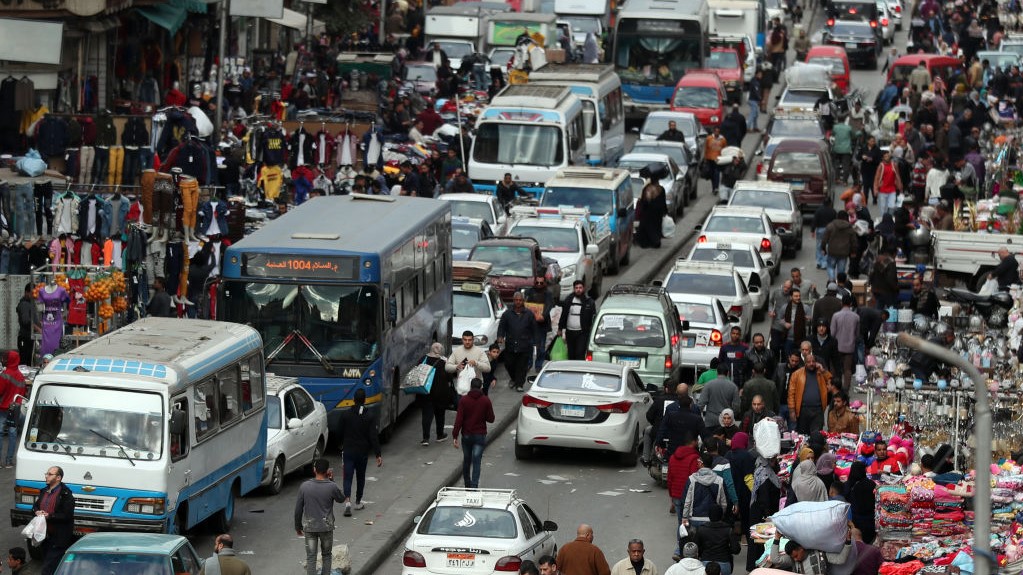
    A picture taken on December 12, 2017 shows an elevated view of al-Attaba district on the edge of downtown Cairo, Egypt. Egypt is the most populated coutry in the Arab world with some 96 million inhabitants and the numbers are rising by 1.6 million every year.
  • Analysis
  • Sustainable development: An unavoidable path for Egypt’s future

    Egypt has realized a significant number of changes in healthcare, education, and economic reform policy over the past decade. It is also increasingly looking toward policy for development that emphasizes cohesive problem solving, in line with its Vision 2030 strategy, which highlights the need for positive knock-on effects from investments in human development

    January 28, 2020

    The ties that bind: The South Caucasus and the Middle East
    Turkish Foreign Affairs Minister Mevlut Cavusoglu (C), Minister of Foreign Affairs of Iran, Javad Zarif (R) and Azerbaijani Minister of Foreign Affairs, Elmar Mammadyarov (L) pose for a photo prior the tripartite meeting of foreign ministers of Turkey, Azerbaijan and Iran in Istanbul, Turkey on October 30, 2018.
  • Analysis
  • The ties that bind: The South Caucasus and the Middle East

    As neighboring regions, the South Caucasus and the Middle East are inextricably intertwined — so much so that the former is sometimes even considered part of the Greater Middle East. While geographical proximity is the strongest driver of interconnectivity between the two regions, geopolitics, business ties, and energy interests also link countries from the South Caucasus and the Middle East and form the basis for important bilateral and regional relationships.

    January 24, 2020

    Iran’s “harsh revenge”: Is blocking the Strait of Hormuz really a plausible option?
    Iranian soldiers take part in the
  • Analysis
  • Iran’s “harsh revenge”: Is blocking the Strait of Hormuz really a plausible option?

    In the immediate aftermath of the assassination of Gen. Qassem Soleimani, head of the Islamic Revolutionary Guard Corps – Quds Force, on Jan. 3, Ayatollah Ali Khamenei warned the U.S. of Iran’s “harsh revenge.” There has been much speculation around the timing, location, and the type (or form) of Iran’s promised revenge. Amin Mohseni-Cheraghlou takes a closer look at the impact of the widely discussed strategy of blocking the Strait of Hormuz.

    January 23, 2020

    Why Iran will keep defying US and EU pressure
    Iranian Supreme Leader Ayatollah Ali Khamenei gives his first Friday sermon after eight years in the Imam Khomeini Musalla, in Tehran, Iran on January 17, 2020.
  • Analysis
  • Why Iran will keep defying US and EU pressure

    On Jan. 5, shortly after Qassem Soleimani was assassinated in Iraq by an American drone strike, Tehran announced that it would no longer remain committed to the enrichment restrictions laid out under the 2015 nuclear deal. Even though European diplomats have rushed to assuage Iranian concerns about the possible resumption of international sanctions, Tehran perceives this as an extension of the U.S. “maximum pressure” campaign and is very unlikely to back down or substantially change its defiant behavior — domestically promoted as a counterpolicy of “maximum resistance” — even if punitive UNSC resolutions against it are reinstated. 

    January 22, 2020

    Can the new Lebanese government survive?
    A handout picture provided by the Lebanese photo agency Dalati and Nohra shows Lebanon's Parliament Speaker Nabih Berri (C-L) and President Michel Aoun (C) and prime minister designate Hassan Diab (C-R) posing for a group photo with the newly formed government at the presidential palace in Baabda, east of the capital Beirut, on January 22, 2020.
  • Analysis
  • Can the new Lebanese government survive?

    No amount of analytical nuance or ingenuity can challenge the conclusion that the newly formed government in Lebanon is Hezbollah’s creation. The only question left to answer is: why did Hezbollah do it?

    January 22, 2020

    Qassem Soleimani’s reign may be over, but his legacy in Syria will endure
    yrians take part in a protest against the United States and in support of Iranian general Qassem Soleimani at the Saadallah al-Jabiri Square in Aleppo, northern Syria, on Jan. 7, 2020.
  • Analysis
  • Qassem Soleimani’s reign may be over, but his legacy in Syria will endure

    The U.S. assassination of Iranian Gen. Qassem Soleimani came as a seismic shock to the Middle East, not least to the embattled political system in Damascus that has reaped the benefits of Iran’s military involvement across the region. While his death will be a severe blow, it will not necessarily translate into a decline in Iran’s influence or military presence in Syria. Soleimani’s army of militias and supporters will outlast him, possibly by decades. 

    Lebanese oligarchs approve technocratic shadow government
    Lebanon's President Michel Aoun (L) meets with prime minister designate Hassan Diab at the presidential palace in Baabda, east of the capital Beirut, on January 21, 2020.
  • Commentary
  • Lebanese oligarchs approve technocratic shadow government

    The new government is politically aligned with the pro-Hezbollah and pro-Syrian axis in Lebanon, and is very unlikely to drum up international and regional support.

    January 21, 2020

    For Russia, Libya and Idlib are now part of the same gamble
    Syria's President Bashar al-Assad (L) and Russia's President Vladimir Putin during a meeting in the Cathedral of Our Lady of the Dormition.
  • Analysis
  • For Russia, Libya and Idlib are now part of the same gamble

    Although Moscow continues to reap the benefits of its Syrian campaign, it is increasingly faced with diminishing returns. Despite its greater geopolitical involvement in the country, the Kremlin has so far failed to extract major economic dividends and may soon face increased competition from Tehran. With Syria’s future clouded in uncertainty and the unresolved issue of the Idlib region hanging like the sword of Damocles over any potential political settlement, Russia is now trying to bring the Libyan conflict into the equation as well.

    January 21, 2020