US Military Assistance to Lebanon: A Discussion of the Pros and Cons
The Middle East Institute is proud to host Aram Nerguizian and David Schenker for a discussion about the pros and cons of US support to the Lebanese Armed Forces (LAF). In 2005, after the withdrawal of Syrian military forces from Lebanon and the subsequent election of a pro-Western Lebanese government, the Bush Administration pledged to help the LAF bolster domestic security and to strengthen state institutions. Since then, the US has provided more than $530 million in security assistance to the LAF and other Lebanese security forces.
This Commentary first appeared as an op-ed in the The National, March 14, 2010.
Iraq’s parliamentary elections have just concluded, but the major political battles are about to begin. At stake is what kind of country Iraq will become. Will Iraq’s progress toward greater stability continue? Will it look east towards Tehran for support and encouragement, or to the United States and its fellow Arabs? The stakes are high, and no one can afford to remain uninterested while Iraq continues its dramatic political evolution.
Beyond Iraq’s National Elections: Planning a New Phase in American Policy
This Commentary is an adaptation of a longer piece published by the Institute for the Theory and Practice of International Relations at the College of William and Mary on February 25, 2010.
Kurdish issues have been an important part of the myriad political and socioeconomic problems that have preoccupied the Islamic Republic of Iran since its inception. The Kurdish factor has also been an important determinant of Iran’s regional foreign policy in the past three decades. Shortly after the onset of the Iran-Iraq War of 1980-1988, the Iraqi government began to woo the Kurdish Democratic Party of Iran (KDPI) as potential leverage in its war effort.
Next to the Arab-Israeli conflict, perhaps few other topics in the history of the modern Middle East have captured the interest of policymakers and scholars alike as has post-revolutionary Iranian-Lebanese Shi‘ite relations, particularly the creation of Hizbullah. Although both groups have come to this topic with a set of similar questions — namely, what is the impact of this transnational network among Lebanese Shi‘ites and how does it operate? — thankfully, they have arrived at very different conclusions.
How the New Arab Media Challenges the Arab Militaries: The Case of the War between Israel and Hizbullah in 2006
One, Two / the Arab army where are you?/ The Arab army where are you?/The Egyptian Arab Army/ resides in an-Nasr [victory] compound/ Wakes up in the afternoon/ to drink its tea/ The Gulf Arab army/ can do absolutely nothing/ “Strategic silence” indeed/ “cut us some slack, man!”/ The Tunisian Arab army/ is green like parsley/ But ‘Aziza loves Yunis/ the wars can wait/ The Sudanese Arab army/ I can hear its clamor in my ears/ “Damn it!
The trials that have faced a sovereign Lebanon as it emerges from a long and bloody civil war, as well as Syrian and Israeli occupations, have been immense. In 2008, Beirut confronted an existential challenge. After years of conflict, the vast majority of Lebanese citizens clamored for positive change to buttress the state and to facilitate prosperity.
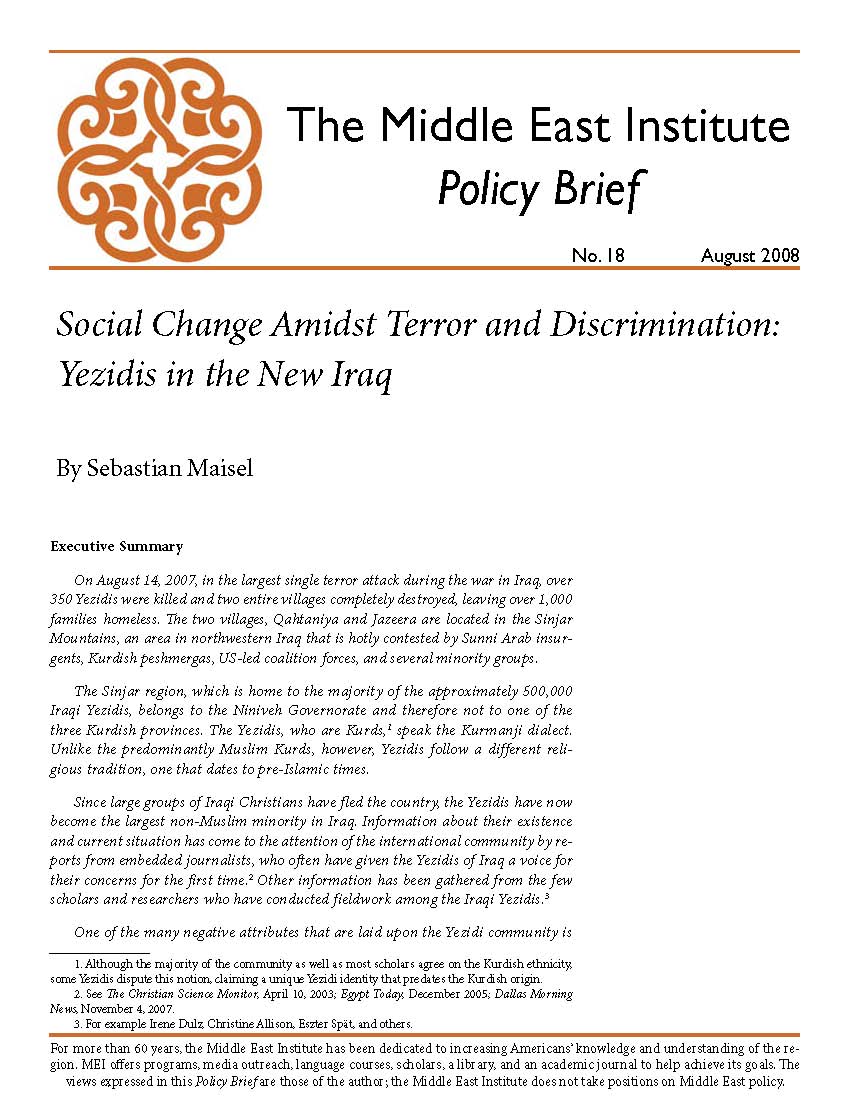
Social Change Amidst Terror and Discrimination: Yezidis in the New Iraq
Originally posted August 2008
On August 14, 2007, in the largest single terror attack during the war in Iraq, over 350 Yezidis were killed and two entire villages completely destroyed, leaving over 1,000 families homeless. The two villages, Qahtaniya and Jazeera are located in the Sinjar Mountains, an area in northwestern Iraq that is hotly contested by Sunni Arab insurgents, Kurdish peshmergas, US-led coalition forces, and several minority groups.