This article first appeared as an Op-Ed on Politico.com on September 19, 2011
Palestinian President Mahmoud Abbas early this week will likely fulfill his longstanding vow to introduce in the U.N. Security Council a resolution to recognize Palestine as the 194th member state. No one should be the least bit surprised.
The Middle East Institute is proud to host Ilan Peleg and Dov Waxman, authors of the book Israel's Palestinians:The Conflict Within (Cambridge, 2011), for a discussion about their findings. One in five citizens of Israel are Palestinian. Often overlooked by outside observers, the challenges facing the Palestinian minority in Israel are an inseparable part of the Israeli-Palestinian conflict. Resolving this conflict – a central concern of U.S. foreign policy and current international diplomacy – requires more than the establishment of a Palestinian state.
The Middle East Institute is proud to host Dr. Mona Makram-Ebeid, Professor of Political Science, American University of Cairo, and former Egyptian Parliamentarian, for an examination of the unprecedented changes that have taken place in Egypt over the last three months. Dr. Makram-Ebeid will analyze the current situation in Egypt, as well as expectations for upcoming parliamentary and presidential elections.
This Burning Land: Lessons from the Front Lines of the Transformed Israeli-Palestinian Conflict
The Middle East Institute is proud to host Greg Myre and Jennifer Griffin for a discussion about the ongoing challenges in the Israeli-Palestinian conflict based on their knowledge and experiences recounted in their new book, This Burning Land: Lessons from the Front Lines of the Transformed Israeli-Palestinian Conflict. Myre and Griffin, journalists who are husband and wife, traveled to Jerusalem in 1999 in hopes of finally seeing Middle East peace. Instead, the pair watched as violence in the area escalated and the peace process disintegrated.
This Burning Land: Lessons from the Front Lines of the Transformed Israeli-Palestinian Conflict
The Middle East Institute is proud to host Greg Myre and Jennifer Griffin for a discussion about the ongoing challenges in the Israeli-Palestinian conflict based on their knowledge and experiences recounted in their new book, This Burning Land: Lessons from the Front Lines of the Transformed Israeli-Palestinian Conflict. Myre and Griffin, journalists who are husband and wife, traveled to Jerusalem in 1999 in hopes of finally seeing Middle East peace. Instead, the pair watched as violence in the area escalated and the peace process disintegrated.
The Obama administration's efforts to win a settlement freeze as a confidence-building measure have failed, and the U.S.has not presented a new vision for resuming the moribund peace process. Nevertheless, many analysts now recommend shifting the diplomatic focus to negotiations to define the border between Israel and the future state of Palestine. Resolving the border would address the issues of settlements and Jerusalem as well as potential land swaps between the two states.
Israel After Egypt: Opportunities and Challenges for Peace
The Middle East Institute is proud to host the Honorable Robert Wexler and Dr. Yoram Peri for a discussion about the challenges facing Israel and the Middle East peace process in the wake of the resignation of Egyptian president Hosni Mubarak. Some in Israel, including former Israeli Prime Minister Ehud Olmert, argue that current events in the region make it imperative that Israel move quickly to secure a peace treaty with the Palestinians. Others insist Israel proceed with caution, given the increased instability in the region.
After the People's Revolution: An Examination of the Egyptian Military
The Middle East Institute is proud to host Dr. Graeme Bannerman and Col. Joseph Engelhardt for an in-depth look at the Egyptian military and its anticipated role in the wake of the resignation of Egyptian President Hosni Mubarak. Bannerman and Engelhardt have had extensive interaction with members of the Egyptian military over the past thirty years.
Covering Egypt, Covering Islam: What the Media Get Wrong (and Occasionally Right)
Drawing on over thirty years' experience covering Middle Eastern and Islamic issues, mostly for the BBC, Roger Hardy argues that the media have all too often shown a chronic lack of understanding of Islam and Muslim societies – and by distorting or sensationalizing Muslim issues have made it harder to combat extremism and win the 'war of ideas.' As Arab and Muslim protesters take to the streets of Cairo and the Arab world, Hardy examines if coverage and understanding of the Muslim world has deepened or improved.
After Mubarak:What do the Egyptian People Really Want?
The Middle East Institute is proud to host Steven Kull and Shibley Telhami for an examination of Egyptian views and attitudes towards governance and their future. As Egyptian demonstrators celebrate the resignation of President Hosni Mubarak, many wonder what kind of system the Egyptian people really want. How do they view the Muslim Brotherhood? If Egypt were to become more democratic what are we likely to see in terms of its relation with the US, Israel and other countries in the region?
The Middle East Institute is proud to host Amb. Alan Goulty and Amb. Edward Walker for an examination of the unrest roiling Tunisia and Egypt and its implications for the region at large. Between them, Goulty and Walker have more than 60 years of experience serving in the Arab world. They will draw upon their unique experience and understanding of the region to examine the evolving crises in Tunisia and Egypt, the impact of the street protests on regional governments and the role that Western governments can play during this period of transition.
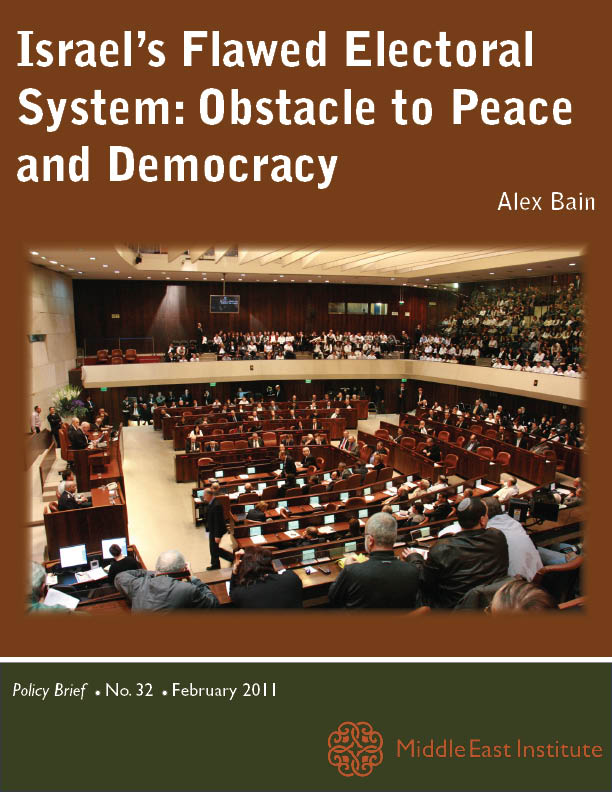
Israel's Flawed Electoral System: Obstacle to Peace and Democracy
Israeli politics is notable for its wide array of parties and unstable coalition governments. The main institutional cause of this chronic instability is the system of nationwide proportional representation, which gives disproportionate influence to minor parties. This instability limits the ability of Israeli governments to pursue coherent long-term strategies and leads to policies that address the concerns of minority groups at the expense of the national interest.