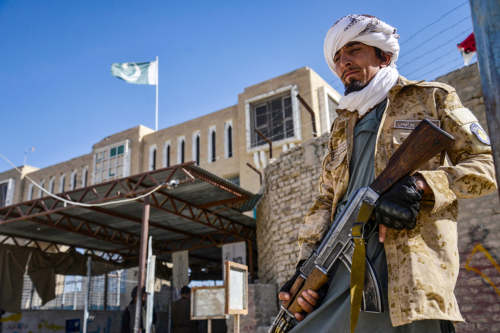
Pakistan’s relationship with the Afghan Taliban has shifted from open sponsorship in the 1990s to a silent partnership following 2001 to alienation and belligerence since 2021. Their current conflict, which comes at great cost to both countries and seems to have no easy military or political resolution, also poses a threat to the stability and prosperity of neighboring states.[1] Although American strategic interests in the region greatly diminished following the United States’ military withdrawal from Afghanistan in August 2021, the region’s altered political dynamics, notably its shifting political and military alignments, have prompted a growing American engagement with Pakistan and tentatively with Afghanistan. At the same time, the US has become a factor in how both Islamabad and Kabul have come to form their national security strategies.
The backdrop
Less than a decade after Pakistan’s founding in 1947, it entered the US strategic horizon as a member of a Cold War alliance structure created to contain the Soviet Union. The security partnership strengthened with the Pakistan-enabled Islamic jihad against the Soviets in the 1980s and was revived after September 11, 2001, to confront the Taliban insurgency in Afghanistan. For the two decades when thousands of US troops were deployed in Afghanistan, Pakistan’s grants of air rights and the availability of the port of Karachi were critical to sustaining the supply chain for the military campaign against Taliban insurgents. Over the same period of time, Pakistan was also central to the conflict for providing a safe haven to Afghan Taliban fighters, without which the insurgency probably could not have prevailed. But with the US military departure from Afghanistan, neither country figured in the US strategic calculus.
Washington designated Pakistan a “Major Non-NATO Ally” in 2004, thus raising relations to a strategic defense partnership. But the South Asian country subsequently saw its close association with the US replaced by a policy of benign neglect, which became plainly evident during President Joe Biden’s administration. A once well-financed counterterrorist program ended, and development and diplomatic ties were minimized. While concerns about the region again exporting terrorism and nuclear nonproliferation remained, Washington’s policymakers tried, as had President Barack Obama’s administration, to turn toward the Asia-Pacific theater, only to be forced by events to direct their attention to the Middle East and then Ukraine.
Detachment from Afghanistan severely sharpened this trend. Washington was anxious to put behind it the US military’s embarrassing exit and America’s failed efforts to build a constitutional, economically viable Afghan state. In its determination to isolate the country, the Biden administration cut off virtually all diplomatic engagement. Although the new government in Kabul was seen as violating the terms of the 2021 Doha agreement and giving refuge to regional terrorist groups, including al-Qaeda, the Taliban regime was itself judged as posing no direct threat to US national security. Both Afghanistan and Pakistan, then, were peripheral when measured against disturbing developments elsewhere in the world.
Relations between the US and Pakistan have assumed a decidedly warmer tone and undergone some reevaluation under the current administration of a transactionally minded President Donald J. Trump. The renewed interest in Pakistan has centered on its offering to provide the US with critical rare earth minerals vital to meeting American energy and defense industry needs and promising opportunities for new American investment. In exchange, Islamabad has sought from the US a policy more sensitive to Pakistan’s foreign policy priorities as well as more willing to press the International Monetary Fund to be more understanding of the country’s critical economic condition. Bilaterally, greater military-to-military engagement has recently brought an agreement on enhanced security cooperation along Pakistan’s borders with Afghanistan and Iran that comes on top of already strengthened US training and military sales programs. The closer US embrace is also marked by the warm relations that have developed between Pakistan’s military chief, Field Marshal Asim Munir, and the White House and top US brass. Cooling US relations with India under the Trump administration have additionally played a role in helping to cement closer ties with Pakistan, as has Washington’s desire to make Islamabad at least somewhat less economically dependent on Chinese investment. On a still larger canvas, with Pakistan as a partner, the US may also be better positioned to regain a geostrategic foothold in a region that has increasingly come under Chinese influence.
The conflict
The enmity between Pakistan and Afghanistan finds its roots in the policy undertaken by a British colonial official in 1893 that divided the unruly Pashtun tribes of pre-Pakistan India and Afghanistan. Ever since the creation of Pakistan in 1947, Afghanistan worried about domination by its more powerful, often overbearing neighbor to the east. It responded by both championing the idea of creating Pashtunistan — a separate ethnic-defined state to be carved out of northwest Pakistan — and seeking a counterweight through establishing a strong relationship with Pakistan’s nemesis India. Successive Afghan regimes have resisted Pakistan’s efforts to employ them as an element of the latter’s strategic defense against Hindu India. While the issue of Pashtunistan remains an irritant in relations, it has been overshadowed by ideological differences.
The Taliban has proven able to consolidate its grip on power, surviving without international recognition and despite sanctions, all the while projecting an image of self-reliance and resilience in rejecting external pressures. Its leadership appears assured that in time the world will have to acknowledge the Taliban’s full authority in Afghanistan and legitimacy as a sovereign government. The group’s confidence stems from its having seized control of Afghanistan from the world’s most powerful military force. The Taliban members’ perception of themselves as battle-hardened fighters with a mission to purify Afghanistan by enforcing of a truer version of Islamic law and precepts distinguishes their thinking. As essentially an ideological regime, its leaders have been resistant to transactional behavior and less susceptible to pressures for compliance with international norms of diplomacy.
The current Pakistan-Afghanistan crisis grows out of the sanctuary the Kabul government provides to an offshoot militant movement, the Tehreek-e-Taliban (TTP), dedicated to making Pakistan like Afghanistan, more authentically a radical caliphate. Since the Afghan Taliban’s seizure of power in August 2021, the TTP, facilitated by the Kabul government, has launched cross-border terrorist attacks against Pakistan that have left thousands of security personnel and civilians dead. This comes despite the Afghan Taliban’s pledge in the February 2020 Doha agreement — which had set the stage for the US decision to withdraw its forces from Afghanistan — to bar any third parties from using Afghan territory to conduct acts of terrorism against any other group or country.
All efforts aimed at ending the impasse over the TTP have failed to date. Taliban leaders have arranged direct negotiations between the TTP and the Islamabad government; and China, Qatar, Turkey, and Saudi Arabia have attempted to mediate. Talks have, however, only served to highlight the existing chasm between the two on basic issues. The Taliban is unwilling to jettison the long-allied-with-it TTP, while the Pakistani military has firmly rejected proposals for a peace deal that it believes would likely empower the extremist terrorists and destabilize Pakistan. To placate Islamabad, the Kabul government has tried to get the TTP to move its fighters further from the border. But escalating violence has led Pakistan’s military to undertake strikes on TTP encampments and other targets inside Afghanistan, including in Kabul. Targeted military action could not dissuade Kabul from maintaining its ties to the TTP, however; and so Pakistani Field Marshall Munir threatened to unleash a “crushing blow” against the Afghan state in the form of intensified bombing attacks combined with the provision of arms to local resistance groups seeking regime change in Afghanistan.
Pakistan is unlikely to follow through on such regime change threats because it would be too unpredictable and possibly destabilize the whole region. Although Pakistan has overwhelming military superiority, ground forces introduced into Afghanistan to wipe out TTP strongholds could expect to face battle-tested Taliban defenders likely to resort to asymmetric guerrilla warfare. Islamabad also has to take into consideration the possibility that enlarging the war could succeed in unifying Afghans in opposition to the attackers. Moreover, an expanded military campaign in Afghanistan might divert Pakistan’s own security forces from countering terrorist threats and could activate domestic radical, anti-state Islamist groups. No matter how effective, it would certain prove financially costly for the already economically hard-pressed government and could generate political resistance at home, particularly from within largely Pashtun Khyber Pakhtunkhwa. Like the province’s ever-popular ruling political party of the jailed Imran Khan, most of Khyber Pakhtunkhwa’s public would prefer a more conciliatory approach to the Afghan Taliban.
To pressure Kabul to halt the infiltration by the TTP and other terrorist groups, Islamabad has applied economic pressure. More than 2.8 million Afghans, many of them long-time residents of Pakistan, have been expelled, creating a heavy burden for an Afghan government forced to seek ways to resettle them. Pakistan also frequently closes off key border crossings to trade with its western neighbor, worsening Afghanistan’s hard-pressed economy. That trade squeeze inflicts severe damage on land-locked Afghanistan’s economy, but it comes at a high cost to Pakistan as well. Khyber Pakhtunkhwa Province is closely linked to Afghan markets, and the closures block Pakistan’s expanding trade with Central Asia. The suspension of Afghan trade with Pakistan is also accelerating efforts by the Taliban regime to replace Pakistani routes with those through Iran that link with India and Europe.
Worsened relations between Pakistan and Afghanistan have had geopolitical consequences aside from pushing Afghanistan closer to Iran and India. They distract from efforts by Islamabad to better align policies with Middle Eastern states on major political issues and demonstrate the limited scope of Pakistan’s defense agreement with Saudi Arabia that calls for the kingdom to lend military assistance. The Saudis have no intention of being drawn into Pakistan’s conflicts involving Afghanistan or India. The absence of peace between Pakistan and Afghanistan also undermines efforts to achieve long-planned regional economic integration, which hinges on cooperation between Afghanistan and Pakistan. Similarly, much of the plans that China has had for its Belt and Road Initiative are reliant on Afghanistan and Pakistan being at peace. Should India’s political and economic embrace of the Kabul government lead to providing security support, there exists the danger of igniting a major conflict between the two nuclear states.
US involvement
With no resolution of their differences in sight, it has naturally been asked whether President Trump, so active in peacemaking initiatives across the map, might step in to lower the tempers between Pakistan and Afghanistan. Early in his second administration, the US president had expressed an interest in intervening between the two countries. On the face of it the United States would not seem well positioned to assume the role of mediator. Unlike Russia, China, nearly all regional powers, or the European Union, the US is not engaged diplomatically through a presence in Kabul. The once-large humanitarian food, health, and development aid flows that might have given the US leverage were largely terminated early in the Trump administration. Washington’s recent embrace of Pakistan also raises questions about whether it would act as an honest broker.
Yet the US is not entirely without the means to influence the Taliban leadership. In its quest for international legitimacy, the Afghan regime would find few things more meaningful than US diplomatic recognition, or at least the establishing of a permanent diplomatic mission in Kabul. Taliban officials have shown strong interest in attracting American economic investment and US assistance with obtaining international loans. As much as the Taliban regime is sanctioned, it is also indirectly propped up by US financial policies that stabilize the Afghan banking system and help avert economic collapse that would lead to massive unemployment and a new mass exodus of refugees. The US also has untapped leverage through the previously frozen $3.5 billion in Afghan reserves that have been released from US accounts, designated to strengthen the Afghan economy but never distributed.
A serious obstacle to US involvement with the Pakistani-Afghan conflict is American public sentiment. The trauma of the turbulent US withdrawal lingers, and the partisan politicalization of that event makes it harder to build a policy consensus. Complicating any renewed American involvement are those influential domestic groups prioritizing human rights and wishing to see US government efforts directed toward sanctioning the Taliban regime for its stance on women’s education. Some groups are also likely to question the US assuming a mediating role between Pakistan and Afghanistan if that results in the prolonging of Taliban rule and undermining the latter’s commitment to forming a politically integrated government.
But Washington cannot be indifferent to a continuing Pakistan-Afghanistan confrontation that acts as an obstacle to the realization of US security and foreign policy interests. Pakistan’s warring with the Taliban regime serves as a distraction from the aims of the newfound Pakistani-US embrace as well as the US’s tacitly endorsed mutual defense arrangement between Pakistan and Saudi Arabia. Regionally, the frequent border closings by Pakistan are drawing Afghanistan closer economically and politically to Iran and making it more dependent on the Chinese for investment. US hopes for counterterrorism cooperation with the government in Kabul against the Islamic State-Khorasan Province (ISKP) seem impossible while the Afghan-backed TTP foments violence in Pakistan’s Khyber Pakhtunkhwa and Balochistan provinces. With the TTP removed from the picture, US concerns of increased domestic Islamic radicalism in Pakistan threatening the security of its nuclear armory could greatly lessen.
Conflict management
The Afghan Taliban has an incentive to prolong its conflict with Pakistan, not in hopes of scoring a clear victory but to avoid defeat that could diminish its hard-fought takeover of Afghanistan. Pakistan, meanwhile, faces a difficult dilemma: It prefers to avert the costs of an all-out war with Afghanistan but cannot allow Taliban-facilitated terrorism within its borders to continue unchecked, an outcome that could call into question the Pakistani military’s stewardship of the country as its ultimate guarantor of domestic security. If there is in fact no visible military or diplomatic means to end the present conflict, probably the best that can be achieved is management that holds outbreaks of fighting to a low level. For this to happen, regional actors and the international community may have to weigh in, as might the US, with its economic, political, and military muscle. This will require, however, far greater diplomatic engagement than Washington has been prepared to exercise to date.
Pakistan and Afghanistan in the context of evolving US national security strategy
The 2025 US National Security Strategy (NSS) increasingly emphasizes the integration of economic strength, military superiority, and technological leadership as the foundations of American power. Central to this strategy is the recognition that economic security is inseparable from national security — a principle that gained prominence during the first Trump administration. Preserving US global leadership requires not only military readiness but also resilient industrial capacity, secure supply chains, and sustained access to critical resources that underpin advanced technologies and defense systems.
A core component of this strategic outlook is the protection and diversification of supply chains for critical minerals and materials. These resources are essential for defense manufacturing, energy security, and emerging technologies. The NSS highlights the need to counter predatory economic practices, reduce overdependence on adversarial suppliers, and ensure that key global assets remain free from hostile foreign ownership or control. To this end, the US intelligence community is tasked with monitoring global supply chains, foreign investments, and technological advances to ensure the US maintains a competitive edge over its strategic rivals.
Within this broader geoeconomic framework, preventing China from consolidating dominance over critical mineral supply chains has become a major US strategic priority. China’s extensive investments in mining, processing, and infrastructure across Asia, Africa, and Latin America pose long-term risks to US economic and national security. It is in this context that Pakistan and Afghanistan assume heightened strategic relevance for Washington, given their significant reserves of rare earth elements and other critical minerals.
Despite Pakistan’s longstanding strategic alignment with China, Islamabad has demonstrated a willingness to engage the United States through cooperation on critical minerals. The conclusion of a US-Pakistan critical minerals agreement reflects Pakistan’s desire to diversify its economic partnerships and signals an opportunity for Washington to secure alternative sources of strategically important materials. However, the viability of such cooperation is contingent upon security and stability within Pakistan. For the US, uninterrupted access to critical minerals requires a stable operating environment, particularly in regions where mining and infrastructure development would occur.
As a result, counterterrorism cooperation becomes an indirect but essential component of US economic and strategic interests. Support for Pakistan’s counterterrorism efforts — especially in areas linked to critical mineral extraction — aligns with US objectives of securing supply chains while maintaining influence in a region where Chinese presence continues to expand. At the same time, Washington seeks to ensure that Pakistan does not further drift into China’s strategic orbit, even if full economic decoupling from Beijing remains unrealistic.
Unlike China, the US cannot replicate large-scale economic corridor projects or provide comparable levels of infrastructure financing to reshape Pakistan’s strategic orientation. Instead, the US can pursue targeted, high-impact economic initiatives. One such approach is the development of a US-Pakistan mineral corridor focused on exploration, extraction, processing, and secure transportation of critical minerals. This model would enhance US supply-chain resilience while offering Pakistan economic incentives without directly competing with China’s Belt and Road-style investments.
Afghanistan further confounds this strategic landscape. Persistent instability, coupled with the presence of terrorist networks, poses risks not only to regional security but also to any long-term resource-development initiatives. Pakistan attributes cross-border terrorist attacks to militant groups operating from Afghan territory and alleges an India-Afghan Taliban nexus behind these activities. These accusations introduce a sensitive geopolitical dimension for the US, particularly given its strategic partnership with India.
Deeper US involvement in Pakistan’s counterterrorism campaign would likely generate expectations in Islamabad that Washington use its leverage to pressure New Delhi. Such involvement risks entangling the United States in regional rivalries that the NSS generally seeks to avoid. Consequently, the US strategy reflects a predisposition toward non-intervention in bilateral disputes, intervening directly only when core American interests are threatened.
From this perspective, US intervention on Pakistan’s behalf — particularly to influence India — would most likely occur only if American strategic assets, such as critical mineral projects, are to be directly targeted by terrorist activity, potentially with credible evidence of external state involvement. Short of such circumstances, Washington is likely to rely on diplomatic balancing rather than coercive engagement.
President Trump’s doctrine of “peace through strength” offers a potential framework for managing these competing interests. By leveraging US strategic relationships with both India and Pakistan, Washington could facilitate a limited and pragmatic understanding between the two rivals. Such an approach would aim to prevent Afghanistan from being used as a theater for proxy conflict and reduce incentives for destabilizing behavior.
If Pakistan continues to view India as a driver of terrorism through Afghan-based networks, the United States could seek to address these concerns by restraining Indian-linked activities perceived as hostile, while simultaneously pressing Pakistan to curtail actions that India views as threatening to its security. Given the US long-term defense partnership with India and its renewed engagement with Pakistan, Washington is uniquely positioned to encourage reciprocal restraint.
A durable easing of India-Pakistan tensions would have significant implications for Afghanistan as well. With regional rivalries diminished, Pakistan would be less inclined to view Afghan-based militancy through the lens of Indian involvement, while greater pressure would emerge on the Afghan Taliban to meet international demands to cut ties with anti-Pakistan militant groups. Over time, this could contribute to greater regional stability and create conditions more conducive to economic development and resource extraction.
Ultimately, stability in Pakistan and Afghanistan serves broader US national security objectives. Securing access to critical minerals, protecting global supply chains, reducing the risk of regional conflict, and constraining China’s expanding influence in South and Central Asia are all aligned with core American strategic interests. In this sense, Pakistan and Afghanistan are not peripheral concerns but integral components of the evolving US national security strategy.
Marvin G. Weinbaum is a Senior Fellow at the Middle East Institute, focusing on Afghanistan and Pakistan. He is a professor emeritus of political science at the University of Illinois at Urbana-Champaign and served as analyst for Pakistan and Afghanistan in the US Department of State’s Bureau of Intelligence and Research from 1999 to 2003.
Naade Ali is currently serving as a Research Assistant to Dr. Weinbaum at MEI. He has more than five years of involvement working with international organizations and think tanks as a political researcher, policy advisor, peace strategist, and human rights practitioner with experience in human and national security, democratization, conflict resolution, and political culture. Prior to joining MEI, Ali worked with Media Foundation 360, a think tank dedicated to strengthening democratic practices in Pakistan.
[1] For those interested in a rapporteur’s summary of two expert panel discussions on this topic, hosted by the MEI in May and November 2025, see Arif Ansar, “The Evolving US Posture and the Perpetual Crisis: Afghanistan-Pakistan Conflict: What Does it Mean for Regional Stability and US Strategic Interests.”
Photo by Sanaullah Seiam/AFP via Getty Images
The Middle East Institute (MEI) is an independent, non-partisan, not-for-profit, educational organization. It does not engage in advocacy and its scholars’ opinions are their own. MEI welcomes financial donations, but retains sole editorial control over its work and its publications reflect only the authors’ views. For a listing of MEI donors, please click here.

Russia’s Taliban Embrace Signals a New Power Shift in Afghanistan
The Pakistani General Running Washington’s Backchannel to Tehran
