Board of Peace Meets as Storm Clouds Gather for Another Possible Middle East War
Making Sense: A Regular Take on US Foreign Policy
February 20, 2026
Share
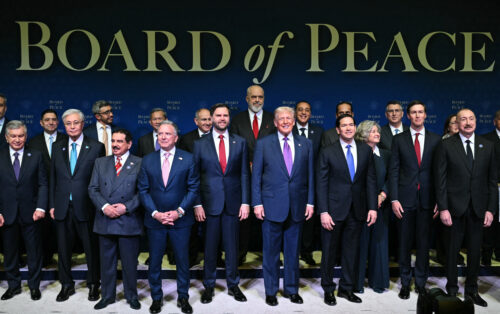
US President Donald Trump hosted an idiosyncratic gathering of global representatives in Washington on February 19 that included some key Middle East figures. They all came together under the banner of peace to discuss the next steps in Gaza, just as the US was sending more military forces to the region to pressure and possibly target Iran.
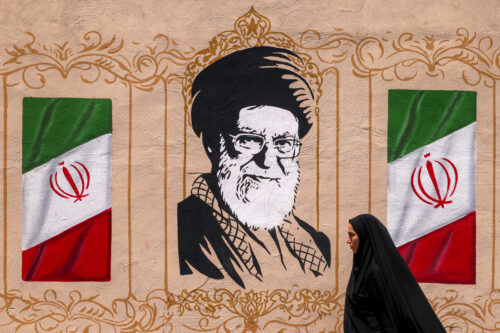
These two big strategic files, Iran and the Israel-Palestine question, have loomed large in US policy for many years, and quite often they are treated as separate in a “stove-piped” manner by US administrations — Republican and Democratic alike. But in my discussions with multiple figures and analysts from the region, these issues are very much seen as interlinked in ways that are often not reflected in how US policy is crafted. Put simply, the Islamic Republic of Iran’s actions in destabilizing the region with ballistic missiles and the lack of serious progress toward a just and sustainable peace between Palestinians and Israelis are inextricably entwined.
With President Trump preparing to deliver the first State of the Union address of his second term on February 24, an address typically focused on a crowded slate of domestic policy issues, the Middle East might end up rising higher on the agenda — particularly if the United States moves closer to another round of conflict with Iran.
Two overarching issues are worth watching in the coming weeks:
1. Who will actually lead the implementation of the next policy steps on the Israel-Palestine front?
The ostensible purpose of the Board of Peace meeting was to announce troop commitments and billions in funding to secure and rebuild Gaza, a step forward into the next phase of implementing the 20-point plan that Trump released last fall after securing a cease-fire and release of the last hostages held by Hamas in Gaza. That cease-fire was an important accomplishment in Trump’s first year, and it set the framework for the contributions announced on February 19.
Four main questions raised in October when the cease-fire was reached remain unanswered:
Who will disarm Hamas?
Who will actually govern Gaza?
Will Israel take meaningful steps forward in implementing this plan?
Will the Trump administration have the bandwidth to focus on the next policy implementation steps, given everything else that it is juggling at home and abroad?
A key metric of success on this front is whether the organizations and structures meant to play key roles on Gaza, including the Board of Peace, the National Committee for the Administration of Gaza, and the Civil-Military Coordination Center, are coordinated in clear ways that produce stability, allow for reconstruction, and address Israel’s security concerns.
In the aftermath of the Board of Peace meeting, it remains unclear how these different bodies will coordinate their efforts. It is also unclear how they will interact with the Palestinian Authority, based in Ramallah, which is only tangentially linked, if at all. This lack of clarity risks repeating the mistakes made in last year’s failed Gaza Humanitarian Foundation initiative and past US policy fumbles, like the early years in Iraq with the Coalition Provisional Authority, that resulted from a rush to action without proper planning or transparency about how resources are managed.
The most important question right now is whether Hamas will lay down its arms, which, according to President Trump, is “the only thing that’s right now standing in the way.” Israel has threatened to restart military operations in Gaza soon if Hamas does not disarm. Were it to do so, that would likely upset the entire venture discussed at the Board of Peace meeting.
2. Will US policy on Iran take a path of war or diplomacy at this critical fork in the road?
The United States is deploying military forces to the Middle East just as it is reengaging Iran in talks about its nuclear program. America now has the most air power in the region since the 2003 Iraq war, and signs are pointing toward another possible military intervention targeting the Iranian regime.
The public readouts of talks held this month in Oman and Switzerland are mixed but seem to indicate that the bottom-line positions of the United States and Iran are still very far apart. Trump has continued to threaten Tehran with military action for a variety of reasons — last month in reaction to the regime’s brutal crackdown on protests, and more recently linked to negotiations over its nuclear program, ballistic missiles, and other tools in Iran’s arsenal that have destabilized the region.
Several factors are influencing Trump’s decision on what course to take — including whether or not the Iranian regime is negotiating in good faith, the views of America’s regional partners, and the US military’s assessment of the likely impact of various options. It remains unclear where things might head, but the next few weeks will likely be pivotal.
One key thing to watch in the Middle East this spring is how these two major files interact with each other — war against Iran could have a significant destabilizing effect on the plans outlined in the Board of Peace meeting. The lack of serious progress in Gaza — or continued moves by the Israeli government to seize territory in the West Bank — could inflame wider tensions across the Middle East, particularly among the members of Iran’s so-called “Axis of Resistance,” including the Houthis in Yemen and Hizballah in Lebanon, which have consistently exploited the Palestinian issue in their propaganda.
The Middle East is now sitting in a tenuous calm — but it is unclear if it is a calm before a storm or a transition to a wider set of diplomatic deals that stabilize the region. The course the United States chooses on both Iran and the Israel-Palestine front will have consequential spillover effects across the region. During the first year of his second term in office, President Trump has focused on the Middle East unlike any other US president since Barack Obama in his first term, and his impact has been mixed.
The coming days and weeks will offer an important test of whether Trump will build on his successes and strengthen some of the weaker aspects of his Middle East policy.
Brian Katulis is a Senior Fellow at the Middle East Institute.
Photo by Saul Loeb / AFP via Getty Images
The Middle East Institute (MEI) is an independent, non-partisan, not-for-profit, educational organization. It does not engage in advocacy and its scholars’ opinions are their own. MEI welcomes financial donations, but retains sole editorial control over its work and its publications reflect only the authors’ views. For a listing of MEI donors, please click here.