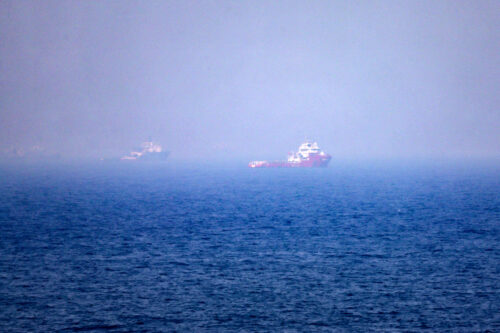
When the war between the United States and Iran flared again in mid-July, the battlefield was already much larger than Iran. On 18 July, American strikes hit areas stretching from Ahvaz and Yazd to Bandar Abbas, Qeshm and Chabahar. Tehran claimed in return to have hit American military facilities in Kuwait, Jordan, Oman, Qatar and Bahrain, with another missile reportedly aimed at a US base in Saudi Arabia. At sea, the Revolutionary Guards claimed two tankers had been hit trying to cross a mined area south of the Strait of Hormuz. Much of the detail remains contested or unverified, but the geography told the story: the war had moved from being about Iran to being about the Persian Gulf around it.
Then came an alert around Yanbu, Saudi Arabia’s great oil outlet on the Red Sea, sitting at the end of the East-West Pipeline built to let Saudi oil escape the Gulf without passing through Hormuz — for years, part of Riyadh’s answer to Iran’s geography. If the war can reach Yanbu, even the escape route from Hormuz is no longer necessarily an escape.
The Middle East Institute (MEI) is an independent, non-partisan, not-for-profit, educational organization. It does not engage in advocacy and its scholars’ opinions are their own. MEI welcomes financial donations, but retains sole editorial control over its work and its publications reflect only the authors’ views. For a listing of MEI donors, please click here.