This article is part of a collection of short essays written by the Fellows of the Middle East Institute to explore aspects of the ongoing war with Iran. The intent of the collection is to help readers see new and unexpected elements of the dynamics and impact of the ongoing hostilities and to think harder, deeper, and broader about the implications of the conflict. To read the other essays from this collection, as well as download the full report, please click here.
A war that the White House initially hoped would last for days or, at most, a few weeks has now dragged on for more than six months, with prospects for a resolution frustratingly remote. A comprehensive deal with Iran encompassing its nuclear enrichment and ballistic missile programs as well as its ties to violent non-state actors appears further away than at any point in recent years. Regional partners have suffered significant physical damage to key infrastructure as well as reputational damage: they are no longer seen as insulated from an otherwise tumultuous region. Iran has suffered setbacks of its own to its military capabilities but has so far proven durable in sustaining its asymmetric advantages and even rebuilding some of these capacities under pressure. Moreover, having on multiple occasions both threatened significant attacks on Iran and signaled an imminent peace agreement with little if any follow-through or accuracy, the Trump administration’s credibility among friend and foe alike is nearly exhausted.
With the war still simmering and little sign of a diplomatic solution on the horizon, assumptions pertaining to US defense strategy beyond the conflict should be considered preliminary and revised regularly. Yet there is little evidence that the new, more hardline Iranian leadership is prioritizing how best to exploit its leverage over the Strait of Hormuz to secure long-term stability. Rather, it appears more focused on exerting pressure on the US while seeking economic benefits from its neighbors. Even if some near-term accommodation is reached, the current regime is likely to continue to rely on asymmetric threats as a means of both deterrence and extortion. Curbing this leverage in coordination and cooperation with regional allies and partners should be the cornerstone of revised US strategy.
Immediate Lessons of the Iran War and Assumptions Guiding US Regional Defense Strategy
On defense and security, the Iran war offers multiple lessons that should shape US strategic thinking. The network of regional air and missile defenses the US was instrumental in developing and facilitating proved very effective in repelling an array of Iranian attacks across the region. These systems were designed for smaller numbers of more advanced ballistic missiles, and when put against Iran’s large stock of lower-trajectory swarming projectiles, they were challenged and forced to expend interceptors at high, unsustainable rates. The US military also was limited in how it confronted some of Iran’s other asymmetric capabilities. The US Navy lacked both the minesweeping vessels to keep the Strait of Hormuz clear and the frigates best suited to escorting commercial shipping. In addition, Iran has been successful in resuscitating relations with its network of regional non-state proxy actors, many of whom have engaged in strikes of their own against US and partner targets in the region. Finally, multiple reports suggest that Russia and China have provided direct support to Iran via intelligence sharing, access to sensitive equipment, and the development of increasingly advanced missiles and rockets.
In terms of force posture and resourcing, US Central Command (CENTCOM) — the American combatant command responsible for the Middle East — will need to conduct a thorough reassessment of the strategic benefits, risks, and costs of its regional force laydown in the wake of the Iran war. Moreover, the high costs associated with sustaining the war for six months and counting will compel both Congress and the Pentagon to closely examine any significant future resource allocations to the Middle East. In this context, a more limited strategy focused on shared threats and vulnerabilities may appear advantageous to US policymakers as the security environment in the Middle East continues to evolve.
Assessing the Evolving Strategic Environment
Before assessing US strategic interests and options in the Middle East beyond the Iran war, it is important to first examine how elements such as the perspective of allies and partners, rival capabilities, and the general threat environment have changed over recent months.
Expectations surrounding US regional security guarantees among allies and partners have diminished following months of persistent Iranian reprisal attacks without diplomatic resolution. As such, many have accelerated efforts to establish, formalize, or expand upon more localized multilateral defense accords. A hallmark foreign policy achievement of the first Trump administration, the Abraham Accords, enabled Arab and Muslim states to initiate or expand ties with Israel.[*] Israel’s heavy-handed response in Gaza to the attacks of October 7, offensives in southern Lebanon, de facto steps toward the annexation of the West Bank, and its comprehensive pursuit of the “seven-front war” (which briefly became eight, when Israel conducted an air strike against Doha in September 2025, targeting senior Hamas negotiators) have collectively quashed any hope of Abraham Accords expansion.
Instead, Saudi Arabia inked a new defense and security agreement with Pakistan in the fall of 2025, and in August 2026, these two countries were joined by Turkey in formalizing a similar pact dubbed the Mecca Joint Defense Agreement. While these pacts were not formed explicitly to counterbalance the Abraham Accords, factors such as recent elevated tensions between Israel and Turkey and episodic rivalries between Saudi Arabia and the United Arab Emirates suggest at least the possibility of competing Middle Eastern blocs. Other regional actors have thus far preferred not to commit to either of these, but the current trend points to increased interest in such options. These nascent agreements serve as both an opportunity and a challenge for US policymakers: an opportunity insofar as these partnerships can increasingly take on a greater share of security responsibilities in line with stated US objectives, but a challenge in that the US must make every effort to avoid being pulled into rivalries or tension points that may arise as these blocs take shape.
Another complicating factor for US policymakers is the potential impact of extra-regional flashpoints. Heightened tensions throughout the Middle East have obscured the fact that US allies and partners have been expanding the geographic scope of their activities. The Red Sea area is increasingly becoming a point of emphasis and a sub-region of competing interests among Middle Eastern actors. Likewise, as of late 2025, the newly formed Israel-Greece-Cyprus Trilateral Axis centers on defense cooperation and procurement, posing a direct challenge to Turkey’s interests in the Mediterranean and indirectly involving North Atlantic Treaty Organization (NATO) equities. Finally, India has signaled growing interest in the region via its involvement first in the Israel-India-UAE-US (I2U2) grouping and later the India-Middle East-Europe Economic Corridor (IMEC). Though these frameworks are not directly involved in defense and security matters, the routes eventually adopted for infrastructural development to support enhanced trade under these frameworks could become yet another point of regional tension. Reports already suggest the Saudis are considering using Syria as a means of entirely bypassing planned trade corridors linking with Israel.
For its part, Iran is entrenched as the primary regional threat and has proven adept at exploiting its newfound leverage. This is underscored by a demonstrated capability to strike targets with great precision and successfully evade current air and missile defenses with greater frequency. It has also proven resilient in sustaining and replenishing its stocks of missiles, rockets, and drones in the face of persistent US strikes. Reports also suggest that Iran has benefitted from Chinese and Russian assistance that includes intelligence sharing, access to sensitive technologies, and cooperation on developing more advanced missiles. Moreover, recent leadership changes and restructuring of its security apparatus suggest the regime is solidifying more hardline stances. Its demands on the US and the region remain largely maximalist, and it appears intent on protracting some semblance of conflict, at least through President Donald Trump’s current term. This points to prolonged instability stemming from Iran but also presents the US with an opportunity to unify its regional partners in developing a defense architecture better tailored to diminishing Iran’s asymmetric advantages.
US Strategic Imperatives for the Middle East: Prioritization and Discipline
The US continues to maintain significant interests in the Middle East. Issues such as providing for energy security, preventing nuclear proliferation, protecting freedom of movement through key waterways, and confronting violent extremist and terrorist threats are evergreen concerns with high relevance to US security and the American economy. Beyond national security concerns, the Middle East’s importance to the United States stems from the fact that regional partners are investing heavily in an array of emerging technologies and offer US industry both key partnership opportunities and lucrative markets. Finally, the geography of the region places it at the crossroads of Europe, Asia, and Africa, and access to its waterways and land routes makes it a vital component of global trade. While some combination of false assumptions, poor advice, overly optimistic expectations, and lack of clarity has driven numerous US strategic missteps in the Middle East over the decades, the abovementioned broad interests continue to be relevant even as the environment evolves.
Events that will likely reshape the geopolitical balance of the region are unfolding rapidly and unpredictably. In this environment, the US needs to be deliberate in devising a revised strategic vision for the Middle East that articulates near- to medium-term priorities and then must remain disciplined in implementing it over the long term. Underpinning this should be a concerted effort to build back trust in the US as both a security enabler and interlocutor. With the expansion of the Abraham Accords on hold and other multilateral arrangements sprouting across the region, the eye of the needle the US must thread to maintain its relationships and facilitate stability has grown narrower.
The US should prioritize engagement among key regional actors to help ensure that geopolitical rivalries do not foment potentially disruptive regional blocs. This must incorporate points of both mutual interest and tension that are increasingly expanding to the periphery of the region. In this role the US must support efforts to increase defense and economic interconnectivity while working to ensure that any disparate or overlapping efforts do not create or enhance points of tension. From a security cooperation standpoint, the trend away from relationships predicated almost exclusively on availing partners of US expertise and technologies toward increased shared and coordinated efforts was in motion prior to the war. Many US regional partners have growing defense industrial bases that value US collaboration and will continue to expand in the wake of this year’s conflict with Iran. The US defense community is well-placed to leverage this in identifying priorities that focus on mutual threats rather than potentially destabilizing rivalries.
Chief among these priorities should be the establishment of revamped air and missile defenses that more comprehensively address the gaps and vulnerabilities identified over the course of the war. This is the most direct way to degrade Iran’s asymmetric leverage in the near term and should positively resonate among US regional partners, almost all of whom have been subjected to Iranian attacks. An initial step should be to work with regional partners in reconceptualizing the requirements for a more robust and efficient air- and missile-defense network better equipped to confront the array of projectiles Iran has at its disposal. Achieving integrated air and missile defenses in the region has long been a CENTCOM objective, but a concerted effort under current conditions can keep partners focused on the enduring threat posed by Iran and its network of non-state actors.
This can inform a plan to rebuild and replenish assets damaged and expended during the war, contest Iran’s lower-trajectory and swarming projectiles more efficiently, and support a comprehensive network that can rapidly distinguish between such threats and employ the ideal countermeasure. To catalyze regional cooperation, the US should be proactive in demonstrating both the economic efficiencies and enhanced benefits of establishing an air- and missile-defense architecture that is integrated (and advocating for the acquisition of interoperable equipment regardless of source).
Aside from keeping regional partners focused on the common Iranian threat, the US will have to be assertive in addressing other political hurdles to achieving integration, both domestically and among partners. These include long-standing challenges tied to sovereignty, classification, and releasability barriers. Additionally, in the wake of the Iran war, the US defense-industrial base will require time to meet the collective demand to replenish interceptors and other key materiel. Given this and the urgency of the threat, US policymakers should be flexible and even support regional partner engagement with other friendly nations in helping meet immediate requirements. This is already occurring as Gulf states have engaged Ukrainian defense contractors offering effective solutions to Iran’s drone and missile threat. The US should also review any legislative or other policy-centric limitations to availing regional partners of the most advanced materiel and information available.
A formidable air- and missile-defense infrastructure in the Middle East will additionally help jumpstart and inform important deliberations pertaining to long-term US strategy and force posture in the region. A wide array of Iranian projectiles struck targets across the Middle East with great precision, damaging US installations throughout the region, many of which were greatly degraded or had to have personnel relocated as a safety precaution. A significant portion of those bases may never be reopened. Multiple factors point to an American footprint that will be significantly reduced beyond the war. Political support for a US presence has waned in many countries, which also need to rebuild key national infrastructure; consequently, host states’ willingness to prioritize new investment in American military bases will be limited. US policymakers, likewise, will be more discerning about the number and locations of US personnel based in the region. The costs associated with building future installations to a more “hardened” standard better suited to revealed threats will also be significantly higher than preexisting expectations and likely necessitate a thorough reconsideration. Finally, should Iran succeed in developing more advanced projectiles, such as supersonic cruise missiles, even the presence of US naval assets in the region could be under enhanced risk.
Nevertheless, a focus on revamped air and missile defenses will gradually provide space for the US to deliberate with partner governments to determine its appropriate strategic objectives and force posture based on these evolving factors. Done successfully, this can help to maintain peace among regional partners while they take on increasing leadership of and responsibility for their collective security. Such a focus can also deprive Iran of its primary tool for wielding influence through hostility and place more pressure on the regime to address a failing economy and simmering risk of civil unrest. On the other hand, if the US and its regional partners become overly distracted by parochial rivalries or otherwise fail to adequately address air and missile defenses, they will collectively be dealing with the specter of an Iranian attack for the foreseeable future.
Conclusion: A Strategy to Match Limited Reach and Resources
Notwithstanding some loss of stature from its inability to force Tehran’s quick capitulation, the US remains uniquely positioned to engage each of the states of the region directly to maintain balance as the environment evolves. The challenge will be to develop clear, comprehensive guidance and maintain discipline in implementing it. Each Middle Eastern country — Iran excepted— has significant interest in retaining the US as a partner, especially in the realm of security. By taking the lead in reestablishing a comprehensive air- and missile-defense network, the US will help its allies and partners address a top priority and degrade the leverage Iran has obtained over the past few months — leverage Tehran appears motivated to wield for the foreseeable future. By clearly outlining expectations and demonstrating the will to use political capital in pursuing them, the US can also encourage allies and partners to productively take on a greater share of their defense requirements without fostering additional points of tension in an area already brimming with them.
Going forward, Washington must contend with a region that is potentially growing more fractious even as collective geopolitical interests — such as in the Red Sea — are expanding. The frustrating course of the Iran war so far has also diminished US credibility and stature as a security guarantor and trusted interlocutor, at least for now. It will be difficult but imperative for the United States to regain that credibility during the process of bringing the war to an end. If not, Washington’s ability to influence priorities and prescribe policies regarding regional defense will suffer. Adopting a more focused and collective strategic approach to the Middle East can help maintain focus on the shared Iranian threat, address the most pressing security vulnerabilities, and promote burden sharing in a way that does not exacerbate rivalries. The first step will be to engage with these partners, garner support for this strategic concept, and help them see the value in prioritizing it above other points of tension between them.
The next question for the US will be how best to operationalize it in an increasingly resource- and access-constrained environment. Stateside, this will require convincing both Congress and the administration, present and future, that an effective air- and missile-defense network is strategically prudent and that coordinated efforts with partners can be cost-effective over the long term. The US must continue to impress upon partners the benefits of integration as well as advocate that air and missile defenses make for a worthy investment among numerous rebuilding priorities.
Overall, if the US can demonstrate leadership in reconstituting a comprehensive regional air- and missile-defense network, it can help erode Iran’s leverage and build back American credibility even with reduced security commitments. This will facilitate a steady transition of defense responsibilities to its partners while ideally helping to prevent destabilization fostered by the formation of competing regional blocs.
[*] Signatories to the Abraham Accords include Israel, the UAE, Bahrain, Morocco, Sudan, and Kazakhstan. While the US is not a formal member, it served as the primary mediator and continues to endorse their expansion.
Jason H. Campbell is a Senior Fellow at the Middle East Institute.
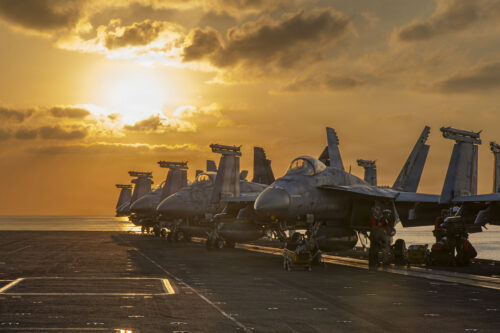
Top image: Aircraft are staged for flight operations on the flight deck of the Nimitz-class aircraft carrier USS Abraham Lincoln (CVN 72) in support of Operation Epic Fury on March 2, 2026, at sea. Photo by US Navy via Getty Images.
The Middle East Institute (MEI) is an independent, non-partisan, not-for-profit, educational organization. It does not engage in advocacy and its scholars’ opinions are their own. MEI welcomes financial donations, but retains sole editorial control over its work and its publications reflect only the authors’ views. For a listing of MEI donors, please click here.

Yemen: The Houthis’ Role in the Next Evolution of the Axis of Resistance

US Regional Foreign Policy: Unforced Diplomatic Errors Risk Accelerating American Retrenchment