
The latest cycle of U.S.-Iran escalation has followed a familiar script: sharpened rhetoric from the United States, calibrated military signaling by Iran in the Persian Gulf, indirect diplomacy through Oman, and Israeli warnings that remain deliberately ambiguous but unmistakably real. Yet beneath this choreography lies a more consequential development inside Tehran. The current crisis is forcing Iran’s political class to reassess its central foreign-policy wager of the past decade: that deepening alignment with Russia and China would provide strategic insulation against Western coercion.
For years, Iran’s Look East doctrine was presented domestically as a structural answer to sanctions, isolation, and military pressure. Integration into the Shanghai Cooperation Organization and BRICS, long-term strategic agreements with Russia and China, expanded energy coordination. Defense-industrial cooperation was framed not merely as economic diversification but as geopolitical insurance. In this telling, the emerging multipolar order would dilute U.S. leverage and render escalation more costly for Washington.
The current confrontation, however, has turned theory into a stress test. And stress tests, by design, reveal structural limits. What this round of escalation has exposed is not the collapse of Iran’s eastern orientation but the narrowing boundary between partnership and protection, as well as between diplomatic alignment and strategic commitment. That distinction now sits at the center of Iran’s internal debate over sovereignty, deterrence, and the future direction of the Islamic Republic, and it comes at a moment when succession politics loom.
Photo by Anadolu/Getty Images
The Middle East Institute (MEI) is an independent, non-partisan, not-for-profit, educational organization. It does not engage in advocacy and its scholars’ opinions are their own. MEI welcomes financial donations, but retains sole editorial control over its work and its publications reflect only the authors’ views. For a listing of MEI donors, please click here.
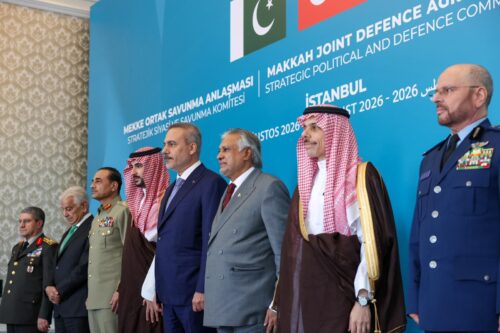
The Mecca Alliance Meets the Red Sea – Saudi Arabia’s New Defense Pact Faces Its First Major Test