When the United States and Israel launched military operations against Iran a month ago, the Middle East was plunged into debilitating conflict, with retaliatory Iranian missiles and drones striking at least 12 countries across the region. In addition to thousands killed through US-Israeli action in Iran, Lebanon and Iraq, at least 37 people have reportedly been killed in Iranian attacks on the UAE, Saudi Arabia, Kuwait, Bahrain, Qatar, Türkiye and Iraqi Kurdistan.
Iran’s strikes on Gulf energy infrastructure and its de facto closure of the Straits of Hormuz, furthermore, have triggered global economic shockwaves that leading experts warn could “send the world economy plummeting into a deep recession.”
It is in this context of escalating regional conflict that Syria has remarkably just completed its most stable month in 15 years. After nearly 14 years of civil war, Syria’s transition has been far from peaceful, and two brief but horrifically deadly chapters of violence on the Coast and the southern governorate of Sweida served as a reminder of the fragility of the country’s transition. Even so, the general trajectory has been one of stabilisation.
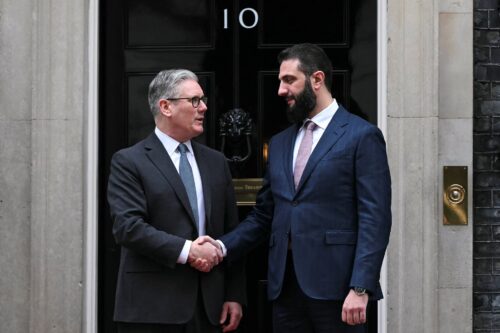
Photo by Justin Tallis / Reuters
The Middle East Institute (MEI) is an independent, non-partisan, not-for-profit, educational organization. It does not engage in advocacy and its scholars’ opinions are their own. MEI welcomes financial donations, but retains sole editorial control over its work and its publications reflect only the authors’ views. For a listing of MEI donors, please click here.