Skip to Content

Latest on the Iran War

Regional Reactions to the Iran War

MEI Senior Fellows share insight into how specific parts of the region are reacting to the war.
Latest on the Iran War

Filter by
2744 Results
Iran’s Regular Army: Its History and Capacities
Middle East Institute
  • Analysis
  • Iran’s Regular Army: Its History and Capacities

    Along with Egypt and Turkey, Iran is one of the most populous countries in the Middle East. Aware of its strategic significance and millennium-long civilization, Iranian leaders have always aspired to assume a leadership role on regional and international issues and pursued an assertive policy to reach their country’s potential. This ambitious strategy requires, among other things, strong military forces.

    November 15, 2011

    The Artesh: Iran’s Marginalized and Under-Armed Conventional Military
    Middle East Institute
  • Analysis
  • The Artesh: Iran’s Marginalized and Under-Armed Conventional Military

    Originally posted November, 2011

    Ravaged, intimidated, and gutted to the core in a series of purges after the 1979 Revolution, the remnant of the Shah’s military, renamed the Army of the Islamic Republic of Iran, known generally in Persian as the Artesh, put itself together as best as it could to face invading Iraqi forces at the beginning of the Iran-Iraq war.

    November 15, 2011

    The Artesh: From the War with Iraq until Today
    Middle East Institute
  • Analysis
  • The Artesh: From the War with Iraq until Today

    Iran’s conventional military forces — ground, air, and naval — once stood tall as the best armed military forces in the Middle East aside from those of Israel.  The United States lavished the most sophisticated military hardware on the Shah, who was willing and able to tap his financial resources from Iran’s oil wealth to buy modern conventional arms.  The Shah had the ambition, the financial means, and the political-military backing of the United States to turn Iran into the Persian Gulf’s most formidable military power.  

    November 15, 2011

    A United States Marine's View of the Artesh and IRGC
    Middle East Institute
  • Analysis
  • A United States Marine's View of the Artesh and IRGC

    United States military forces use standard procedures for planning operations against other militaries.  These procedures differentiate between different branches, or units, of an opposing force depending on their capabilities and limitations.  This article presents one such analysis of the Iranian Military, where there are vast differences between the Islamic Revolutionary Guard Corps (IRGC)and the Artesh, or the regular Iranian armed forces.  The article then draws parallels to the planning for Operation Iraqi Freedom that led to the defeat of the Iraqi Republican Guard and regular Iraqi

    November 15, 2011

    Sanctioning Iran's Military-Industrial Complex
    Middle East Institute
  • Analysis
  • Sanctioning Iran's Military-Industrial Complex

    As the United States and its allies have tightened sanctions on Iran, they have sought in particular to isolate the Islamic Revolutionary Guard Corps, the regime’s most aggressive institution. The IRGC, known in Persian as the Pasdaran, fields its own army, navy, and air force, and dominate a large and increasing share of Iran’s national economy.

    November 15, 2011

    The Politics of Iran's Regular Army
    Middle East Institute
  • Analysis
  • The Politics of Iran's Regular Army

    Iran’s regular military, the Artesh, receives virtually no attention from international media or scholars on Iran. By contrast, its political rival, the Islamic Revolutionary Guard Corps (IRGC, also known in Persian as the Pasdaran), is scrutinized constantly by analysts for its visible, high-profile role in Iran’s political system, its economic resources and corporate activities, and its role as a spearhead of Iran’s regional policies.

    November 15, 2011

    Introduction to The Artesh: Iran's Marginalized Regular Military
    Middle East Institute
  • Analysis
  • Introduction to The Artesh: Iran's Marginalized Regular Military

    As the US-Iran showdown continues, among Western analysts there is an infinite desire for more data and analysis relating to the workings of the Islamic Republic. From a US standpoint, a better understanding of the various organs and players in the Iranian regime setup is imperative as Washington weighs its options and sets out to formulate its policies.

    November 15, 2011

    Hezbollah in the Wake of the Arab Spring

    Hezbollah in the Wake of the Arab Spring

    October 11 – January 1, 1970, October 11 - 12:00 PM – 12:00 AM
    January 1 - 12:00 PM – 12:00 AM

    1761 N Street NW, Washington, 20036

    Hezbollah in the Wake of the Arab Spring
  • Video
  • Hezbollah in the Wake of the Arab Spring

    MEI scholar Randa Slim led a discussion about Hezbollah and its reaction to shifting regional dynamics in the wake of the Arab Spring. Although Lebanon has not experienced the same levels of unrest as its neighbors, Hezbollah is not immune from the regional instability resulting from the revolutions roiling the Middle East. Hezbollah is currently the principal orchestrator of a new governing coalition that is rife with internal divisions.

    October 11, 2011

    Iran After the Sanctions: What Next?
    Middle East Institute
  • Video
  • Iran After the Sanctions: What Next?

    The Middle East Institute is proud to host a discussion with Trita Parsi and Michael Singh on the prospects for a diplomatic solution to the Iran nuclear crisis in the wake of recently imposed UN and US sanctions.

    Their discussion will draw upon a forthcoming Middle East Journal article entitled "The Case Against the Case Against Iran" written pseudonymously by a European diplomat, who argues for greater engagement by regional actors like Turkey, Saudi Arabia, Russia and China to mediate and mitigate Iran's nuclear ambitions.

    August 18, 2011

    China's Angst Over Iran

    China's Angst Over Iran

    September 23 – January 1, 1970, September 23 - 4:26 PM – 12:00 AM
    January 1 - 4:26 PM – 12:00 AM

    1761 N Street NW, Washington, 20036

    Expert Coverage

    The Middle East Institute's experts continue to monitor the situation and provide analysis in real time as events unfold.

    To interview our experts please reach out to [email protected]

    Top photo:
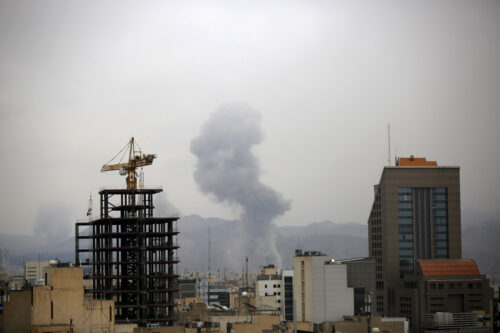
    TEHRAN, IRAN – MARCH 10: Smoke rises among the residential buildings following an Israeli attack on Tehran, Iran on March 10, 2026. (Photo by Fatemeh Bahrami/Anadolu via Getty Images)