Alex Vatanka is a Senior Fellow at the Middle East Institute. He specializes in Middle Eastern regional security affairs with a particular focus on Iran. He was formerly a Senior Analyst at Jane’s Information Group in London. Alex is also a Senior Fellow in Middle East Studies at the US Air Force Special Operations School (USAFSOS) at Hurlburt Field and teaches as an Adjunct Professor at DISAS at Wright-Patterson Air Force Base. He has testified before the US Congress and lectured widely for both governmental and commercial audiences, including the US Departments of State and Defense, US intelligence agencies, and a list of international corporations.
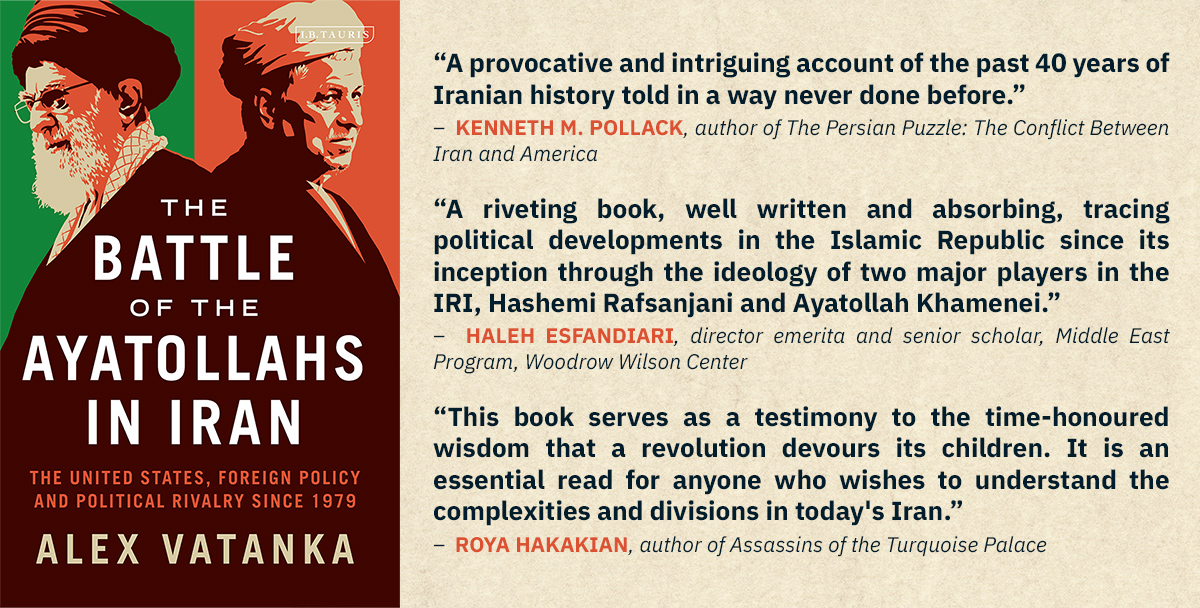
Born in Tehran, he holds a BA in Political Science (Sheffield University, UK), and an MA in International Relations (Essex University, UK), and is fluent in Farsi and Danish. He is the author of two books: The Battle of the Ayatollahs in Iran: The United States, Foreign Policy and Political Rivalry Since 1979 (2021) and Iran and Pakistan: Security, Diplomacy, and American Influence (2015).
He has also written chapters for a number of books, including Authoritarianism Goes Global (2016); Handbook on Contemporary Pakistan (2017); Russia in the Middle East (2018), Winning the Battle, Losing the War: Addressing the Drivers Fueling Armed Non-state Actors and Extremist Groups (2020); Global, Regional and Local Dynamics in the Yemen Crisis (2020); Routledge Handbook of Counterterrorism and Irregular Warfare Operations (2021); and Understanding New Proxy Wars (2022). He is presently working on his third book, Iran’s Arab Strategy: Defending the Homeland or Exporting Khomeinism?
Education
B.A. in Political Science at Sheffield University; M.A. in International Relations at Essex University
Languages
Farsi, Danish
Countries of Expertise
Iran
Issues of Expertise
Iran domestic and foreign affairs, Iranian military and security forces, Iran-US relations, Political Islam in Middle East
*This Policy Insight first appeared as a feature article in the Majalla on February 9, 2011.
Half a century after independence and two decades since the liberation from Iraqi occupation, Kuwait’s bitter experience with pan-Arabism and ongoing regional power plays have affected its growth. However, since the downfall of Saddam Hussein in 2003, and thanks to robust oil revenues, Kuwait has witnessed an unprecedented boom, albeit amidst raging internal disputes over the need for reform and the future direction of the country.
*This article was first published in November 2010 by Jane's Islamic Affairs Analyst.
The second half of 2010 witnessed a flurry of interaction between Iranian diplomats and their African counterparts. Not all the buzz has been beneficial to Tehran, as was most recently demonstrated by the Republic of the Gambia’s 22 November decision to break its ties with Iran, but the overall activity nonetheless reflects the increasing emphasis Tehran is putting on closer relations with countries on the continent.
Brazil’s Embrace of the Iranian Government Will Only Embolden the Regime Internationally
This Commentary first appeared as an op-ed in the America's Quarterly Policy Journal, Spring 2010
Can Brazil play a significant role in containing Iran's nuclear ambitions? No.
Brazil’s self-perceptions and aspirations as an emerging global power are a key to understanding why the government of President Luiz Inácio Lula da Silva has chosen this particular moment in time to deepen ties with an Iranian regime that is facing crisis, both at home and abroad.
On January 3, 2008, Iran’s supreme leader, Ayatollah ‘Ali Khamene’i once again sought to remind domestic and foreign audiences about his stature in Tehran. Stating that “cutting off relations with the US” was one of the “principal policies” of the Iranian government, but that he would be the “first person to endorse these relations” if it benefited the Iranian people, Khamene’i secured news headlines.[1]