This individual is a guest contributor. MEI is not able to assist with contact requests.
Jean-Pierre Cassarino holds a professorship at the Robert Schuman Center for Advanced Studies (RSCAS/European University Institute, Florence) where he directs the Return migration and Development Platform (http://rsc.eui.eu/RDP/). He is also research associate at the Tunis-based Institut de Recherche sur le Maghreb Contemporain (IRMC). Since the mid-1990s, he has published extensively on international migration, particularly on return migration and has carried out numerous field surveys investigating returnees’ manifold patterns of reintegration. Selected publications include: (ed.) Unbalanced Reciprocities: Cooperation on Readmission in the Euro-Mediterranean Area, The Middle East Institute Press, Washington, 2010; (ed.) “Conditions of Modern Return Migrants”, International Journal on Multicultural Societies, Vol. 10, Issue 2, UNESCO, Paris, 2008; (ed.) Return Migrants to the Maghreb Countries: Reintegration and development challenges, RSCAS, European University Institute, Florence, 2008; Tunisian New Entrepreneurs and their Past Experiences of Migration in Europe: Networks, Resource Mobilisation, and Hidden Disaffection. Ashgate Publishers, Aldershot, 2000. Email: [email protected]
The US and Libya: Normalization of a Stormy Relationship
*This article was first published in January 2011 by the Foreign Service Journal.
Relations between Libya and the U.S. have a turbulent history: War at the beginning of the 19th century; U.S. government support for Libyan independence after World War II; official and private-sector American engagement in the development of Libya’s oil wealth and human resources in the mid-20th century; Libyan terrorism and U.S. military retaliation in the 1980s; U.S.-engineered economic sanctions and isolation in the late 20th century; and restoration of diplomatic relations in 2006.
Iraq's Nobel No Show Suggests Democracy in the Balance
An earlier version of this Commentary first appeared in the American Interest on December 10, 2010
Iraq, the newest democracy in the Middle East, turned down an invitation to attend the December 10 investiture ceremony for the Chinese Nobel Peace Prize laureate Liu Xiaobo. It thus kept company with a litany of repressive governments that declined invitations to the ceremony, including Afghanistan, Cuba, Egypt, Iran, Kazakhstan, Morocco, Pakistan, Russia, Sudan, Saudi Arabia, Serbia, Tunisia and Venezuela.
Travelogue of a Nigerian Codesria Laureate in Lebanon (January–July 2006, July–November 2008)
On December 18th 2004, I discovered the Lebanese Emigration Research Centre (LERC), Notre Dame University, Zouk over the internet while searching for a post-doctoral research fellowship program on Lebanese studies in either Australia or New Zealand. I contacted the Director, Guita Hourani, who was instrumental in my winning the Codesria post-doctoral fellowship award. Elated, I departed for Beirut, Lebanon on February 21, 2006.
Kān Yāmā Kān: Curriculum Development in the GCC – Adopting (Adapting) Models of Higher Education
Once upon a time in the land where the light of creation first shone, the fertile grounds around Baghdad nurtured the House of Wisdom.[1] Even as Europeans were looking for the light at the end of the Dark Ages, Caliph Haroon al-Rasheed and his son Caliph al-Mamoon had made Baghdad a center of learning. In Baghdad, scholars put words on “real” paper. They preserved Aristotle, Plato, Hippocrates, Euclid, Ptolemy, Pythagoras, and Brahmagupta and translated Greek, Persian, and Indian manuscripts.
Partnerships, Collaborations, and International Education in the UAE: The Question of Context and Relevancy
Education reform is essential for the continued social and educational development of the United Arab Emirates (UAE).[1] The country has grown considerably over the past decade, and opportunities for business and professional opportunities have expanded. Educational development has been deemed necessary for the citizens of the country to take advantage of such opportunities.
A New Paradigm of Educational Borrowing in the Gulf States: The Qatari Example
More than in any other world region, the Arab Gulf states are experiencing a “higher education boom” in terms of the quantity and quality of institutions and programs now available. Over the past two decades, the Gulf states have imported a Western, largely American, model of higher education to address inefficiencies in labor markets and invest in their economic futures, to meet national reform agendas, and in some cases, to function as profit-making ventures.
Internationalization of Higher Education in Jordan
There is a growing need in Jordan for universities to establish joint programs with overseas universities in countries such as the United Kingdom and to uphold partnerships with universities in the United States, Europe, and the Gulf states. Public universities are already highly regarded. Private universities are also seeking partnerships or joint programs with foreign institutions.
External and Internal Partnerships in Israeli Education
Educational reform in Israel has repeatedly shifted from expecting individual excellence to expecting access for all. Excellence and access reflects the early history of the country when Jewish funders from France, England, and Germany established educational systems for Jewish children. The Zionist organizations that structured much of the curriculum and the external funding streams insured the Jewish schools were far better funded than the British-supported schools during the Mandate.
Benefitting from the Knowledge Economy? Examining Secondary Education Reform in Jordan
Jordan today, in spite of the scarcity of its natural resources, is at the forefront of the region’s states in several areas, primary among them are education, economic growth rates, and the qualifications of the Jordanian youth who have always proved their excellence nationally and abroad.
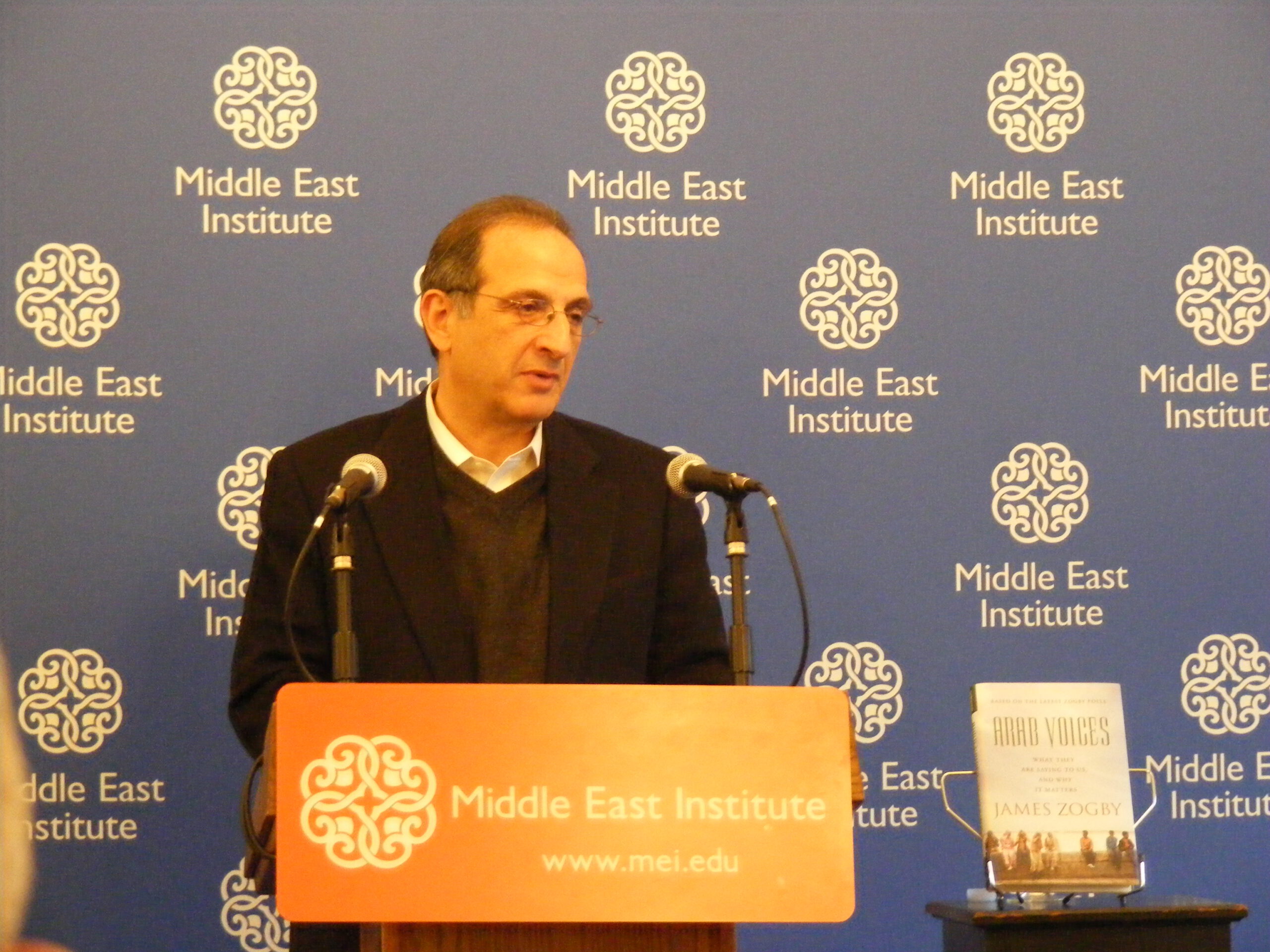
Arab Voices: What They Are Saying to Us, and Why It Matters
The Middle East Institute is pleased to invite you to a lecture and book signing by James Zogby, President of the Arab American Institute. The Arab world has been vastly misunderstood in the West. Zogby's Arab Voices: What They Are Saying to Us, and Why It Matters asks the questions, collects the answers, and shares the results that will help readers better understand the Arab world. The book brings into stark relief the myths, assumptions, and biases that prevent many from understanding the greater Middle East region and its people.
The Realities of Power Sharing in the Next Iraqi Government
MEI is proud to host Reidar Visser of the Norwegian Institute for International Affairs for a discussion on the current political situation in Iraq based on his latest publication, The United States and the Iraqi Transition, 2005-2010 (Just World Books, 2010). The book examines Iraq's process of democratization over the last five years and the impact of regional and international players, not least the US government, in shaping Iraq's new political system.