Gulf: The War Has Shaken Relations With Washington
September 28, 2026
Share
This article is part of a collection of short essays written by the Fellows of the Middle East Institute to explore aspects of the ongoing war with Iran. The intent of the collection is to help readers see new and unexpected elements of the dynamics and impact of the ongoing hostilities and to think harder, deeper, and broader about the implications of the conflict. To read the other essays from this collection, as well as download the full report, please click here.
Surviving an Earthquake
When President Donald Trump ordered US forces into war against Iran, the administration’s ambitions reached well beyond Tehran’s nuclear program. Trump openly encouraged Iranians to topple their government. Israeli leaders spoke of reshaping the Middle East. The US and Israel’s bet was that overwhelming military superiority could bring about fundamental changes to regional security and to Iran itself.
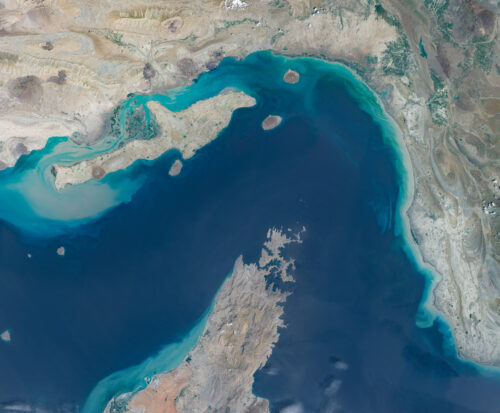
The war’s architects got their wish — only not in the way they intended. The military campaign demonstrated unmatched capabilities, but it also exposed the limits of US firepower to dictate political outcomes from the skies. Iran’s leadership was decimated, only to be replaced by harder-edged successors. Its conventional military, nuclear program, and economy were badly set back. But the regime showed that it can still use missiles and drones to threaten Arab Gulf capitals and choke off the Strait of Hormuz, disrupting the global economy.
The conflict remains ongoing and unresolved. But the failure to topple the Iranian regime, the loss of control over a vital sea lane, and the perception of US unreliability already amount to serious strategic setbacks for the United States in the eyes of the Gulf states — in particular Bahrain, Kuwait, Oman, Qatar, Saudi Arabia, and the United Arab Emirates.
So how has the 2026 Iran war changed US relations with the Gulf? To date, the answers are less immediately cataclysmic than one might expect, but still hardly reassuring.
The war has not produced a post-American Gulf. But it has shaken multiple pillars of long-term US regional leadership and the Gulf states’ own strategies. A deepening sense of uncertainty is already driving important changes in their relations with Washington, Tehran, each other, and other centers of power — even as it reshapes and rewires regional economies themselves.
In one sense, the arrival of war was an earthquake. It interrupted a several-year stretch during which Gulf governments increasingly imagined themselves leaving behind the post-1979 Middle East defined by the Iranian revolution, Iraq wars, terrorism, and a permanent sense of crisis. Their attention had shifted to overdue economic transformation and youth-focused reforms to build societies that could engage and compete globally rather than merely survive regionally.
The war has left the region trapped between a post-1979 past it cannot escape and pre-2030 aspirations it has not yet realized. Iran retains the will and continued capacity to threaten Arab Gulf states and appears poised to exercise significant control over the Strait of Hormuz. The conflict has raised fresh doubts across the region about American judgment — but it has not produced a viable alternative to American power.
Moreover, the region itself weathered the crisis remarkably well. As one regional diplomat put it, while Iran’s aggression surpassed the Gulf leaders’ worst fears, these countries’ resilience surpassed their greatest hopes. Societies held together and remained stable. Air defenses, with considerable US and some Israeli help, intercepted the overwhelming majority of Iranian attacks. Economies, financial systems, and supply chains adapted under pressure.
Despite frustrations and some rough patches, security cooperation with the United States also remained largely intact. In fact, Iran’s attacks at the outset reinforced rather than diminished Gulf appreciation of the threat Tehran continues to pose. The missiles attacking Gulf states were Iranian, while the systems defending them were largely American.
Closeness Without Confidence
Though the onset of war may have been an earthquake for the Gulf, the result was not the collapse of the existing regional order. Many of the key structures held, even as the ground beneath them shook and shifted. Instead, the result has been a mix of forced adaptation and wobbly continuity — of cracked foundations, tectonic shifts, and ongoing aftershocks.
Nowhere is that more apparent than in Gulf states’ relations with the United States. America has hard questions to answer about its regional future — from finally resolving the immediate conflict to reassessing its own long-term force posture. However, reports that this marks the end of America’s role in the Middle East appear overblown. No other country can provide a viable alternative to US integrated power, intelligence, logistics, cutting-edge technology, and diplomatic clout — and Gulf states know it.
China remains an indispensable economic partner but has shown little capability and less appetite to assume responsibility for regional security. Russia is almost fully consumed by Ukraine. Other powers contribute important capabilities. None offers a comprehensive alternative.
Still, close cooperation with the Trump administration is increasingly strained by a lack of confidence in Washington’s strategic judgment. The Gulf states have absorbed the consequences of a war they neither sought nor controlled. As the US government has gone through multiple abrupt reversals and periods when diplomacy has struggled to keep pace with presidential rhetoric, Gulf leaders have increasingly questioned whether Washington adequately appreciates the risks they face — or has a serious plan to end the war. “Go experiment somewhere else,” one official lamented to the author.
After decades when the overarching question for regional states seemed to be whether the United States remained committed, at the moment the question is more about how it exercises that commitment.
These concerns are unlikely to produce an outright strategic break, and public critiques remain muted to avoid offending the US president. But they appear to already be producing a different texture of partnership — one that might be characterized as closeness without confidence. Gulf states are not seeking an immediate replacement for the United States, but they do want more and better alternatives — and greater freedom of maneuver.
The Gulf states remain eager to enjoy the advantages of partnership with Washington, from military cooperation to nuclear technology to artificial intelligence (AI). But they are also willing to act with greater autonomy to secure their own interests, even when this means disagreeing with Washington or quietly going a different way. Qatar and Oman, meanwhile, have seen their agenda-setting roles as mediators grow as Washington’s professional diplomatic expertise has withered.
The result is less a truly multi-polar Gulf than a multi-partner region. From investment and infrastructure ties to India to air-defense cooperation with Israel, South Korea, and Ukraine, ad hoc connections with middle powers are proliferating and deepening alongside enduring ties to the US, shifting the overall balance of engagement notably but not decisively away from Washington.
In many cases, this cooperation is happening with other American partners rather than Russia or China. Both retain strategic ties to the region, but Moscow and Beijing have found themselves on the wrong foot with Gulf capitals that see them as frustratingly complicit and cozy with Tehran. Gulf governments may hope Beijing will eventually press Tehran to respect their sovereignty, but so far, such magnanimity is nowhere in evidence.
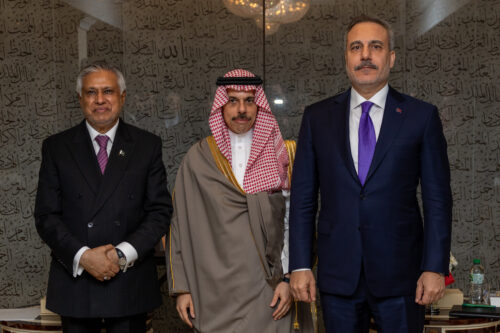
Of particular note is the new Mecca Joint Defense Agreement grouping of Saudi Arabia, Pakistan, and Turkey, with Egypt as a prospective partner. This defensive alignment of Muslim-majority states is far short of an alternative security guarantor: for example, Turkey is unlikely to join Saudi Arabia in retaliating against strikes by the Houthis or Iran-backed militias in Iraq. But the grouping does represent the initial building blocks of an alternative strategic orientation where Riyadh’s ties with Washington prove unavailable, unreliable, or undesirable — less a new patron than a diversified portfolio.
The Mecca accords are also a strategic counterweight to burgeoning UAE-India-Israel cooperation — and in that respect an important step away from the long-held US aspiration to achieve greater alignment among its regional partners, culminating in the normalization of ties between Israel and Saudi Arabia. Though President Trump is likely to keep trying, that achievement appears to have drifted out of reach. Even so, neither intra-regional grouping can replace the unique US diplomatic and military role; each can only shape the strategic terrain and fill in the gaps. In fact, President Trump has also deepened US ties with leaders in Turkey and Pakistan. But both nascent blocs illustrate the Gulf states’ increasing intent to develop new options, even if they sometimes divide the Gulf states down the middle.
Another major test of US-Gulf relations lurks only a bit further down the road: coming changes in US force posture. The war exposed the vulnerability of US bases in the smaller states closest to Iran. Much of the campaign was prosecuted from further afield, including from offshore, from US territory, and from outside the immediate region. As the conflict ebbs, force protection and costly repairs will intensify longstanding debates over US basing in the Middle East, particularly amid competing demands in the Asia-Pacific and US frustration with Gulf restrictions on the use of their territory.
The United States’ military will need to adapt without creating the impression of a broad or sudden US pullout that further spooks partners and emboldens Iran. Washington will need creative solutions to project continued forward presence, including through dynamic deployments, dispersal, and selective rebuilding with hardening, resilience, and redundancy in mind — all while making necessary shifts to protect its people. Deft military diplomacy will be needed, rooted in a sensitivity to the strategic impact of redeployments that are likely coming.
The war also exacerbated another longstanding Gulf concern: US political unpredictability. Public fatigue with Middle Eastern wars and outrage over the administration’s unprecedented mingling of public responsibilities and private business with Gulf partners will make it harder to sustain new initiatives in areas like AI and nuclear energy once political power changes hands in Congress. Gulf states that lavishly courted President Trump risk being caught once again in the political crosscurrents of Washington.
Iran: Détente to War and Back Again?
A second important shift underway concerns the Gulf states and Iran.
Long before the US and Israel undertook their latest air campaign against Iran, regional Arab Gulf governments had arrived at the hard-won conclusion that no outside power was going to rid them of the revolutionary regime in Tehran. To protect and prioritize their economic transformations, they needed to lower the temperature. That realization helped drive a cautious détente with Iran beginning in early 2023.
As Tehran struck targets in every Gulf Cooperation Council (GCC) state and multiple Gulf militaries eventually responded, that détente appeared to be over. Yet with surprising speed, the war began to reinforce the geographic and strategic logic behind it. Gulf governments had few illusions that Iran could be bombed or wooed into becoming a normal neighbor. But as Tehran’s capacity to threaten critical infrastructure and impose huge economic costs went from theoretical to all too real, the old lines of communication snapped back into place.
Qatar and Oman quickly returned to mediation, despite having been burned repeatedly by such efforts. Even the UAE, the Gulf state hit the hardest at the outset of the war and initially the most hawkish, seems to have recognized the prevailing diplomatic direction of its neighbors. While admittedly an imperfect heuristic, the lack of Iranian strikes for several months against certain Gulf states does lend credence to reports that individual governments reached understandings with Iran — quite possibly involving significant financial payments — to avoid further attacks.
If the war reinforced the logic of détente, it also exposed its limits. Iran struck every Gulf state in the first hours of the conflict. Neither Qatar nor even Oman was spared despite close ties and public opposition to war. And so even as they have sought to lower tensions, Saudi Arabia, the UAE, Kuwait, and possibly others have retaliated against Iran, its proxies in Iraq, and its Houthi allies in Yemen. A recent Saudi-Houthi flare-up points to the continued risks of reigniting what has been a frozen conflict in Yemen. The UAE, for its part, has threatened to cut Iran’s economy off from its own. In various ways, multiple Gulf states have contributed to efforts to establish a southern maritime route through Oman rather than Iranian territorial waters. Each Gulf capital will continue to seek the right mix, but so far that includes a heavy dose of détente with Tehran alongside periodic pushback.
Each Gulf capital is striking this balance individually rather than collectively. Not even an unprecedented common security crisis has produced genuine strategic GCC unity. For all the resilience and cross-border cooperation the war has showcased, it has generated more national solidarity than regional cohesion. Oman continues to emphasize dialogue. Bahrain’s threat perceptions differ sharply from Qatar’s, and Saudi Arabia and the UAE are pushing distinct and sometimes divergent approaches based on their own exposure and priorities and an enduring lack of strategic trust between them.
The result is a thicket of bilateral and multilateral cooperative arrangements, alongside an every-country-for-itself instinct that increases Iran’s coercive leverage and makes coordinated counterpressure harder. The Gulf’s heightened nationalism extends far beyond the war that sparked it — and is evident in everything from a harder line in handling domestic dissent to the UAE’s exit from the Organization of the Petroleum Exporting Countries (OPEC). Before the latest round of war began in February, the Gulf in aggregate was poised to overtake the United States as the largest humanitarian donor. Now, Gulf states have joined Western governments in paring back humanitarian aid to focus inward in ways that will compound the damage to fragile states and people in need in the region and beyond.
The Gulf Rewires Itself
The same search for options amid uncertainty that is recalibrating the Gulf states’ foreign policies is also rewiring their economies.
For years, Saudi Arabia, the UAE, and their neighbors have raced to convert hydrocarbon wealth into a post-oil future built around new industries, technology, tourism, logistics, and global investment. That vision depends heavily on attracting foreign capital, companies, and talent. The 2026 Iran war has not displaced that vision, but it will force Gulf states to adapt it to a far more dangerous regional environment.
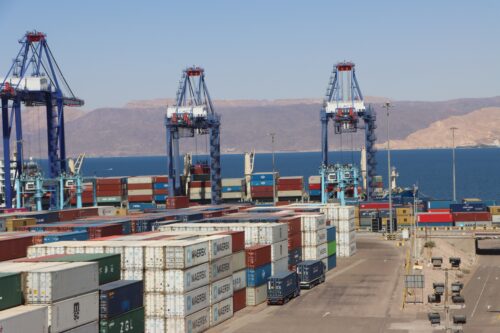
At the heart of that effort will be a crash course to reduce dependence on the Strait of Hormuz. Saudi Arabia and the UAE entered the war furthest ahead in creating alternative routes for oil exports, while Oman enjoys the most favorable geography. Kuwait, Bahrain, and Qatar have been most harmed by Iran’s Hormuz blockade. As one policymaker from a small Gulf state lamented to the author, “Three minutes is a short time, unless you are underwater.”
It is therefore unsurprising that more than a half-dozen infrastructure initiatives have been set in motion, stretching from the Red Sea and Egypt to Syria and Turkey. These projects may produce a more interconnected Middle East, but competing corridors will also reflect differing visions and geopolitical alignments. And not all will be completed.
Alongside massive investments to bypass the Strait of Hormuz, Gulf states will need to spend more on defensive munitions, domestic reconstruction, and hardening of ports, pipelines, grids, logistics corridors, data centers, desalination plants, and transportation networks. Redundancy and resilience have become central to the region’s pre-2030 plans.
AI offers an important test case. Saudi Arabia, the UAE, and other Gulf states are working to ensure that Iran’s targeting of data centers does not foreclose their own outsized AI ambitions. Before the war, the Gulf region appeared on track to develop the largest cluster of computing power outside the United States and China, even outpacing Europe and India. The war has added cost, delay, security requirements to meet emerging threats, and a sense of uncertainty to those plans.
So far, Washington, private US tech giants, and Gulf states all seem poised to forge ahead — helped by a recent US policy shift that removes Commerce Department curbs on the UAE’s access to cutting-edge US chips. But the war has cost the region precious time and confidence as an early mover in the global AI race.
Risks and Opportunities for the United States
For the United States, this unsettled landscape presents opportunities but also a warning.
Of course, the first priority is the unfinished war itself. Nothing would do more to restore regional confidence than a settlement that reliably opens the Strait of Hormuz and reduces Iran’s threats to Gulf states. Despite mediators’ unstinting efforts and some success in opening alternative routes to reduce Iran’s leverage, that appears unlikely in the near term. Consequently, it is more probable that Washington and Arab Gulf capitals will instead have to navigate a range of unsatisfactory outcomes together.
Second, the US should use the war to build a deeper partnership helping the Gulf defend its seas, skies, and critical infrastructure. Gulf states have joined Ukraine and Israel on the receiving end of enormous numbers of Iranian-designed missiles and drones. Their experience, capital, and sense of urgency create an opportunity for joint research, development, manufacturing, and deployment of next-generation air defenses — but will require the United States to actively encourage and streamline such partnerships. Washington should also use its convening power to encourage allied countries with relevant capabilities and battlefield experience, like Ukraine, to help bridge urgent gaps — and keep Russia and China on the sidelines.
The warning is equally clear. Military primacy by itself will not sustain America’s long-term position in the Gulf region. Washington’s partners will judge the United States not only by its willingness to project power, but also by its ability to exercise that power prudently to leave behind a more stable region.
That requires more than just avoiding foolish wars. It requires continuing to update relations for the future. Bruising as the war has been, the Gulf states still want American partnership not only to manage old threats but to realize new ambitions. Before the war, the Trump administration had taken promising steps in this direction. The president’s May 2025 visit to Riyadh, Doha, and Abu Dhabi mattered less for its headline-grabbing investment pledges than for the conception of the relationship they reflected: AI, infrastructure, interconnection, joint projects, and business ties alongside security.
The war wrenched Washington and the region back into crisis management. That should not be allowed to consume the broader agenda.
Even while the conflict persists, the US should encourage Gulf and American businesses to follow through on ambitious plans. The Gulf’s long-term trajectory will be determined as much by decisions about investment, infrastructure, AI, and plans for a post-oil future as by force posture. A Gulf that succeeds in building more diversified, resilient, and interconnected economies — especially in partnership with the United States — is likely to remain a more stable and capable American partner for decades to come.
People-to-people ties deserve particular attention. The US has long taken for granted the strategic and economic advantages of being the country where Gulf elites want to study in their youth, seek medical care in old age, and shop, invest, and forge friendships and business partnerships in between. Those bonds are fraying. Gulf student enrollment at US universities is a fraction of what it was two decades ago — and sinking fast. Current immigration policies have increased apprehension about visiting the United States. At precisely the moment Washington needs a new generation invested in the relationship, there is a risk the next generation will simply look elsewhere.
Caught Between 1979 and 2030
Gulf governments are trying to build the Middle East of 2030 while still contending with the unresolved conflicts dating back to 1979 and the renewed violence unleashed after October 7, 2023. American policy will remain relevant only if it can address both: helping to secure the region that exists while investing in the one its partners are trying to build.
Gulf officials increasingly sound less interested in debating whether the United States is “in” or “out” of the region than in asking what kind of partner it intends to be. Few expect Washington to fully withdraw or another power to fill its role — as the United States (eventually) did when the British withdrew from east of Suez in the early 1970s. Diversification has accelerated despite the continued centrality of the American relationship.
The war has demonstrated both the Gulf’s resilience under pressure and the limits of the assumptions on which its recent strategies rested. The response across the region is a growing hunger for options: in diplomacy, security partnerships, infrastructure, trade routes, technology, and relations with Washington itself.
In recent years, the pendulum has swung a few times in the region between diversification and closer dependence on Washington. Each time, many policymakers and analysts have projected forward from the present, only to be surprised by change. The pendulum is sure to swing again. Humility is in order in defining the aftermath of a war that has not yet ended.
As Washington struggles to salvage an ill-advised war, there has been no geopolitical collapse, but the ground has shifted. It is not too soon to be thinking about how to help develop and navigate the options for a region that will never be quite the same.
Daniel Benaim is a Distinguished Diplomatic Fellow at the Middle East Institute. During the Biden administration, he was Deputy Assistant Secretary of State for Arabian Peninsula Affairs.
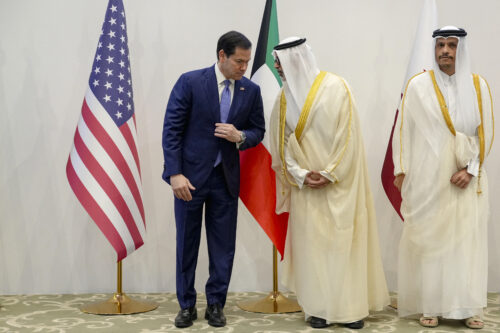
Top image: US Secretary of State Marco Rubio (L) speaks with Kuwait’s Foreign Minister Sheikh Jarrah Jaber al-Ahmad al-Sabah as he stands next to Qatar’s Prime Minister and Foreign Minister Sheikh Mohammed bin Abdulrahman al-Thani during a meeting with foreign ministers of the GCC member states, in Manama on June 25, 2026. Photo by Eric Lee / POOL / AFP via Getty Images.
The Middle East Institute (MEI) is an independent, non-partisan, not-for-profit, educational organization. It does not engage in advocacy and its scholars’ opinions are their own. MEI welcomes financial donations, but retains sole editorial control over its work and its publications reflect only the authors’ views. For a listing of MEI donors, please click here.