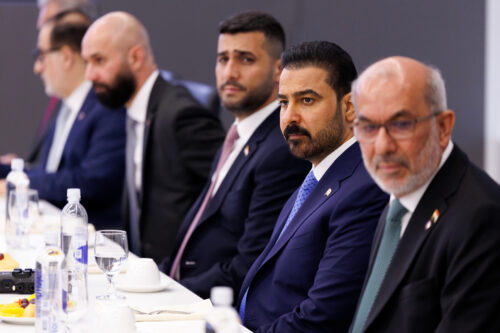
John Calabrese is a senior fellow at the Middle East Institute (MEI) and book review editor for The Middle East Journal. His work focuses on the international relations of the Middle East, with a particular emphasis on cross-regional ties between the Middle East and Asia. He also teaches US foreign policy at American University.
He holds a PhD in International Relations and a Diploma (with Distinction) in Comparative and International Politics from the London School of Economics, and a BA in English and Government from Georgetown University.
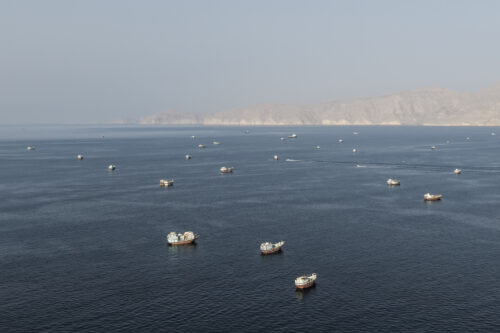
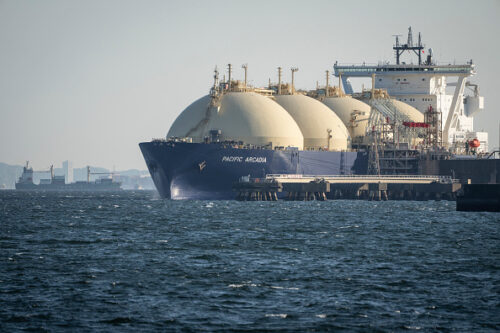
Crude oil is flowing out of the Gulf again, but the market is no better prepared for another disruption in the Strait of Hormuz. It has assembled a temporary system for managing one. Crude exports from the Gulf, excluding Iran, returned to pre-war levels in September, while total Gulf shipments reached 15.5 million barrels a day, more than 80% of the pre-conflict volume.
The Mecca Alliance Meets the Red Sea – Saudi Arabia’s New Defense Pact Faces Its First Major Test
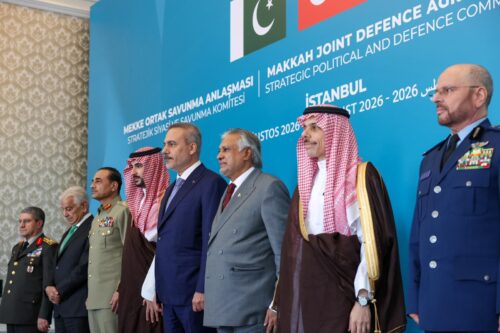
When Saudi Arabia, Turkey and Pakistan agreed to a mutual defense pact in August, it was principally seen as a political commitment. The “Mecca alliance,” as it was dubbed, stipulated that an armed attack on one would be treated as an attack on all three, accompanied by deeper military cooperation.
The conventional framing of China’s role in the Middle East in policy discourse centers on a familiar question: what challenge does Beijing pose to US primacy? The answer is often framed as a largely linear story in which expanding economic influence gradually translates into geopolitical leverage.Yet this view captures only part of the reality.
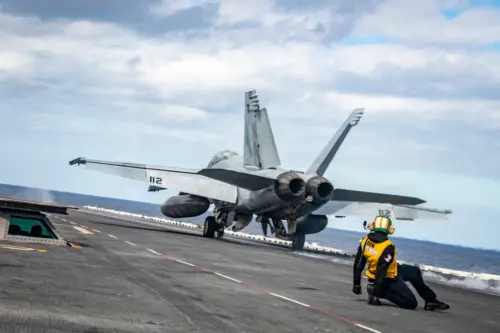
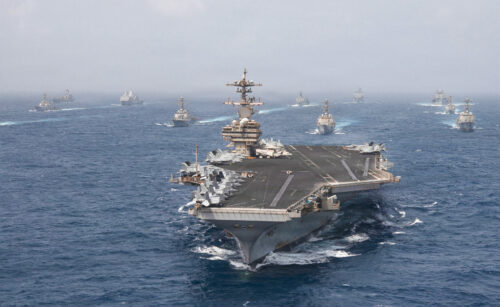
The consequences of the war with Iran are now showing up far beyond the Middle East. U.S. Patriot missile stocks in Europe are reportedly “beyond critical,” with the U.S. having burned through roughly 65% of its Patriot interceptor inventory during the conflict, while the Pentagon is extending Middle East deployments into 2027 and maintaining roughly 50,000 troops in the region, alongside 19 warships and other assets.
Hormuz crisis has forced Japan into rethinking – and domesticating – its energy security needs
Japan’s Foreign Minister Motegi Toshimitsu phoned his Iranian counterpart, Abbas Araghchi, on Sept. 8, 2026, to express concern over the de facto closure of the Strait of Hormuz. It was reportedly the ninth such phone call between the pair since March.
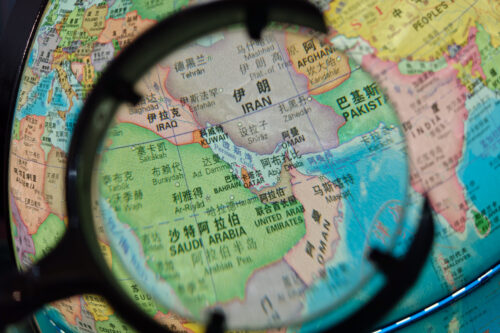
Six months into the U.S.-Israeli war against Iran, Southeast Asia’s exposure to a conflict thousands of miles away has proven durable rather than transient — and it is beginning to function as a genuine stress test of the region’s institutions, not just its energy bills.
America at War Again. What the Iran War Reveals About U.S. Global Leadership
The U.S.-Iran war has become the most consequential American military engagement in the Middle East since the 2003 Iraq invasion. Despite periodic ceasefires and diplomatic efforts, the conflict has revealed that 21st-century power is not determined by military dominance alone. The United States has demonstrated unmatched force-projection capabilities, severely degrading Iran’s conventional forces, yet battlefield success has not produced a durable political settlement or fundamentally altered Tehran’s strategy. Instead, the conflict has settled into a cycle of coercion, adaptation, economic pressure, proxy warfare, and renewed confrontation.
America Asked Allies to Do More. They Are Also Preparing for a Less Predictable Washington
Taiwan has proposed an 18% increase in its defense budget for 2027, pushing military spending above 3% of GDP as Chinese military and political pressure grows. The move comes as the United States remains engaged in its six-month war with Iran and has deployed its last aircraft carrier in the western Pacific to the Middle East, temporarily leaving the region without a US carrier presence.
From Oil to AI: How Water Constraints Shape the Gulf’s Digital Future
Gulf Cooperation Council states are investing hundreds of billions in AI infrastructure, data centers, and semiconductor capabilities, making technology central to post-oil economic diversification. Yet this expansion faces a critical constraint: severe water scarcity turns AI growth into a challenge, as data centers in some of the world’s most water-stressed territories strain already overextended hydrological systems. The U.S.-Iran war has also underscored the physical vulnerability of the infrastructure supporting these ambitions. Together, these pressures raise pressing questions about the sustainability and scalability of Gulf states’ AI-driven development strategies.
Saudi Arabia’s approach to the Iran war has been defined by a sustained effort to avoid direct entanglement. That restraint was notable given Riyadh’s position as Iran’s principal Gulf rival, its close security relationship with Washington, and its exposure to regional escalation. The kingdom made clear that it would not permit its territory or airspace to be used by any party for military action against Iran, avoided rhetorical alignment with Israel, and preserved the diplomatic channels with Tehran that were restored in 2023.
Beyond Ports: China’s Digital Networks of Influence in the Middle East and Africa
For more than a decade, assessments of Chinese strategy in the Middle East and Africa have focused on assets, including the ports Chinese firms own, the pipelines they finance, and the networks they build. This lens has produced familiar maps of Chinese “footholds” and debates over future military bases, but ownership alone reveals less about influence.
The more useful question is not what China owns, but how Chinese firms become embedded in the operational and digital systems that keep trade corridors moving. Influence derives not from controlling infrastructure outright but from participating in the governance of the networks that move goods, data, finance, and information across them.
Something more consequential than another oil market disruption is underway. The Iran war has exposed and accelerated an institutional weakness within OPEC that had been building for years. The closure of the Strait of Hormuz, the UAE’s departure, Iraq’s brief flirtation with exit, and the continued rise of U.S. oil production all point to a deeper question about the cartel’s durability. The issue has shifted from OPEC’s ability to manage crises toward whether its model of collective discipline can withstand mounting structural strain.
The Gulf’s New Information Battlefield: War, Technology, and the Reconfiguration of Security
During the opening days of the 2025–2026 U.S.–Israel war with Iran, Kuwait’s military briefings highlighted intercepted Iranian missiles and drones while revealing little about strike locations or damage. The approach reflected a familiar wartime dilemma in which governments must reassure populations while limiting information that could aid adversaries or fuel uncertainty. Yet Kuwait’s response revealed a broader shift across the Gulf. Information was no longer simply a messaging tool; it had become part of the battlefield.
Buying certainty: How Hormuz is redefining global shipping
At the recent Lianhe Zaobao Singapore-China Forum 2026 in Singapore, Professor Joseph Liow, dean of the Lee Kuan Yew School of Public Policy and chairman of the Middle East Institute at the National University of Singapore, suggested that the Strait of Hormuz (SOH) may be entering a “new normal”, one in which Iran — and perhaps Oman — could justify charging vessels fees for transiting one of the world’s most important waterways.
Iraq is emerging as the Middle East’s strategic connector – but can it turn foreign competition into advantage?
Iraqi Prime Minister Ali al-Zaidi is on something of a diplomatic roll at the moment. Having concluded a weeklong visit to the United States on July 19, 2026, during which he charmed President Donald Trump, al-Zaidi is now expected to head to Tehran to do the same with Iran’s new leaders. Trips to Qatar, Saudi Arabia, Turkey and Syria all figure on his itinerary, too.