
Skip to Content

Judy Barsalou

Expertise

Egypt

Judy Barsalou

Judy Barsalou is President of the El-Hibri Foundation. Prior to joining EHF in 2013, Dr. Barsalou was a visiting scholar at the American University in Cairo, where she conducted research about Egyptian views about justice and accountability in post-Mubarak Egypt.  Dr. Barsalou has two stints working for the Ford Foundation. Between 1982 and 1990, she served as a program officer in the Foundation’s New York headquarters and its Middle East and North Africa office, based in Cairo. From 2008-2011 she returned to Cairo as the Ford Foundation’s Representative for MENA region, managing a grant program that awarded approximately $13 million annually in grant funding.  Judy has also served as the Vice President of the Grant and Fellowship Program at the United States Institute of Peace; Executive Director of the Middle East Research and Information Project, which publishes Middle East Report; Director of Academic Programs at the Institute of Governmental Affairs, the University of California, Davis; and Program Officer at the Jerusalem Fund’s Center for Policy Analysis on Palestine. Her research focuses on transitional justice, including the role of memorials in social reconstruction; the challenges of teaching history in societies emerging from violent conflict; and trauma and transitional justice. She holds a B.A. in political science from the University of California, Berkeley, and an M.A., M. Phil and Ph.D. in comparative politics from Columbia University.

The Latest from Judy Barsalou

Filter by
1 Result
Unrequited Desire: Egyptians' Passion for Justice and Accountability
  • Analysis
  • Unrequited Desire: Egyptians' Passion for Justice and Accountability

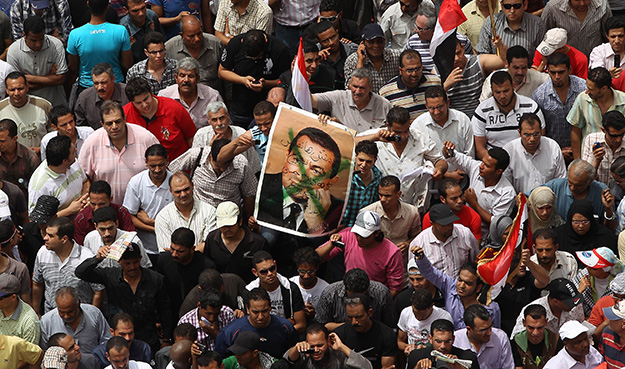
    Egyptians who believed that the removal of President Hosni Mubarak in February 2011 would lead to the establishment of a democratic government have faced many setbacks. Youthful revolutionary activists unsuccessfully challenged the power of the Supreme Council of the Armed Forces (SCAF) transitional government and the autonomy of the military. The electoral triumph of Islamist parties and candidates in parliamentary and presidential elections in 2011 and 2012 eclipsed weak and inexperienced secular parties and brought to power leaders who failed to ensure adequate representation of political opponents, women, and Copts in key aspects of governing, or to protect Copts from rising attacks. Continuing divisions among opposition forces, along with the roundup of Islamists and other opponents by the military, which engineered the July 2013 removal of President Mohamed Morsi, suggest that the struggle to achieve justice and create an accountable government will be prolonged.

    December 17, 2013