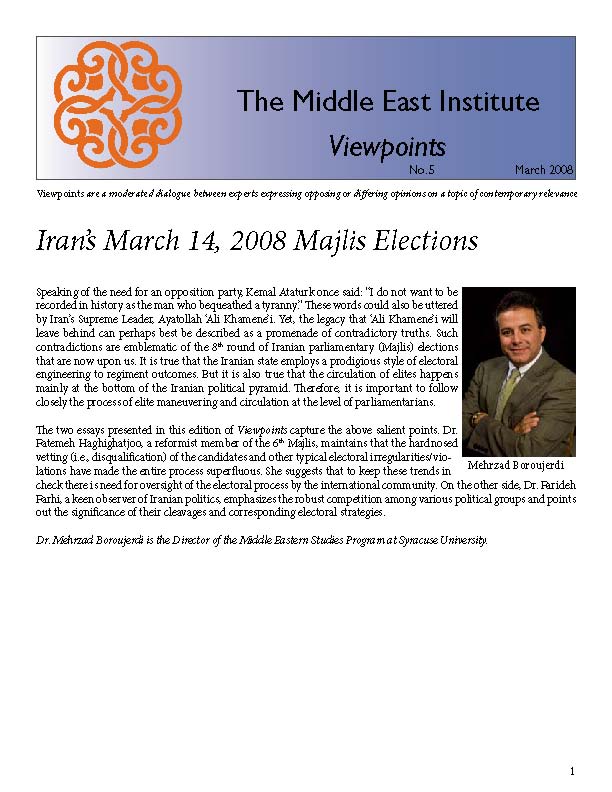
This individual is a guest contributor. MEI is not able to assist with contact requests.
Dr. Mehrzad Boroujerdi is O’Hanley Family professor and chair of the political science department at Maxwell School of Citizenship and Public Affairs at Syracuse University. He has served as the president of the International Society for Iranian Studies, founding director of the Middle Eastern Studies program at Syracuse University, editor of the Modern Intellectual and Political History of the Middle East book series published by Syracuse University Press, book review editor for the International Journal of Middle East Studies, and member of the board of directors of the Near East Foundation. He has been the recipient of grants and fellowships from Harvard University, Henry R. Luce Foundation, Carnegie Foundation, Rockefeller Foundation, Social Science Research Council, the Institute of International Education, the U.S. Department of Education, and the United States Institute of Peace.
Boroujerdi is the author of numerous books and articles on Iranian society and politics, including Iranian Intellectuals and the West: The Tormented Triumph of Nativism (1996), and editor of Mirror for the Muslim Prince: Islam and Theory of Statecraft (2013).
Education B.A. at Boston University; M.A. at Northeastern University; Ph.D. at American University
Countries of Expertise Iran, Iraq, Syria
Issues of Expertise Political elite, Political Islam, Intellectual Life, History
Introducation to Iran's March 14, 2008 Majlis Elections
Speaking of the need for an opposition party, Kemal Ataturk once said: “I do not want to be recorded in history as the man who bequeathed a tyranny.” These words could also be uttered by Iran’s Supreme Leader, Ayatollah ‘Ali Khamene’i. Yet, the legacy that ‘Ali Khamene’i will leave behind can perhaps best be described as a promenade of contradictory truths. Such contradictions are emblematic of the 8th round of Iranian parliamentary (Majlis) elections that are now upon us. It is true that the Iranian state employs a prodigious style of electoral engineering to regiment outcomes.