Skip to Content

Shahmahmood Miakhel

Country Director, Afghanistan

Expertise

Afghanistan

This individual is a guest contributor. MEI is not able to assist with contact requests.

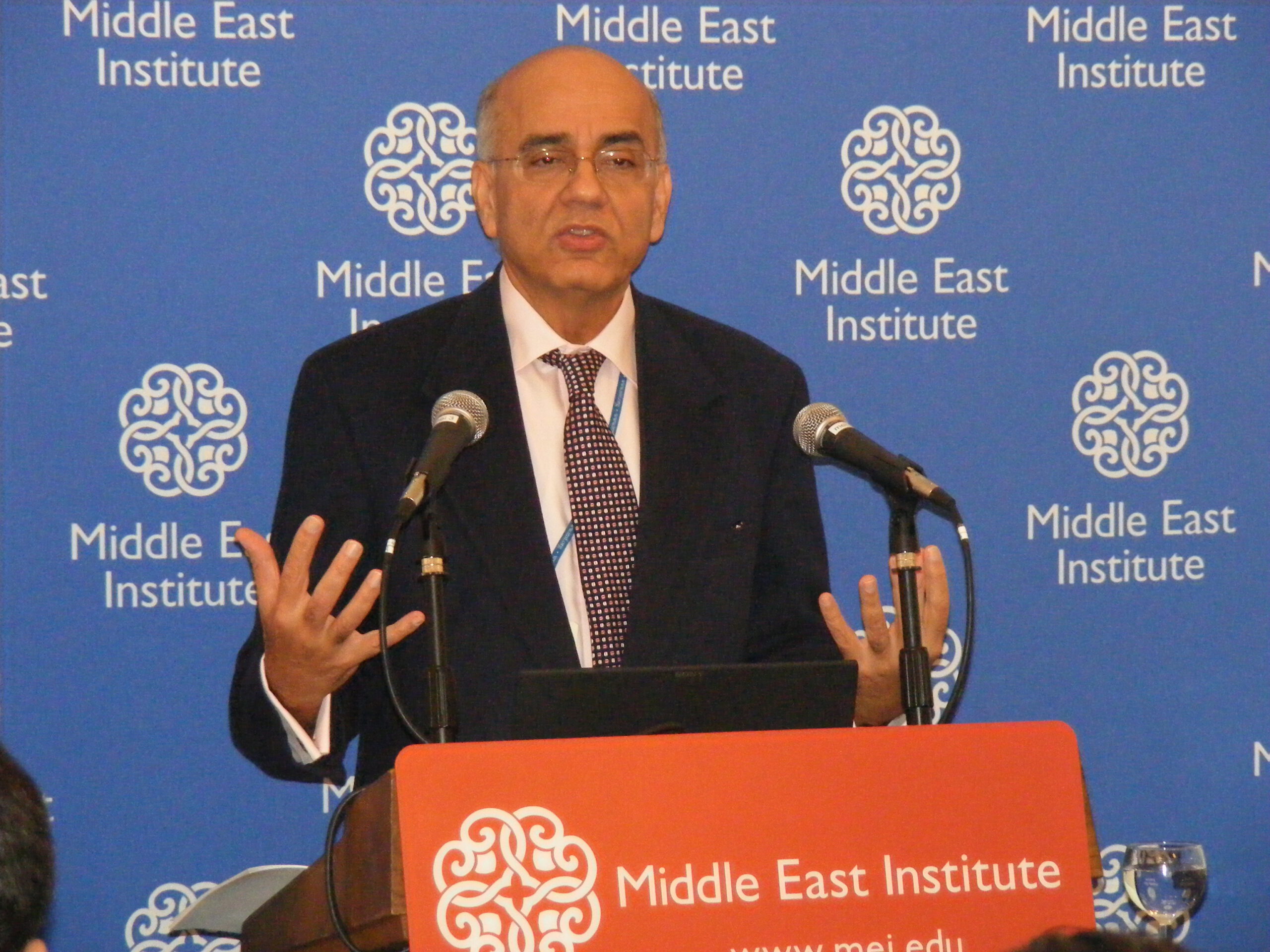
Shahmahmood Miakhel is the Country Director in Afghanistan for the US Institute of Peace (USIP). Prior to that he was a Governance Advisor for the United Nations Assistance Mission in Afghanistan (UNAMA), and, from 2003–2005, a Deputy Minister of the Interior in the Government of Afghanistan. In 1994–1995 he worked for the United Nations Development Programme (UNDP) and United Nations Office for Project Services (UNOPS) in South and Southeast Afghanistan helping to establish District Rehabilitation Shuras (DRS). He also worked as a reporter for the Pashto service of the Voice of America from 1985–1990.

The Latest from Shahmahmood Miakhel

Filter by
10020 Results
Walls and Goals: The Israeli-Palestinian Encounter in Football
Middle East Institute
  • Analysis
  • Walls and Goals: The Israeli-Palestinian Encounter in Football

    Dedicated to the memory of Israel Tzvi Raab Z”L, a true lover of the game

    The long, complex encounter between the Israeli and Palestinian people has been examined in many cinematic and literary creations. In this essay, I will explore several that use football as a lens to read opposing political agendas and as a means to resolve conflict.

    May 2, 2010

    Yemeni Football and Identity Politics
    Middle East Institute
  • Analysis
  • Yemeni Football and Identity Politics

    The Republic of Yemen occupies the southwest corner of the Arabian Peninsula. Unlike its oil-rich neighbors, Yemen is the poorest country in the Arab world. Like other countries football (soccer) is Yemen’s most popular sport. Football has been played in parts of Yemen since before the turn of the 20th century, and since the 1970s, the game’s popularity has increased significantly.

    May 2, 2010

    Assyrians or Syriacs? Middle Eastern Identity Formation through Football in Sweden
    Middle East Institute
  • Analysis
  • Assyrians or Syriacs? Middle Eastern Identity Formation through Football in Sweden

    It is the last Sunday in May 2009, and people in Södertälje – a small industrial town, half an hour’s drive southwest of the Swedish capital Stockholm – are enjoying the first hot day of the summer. It is also the day of the biggest football match of the year. Later in the afternoon, Södertälje’s two second division rivals, Assyriska FF and Syrianska FC, will clash. In the hours before kick-off, one sees flags and matching shirts everywhere, either in the white and red colors of Assyriska or in the red and yellow representing Syrianska.

    May 2, 2010

    A Step on the Path to Peace: How Basketball is Uniting Arab and Jewish Youth in Jerusalem
    Middle East Institute
  • Analysis
  • A Step on the Path to Peace: How Basketball is Uniting Arab and Jewish Youth in Jerusalem

    Basketball is a game where all five players need to share the ball. If it is played with great teamwork, the sum of the parts is greater than the individual. It’s a great forum for building trust. A lot of the game happens with things you can’t see. Communication and trust with teammates is the key. It seems to me that the same can be said of peacemaking.

    –R.C. Buford, General Manager of the NBA’s San Antonio Spurs[1]

    May 2, 2010

    Al-Wihdat: The Pride of the Palestinians in Jordan
    Middle East Institute
  • Analysis
  • Al-Wihdat: The Pride of the Palestinians in Jordan

    “Wahid, itnen, talagha ya Abu Hussein” (One, two, divorce her Abu Hussein), Al-Faisali supporters sing, as their soccer team plays against Al-Wihdat.[1] Al-Faisali is the club associated with ethnic Jordanians, while Al-Wihdat is the club of the Palestinians.

    May 2, 2010

    The Evolving Role of Afghan Female Athletes
    Middle East Institute
  • Analysis
  • The Evolving Role of Afghan Female Athletes

    Children can learn many lessons from playing sports: leadership, self-confidence, and the concept of working toward a common goal are a few such lessons. These are all skills that, when applied in life off the field, can augment the potential for success there as well.

    May 2, 2010

    Tradition Trumps Sport: A Female Wrestler Retreats
    Middle East Institute
  • Analysis
  • Tradition Trumps Sport: A Female Wrestler Retreats

    The 20th century has yielded new and expanding arguments for increasing sports opportunities for women and girls. From Title IX to the Women’s Sports Foundation, the importance of women’s access to sports has received a great deal of attention from academia, the media, and the non-profit circuit. While I agree that women should have access, and that our opportunities lag far behind those of men, I do not agree with the social and political promises of change made by some of these programs.

    May 2, 2010

    The Development of Women's Football in Morocco
    Middle East Institute
  • Analysis
  • The Development of Women's Football in Morocco

    Several months ago on a Tuesday afternoon, a local girls football team was practicing on a dirt field in Sidi Moumen, a notorious 350,000-person shantytown on the outskirts of Casablanca, Morocco. A crowd of boys had gathered along the fence. One of the boys began making comments. “Look at her touch on the ball,” he mumbled to his friend, “where did she learn to play football?” “My five-year old brother has better control,” shot back the other, slapping his friend’s hand and laughing.

    May 2, 2010

    Lebanon and Syria: The Challenge of an Evolving Relationship
  • Video
  • Lebanon and Syria: The Challenge of an Evolving Relationship

    The Middle East Institute is proud to host Andrew Tabler and Mona Yacoubian for a discussion about the current state of Lebanese-Syrian relations. Bitterly strained by the 2005 assassination of Lebanese Prime Minister Rafik Hariri, Lebanese-Syrian relations started to mend following French mediation leading to the exchange of ambassadors between Beirut and Damascus in 2009. Prime Minister Saad Hariri's visit to Damascus at the end of 2009 marked yet another phase in this evolving relationship.

    April 27, 2010

    Iraq's Petroleum Industry: Unsettled Issues
  • Analysis
  • Iraq's Petroleum Industry: Unsettled Issues

    Iraq has the world’s third-largest oil reserves. However, the development of Iraq’s petroleum sector has been severely hampered by decades of war, sanctions, underinvestment, the exodus of scores of technocrats, and sabotage. Repairing Iraq’s oil infrastructure and expanding exploration, development, and production is of paramount importance to the country’s future. In June 2009, the Iraqi Oil Ministry embarked on an effort to help meet this challenge by offering service contracts to international oil companies (IOCs) in two rounds of tenders.

    April 26, 2010

    Political and Legal Obstacles in Iraq
    Middle East Institute
  • Analysis
  • Political and Legal Obstacles in Iraq

    Since June 2009, the Government of Iraq (GoI) has secured nearly a dozen major oil field technical service agreements with international oil companies (IOCs) after two highly publicized bidding rounds. The deals are seen as the cornerstone of Iraq’s economic development in the coming years. While future oil production has been rather optimistically projected as high as 12 million barrels per day (bpd) by 2020, significant obstacles to the development of the oil and gas industry remain.

    April 26, 2010

    The Status of Forces Agreement and Investing in Iraq: Risky Business?
    Middle East Institute
  • Analysis
  • The Status of Forces Agreement and Investing in Iraq: Risky Business?

    In spite of ongoing security and political instability, Iraq remains one of the most fertile yet volatile regions in the world for emerging business opportunities, specifically in the petroleum industry. Since the completion of the widely successful “surge” and implementation of the Status of Forces Agreement (SOFA), Iraq has experienced slow but steady improvements in security and economic opportunities in the petroleum sector. As a result, there has been an influx of international companies eager to engage Iraq’s ministries for access to these lucrative markets.

    April 26, 2010