The Americans Are Gone. Will Iraq’s Militias Disarm?
On September 30, the US completed its military withdrawal from Iraq, ending a 12-year-long mission to combat ISIS that began in 2014. The date was also meant to be the deadline for disarming the largely Iranian-backed militias known as the Popular Mobilization Forces (PMF), but Prime Minister Ali al-Zaidi has now pushed that cutoff back to June 30, 2027. MEI Distinguished Diplomatic Fellow Amb. (ret.) Robert S. Ford joins hosts Alistair Taylor and Matthew Czekaj to discuss what the US military withdrawal means for Iraqi security and the nature of the bilateral relationship going forward. They also speak about what it will take for Baghdad to bring the PMF militias to heel, and how Iraq may navigate the post-Iran war era.
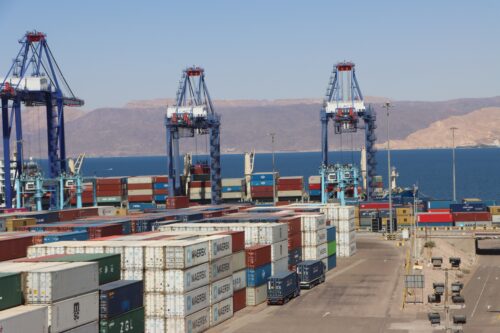
Jordan’s Economy Weathers Iran War’s Shocks and Finds New Opportunities
In the summer of 2003, King Abdullah II told Bloomberg Jordan sits “between Iraq and a hard place,” a play on words designed to describe the kingdom’s challenging environment to an American audience amid the US-led Iraq war to the east and the lingering Palestinian-Israeli conflict to the west. Jordan is grappling with a much “harder place” today.
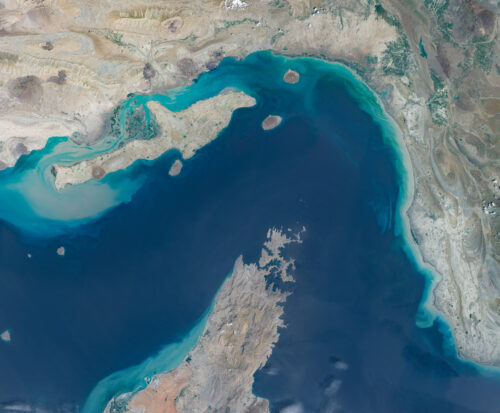
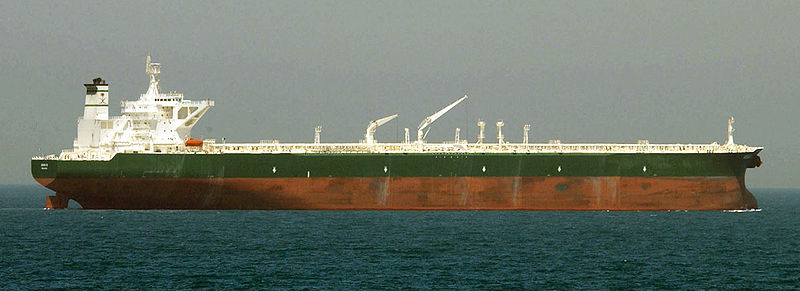
Proponents of the war with Iran have taken recent increases in crude-oil flows through the Strait of Hormuz as proof that the US strategy is finally working. President Trump is so confident in this that he recently rejected a seven-day plan, set forward by Iran’s foreign ministry, to end the war and open the strait. The United States is “winning tremendously,” Trump boasted.
From Generation to Generation: The Succession Problem in Saudi Arabia
The question of succession is the core issue of contention among the members of the Saudi royal family. Ever since its advent in the second half of the 18th century, the dynasty has been suffering from this problem and been trying to overcome it, succeeding as often as failing. This problem is due to the power structure inspired by the local system of kinship.
For the past 50 years, Saudi Arabia has been endlessly engaged in defending and expanding its position in the Middle East. This is, in part, a function of its self-image as the guardian of Mecca and Medina, the two holiest shrines in the Islamic world, but it also reflects its dominant role as the world’s largest repository of oil and as one of its largest producers. Ironically, these two factors behind the Kingdom’s foreign policy have made, at times, uncomfortable bedfellows, particularly when set against its domestic politics and foreign attitudes towards them.
Saudi Arabia and Iran: Less Antagonism, More Pragmatism
The siege of the Grand Mosque in November 1979 came on the heels of the Islamic Revolution in Iran. Juhayman al-‘Utaybi, the leader of the rebels, though, seemed not be very much inspired by what had happened next door. Whatever he may have noticed from Iran’s turmoil — and it might not have been too much because he never watched TV and rarely browsed newspapers — he deemed it to be irrelevant because Iranians were Shi‘ites, incorrigibly stuck in their heretic beliefs.
How Salafism Came to Yemen: An Unknown Legacy of Juhayman al-'Utaybi 30 Years On
Since it emerged in Yemen around three decades ago, the country’s Salafi movement has maintained complex, if not tense links with Saudi Arabia.[1] Before establishing a Yemeni manifestation of Salafism with its own features and clerics,
In 1979, Saudi-Russian relations were extremely poor. The two countries did not even have diplomatic relations — nor had they since the 1930s. Many observers regarded Soviet military support for Marxist regimes in Ethiopia, South Yemen, and Afghanistan as ultimately aimed at surrounding the oil-rich Kingdom and bringing about the downfall of its US-allied ruling family. The Soviet invasion of Afghanistan and the uncertainty about whether the Iranian Revolution might evolve in a Marxist direction only served to intensify the perception of a Soviet threat to the Kingdom.
Cooperation under the Radar: The US-Saudi Arabian Joint Commission for Economic Cooperation (JECOR)
Economists and political analysts who write about Saudi Arabia often say that the most difficult part of their research is finding accurate statistics about the Kingdom. Population, food production, water resources, oil and gas reserves, industrial output — many kinds of data that are essential to sound planning and accurate evaluation cannot be taken at face value, especially if they are generated by Saudi government agencies.
The past 30 years of the Saudi-American relationship have seen highs of intense geopolitical cooperation and the lows of the post-September 11, 2001 period. What has tied those ups and downs together is the fluctuating relationship between both governments and the transnational Salafi Islamist movement. Both governments fostered the movement — domestically in Saudi Arabia and as an international force — during the Afghan jihad against the Soviet Union in the 1980s. Both have seen the movement shift from a tool of their foreign policies to a threat.
In various entries in his unpublished diaries, British Mesopotamian officer Harry St. John Philby, on special mission to central Arabia during 1917-1918, recorded the minutes of his many private “interviews” with Ibn Saud. He concluded that the newly re-emerging Wahhabi movement under Ibn Saud would, with British political and military support, effectively serve British military and political objectives in the Arabian Peninsula and beyond during the ongoing war and in its aftermath.
The United States and Saudi Arabia: Challenges Ahead
The Obama Administration confronts a vexing set of challenges across the greater Middle East, an area that stretches from Egypt in the west, Afghanistan and Pakistan in the east, Central Asia in the north and Yemen in the south. In the midst of this “arc of instability” sits Saudi Arabia, a long-standing partner whose relationship with the United States has been enduring but fraught.
Kuwait Looks towards the East: Relations with China
Originally posted September 2009
There is a growing tendency among the Gulf Cooperation Council (GCC) states to benefit from the favorable conditions in the rapidly growing economies of the East. As was amply demonstrated at a symposium organized by the Centre for Gulf and Arabian Peninsula Studies at Kuwait University in May 2009 on the “Reality of GCC-Asian Relationship — opportunities and challenges,” Kuwait exemplifies this trend.
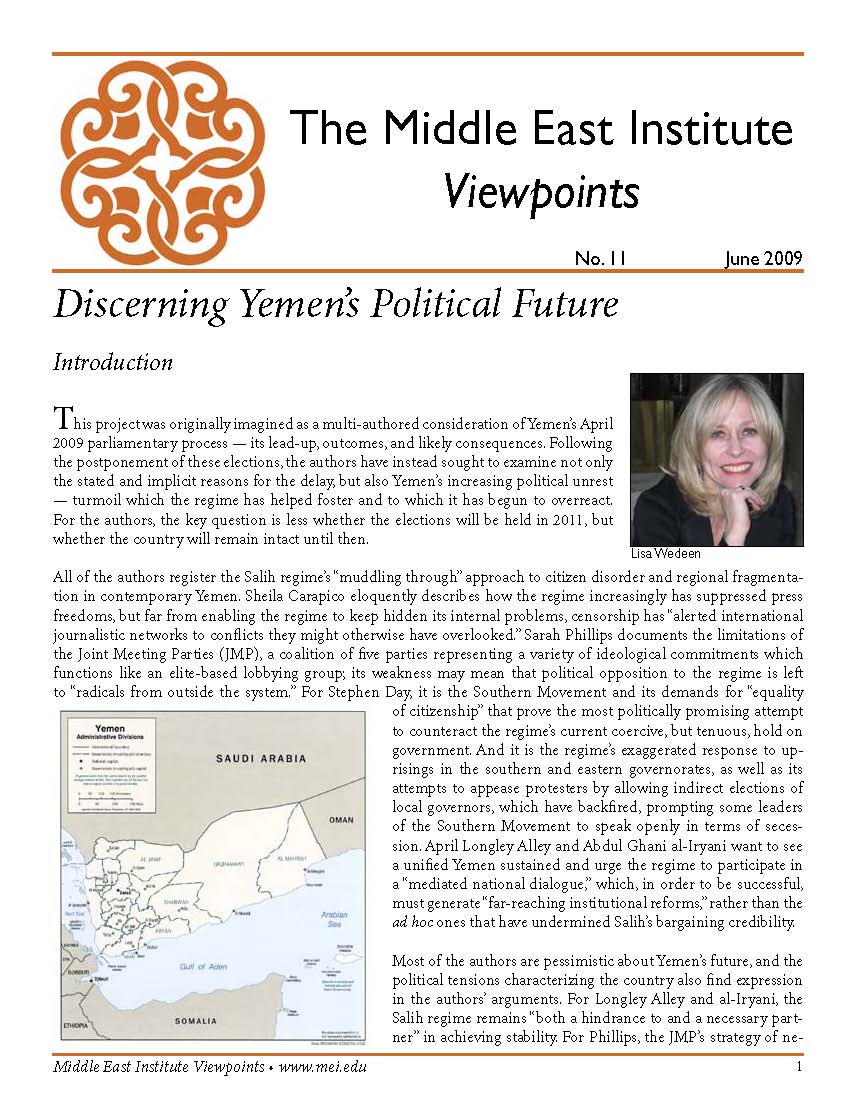
This project was originally imagined as a multi-authored consideration of Yemen’s April 2009 parliamentary process — its lead-up, outcomes, and likely consequences. Following the postponement of these elections, the authors have instead sought to examine not only the stated and implicit reasons for the delay, but also Yemen’s increasing political unrest — turmoil which the regime has helped foster and to which it has begun to overreact. For the authors, the key question is less whether the elections will be held in 2011, but whether the country will remain intact until then.
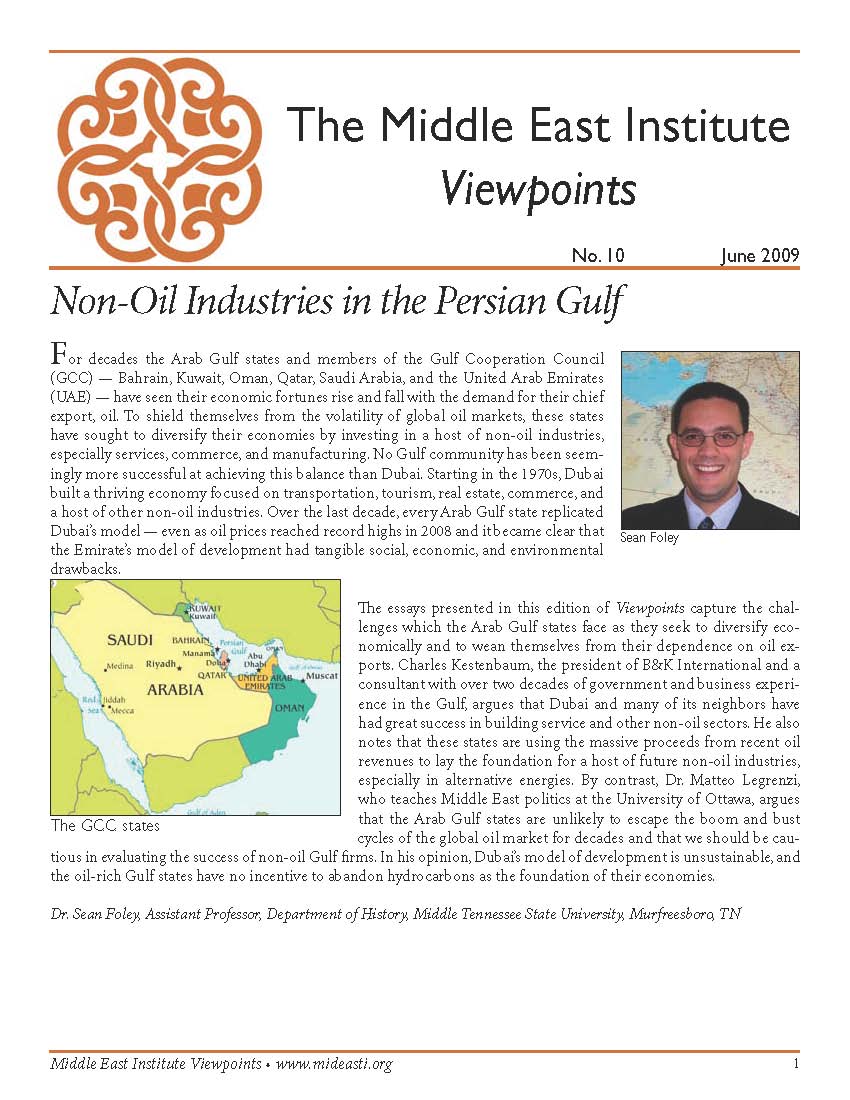
For decades the Arab Gulf states and members of the Gulf Cooperation Council (GCC) — Bahrain, Kuwait, Oman, Qatar, Saudi Arabia, and the United Arab Emirates (UAE) — have seen their economic fortunes rise and fall with the demand for their chief export, oil. To shield themselves from the volatility of global oil markets, these states have sought to diversify their economies by investing in a host of non-oil industries, especially services, commerce, and manufacturing.
The oldest peer-reviewed publication dedicated to the study of the modern Middle East, MEI’s flagship journal covers politics, society, and culture in the region.