Brazil’s Embrace of the Iranian Government Will Only Embolden the Regime Internationally
This Commentary first appeared as an op-ed in the America's Quarterly Policy Journal, Spring 2010
Can Brazil play a significant role in containing Iran's nuclear ambitions? No.
Brazil’s self-perceptions and aspirations as an emerging global power are a key to understanding why the government of President Luiz Inácio Lula da Silva has chosen this particular moment in time to deepen ties with an Iranian regime that is facing crisis, both at home and abroad.
The Republic of Yemen occupies the southwest corner of the Arabian Peninsula. Unlike its oil-rich neighbors, Yemen is the poorest country in the Arab world. Like other countries football (soccer) is Yemen’s most popular sport. Football has been played in parts of Yemen since before the turn of the 20th century, and since the 1970s, the game’s popularity has increased significantly.
Omanization Policy and International Migration in Oman
The six states of the Gulf Cooperation Council (GCC)[1]have over five million migrant workers — one of the highest concentrations of migrant workers in the world. According to the World Migration Report (2003), 25% of the workers in Saudi Arabia, 65% in Kuwait, 67% in the UAE, and as much as 70% in Qatar are immigrants or non-nationals.
The convergence of multiple crises in an already vulnerable environment has left Yemen and aid agencies at a crossroads. The context has become an extremely complex and challenging one within which to reduce hunger, malnutrition, and fragility. Yet it is precisely because of these challenges that humanitarian intervention is vital to keep struggling populations from tipping into utter disaster.
Addressing the Crisis in Yemen: Strategies and Solutions
The Middle East Institute is proud to host two former Ambassadors to Yemen, Thomas Krajeski and David Newton, for a discussion about Yemen and the role of US foreign policy in a country some political analysts characterize as a failed state. As Yemen grapples with multiple crises, including the growing influence of Al Qaeda, a Houthi Rebellion in the north, a secessionist movement in the south and severe economic woes, what should the US do to help stabilize and secure one of the Arab world’s poorest countries?
How Salafism Came to Yemen: An Unknown Legacy of Juhayman al-'Utaybi 30 Years On
Since it emerged in Yemen around three decades ago, the country’s Salafi movement has maintained complex, if not tense links with Saudi Arabia.[1] Before establishing a Yemeni manifestation of Salafism with its own features and clerics,
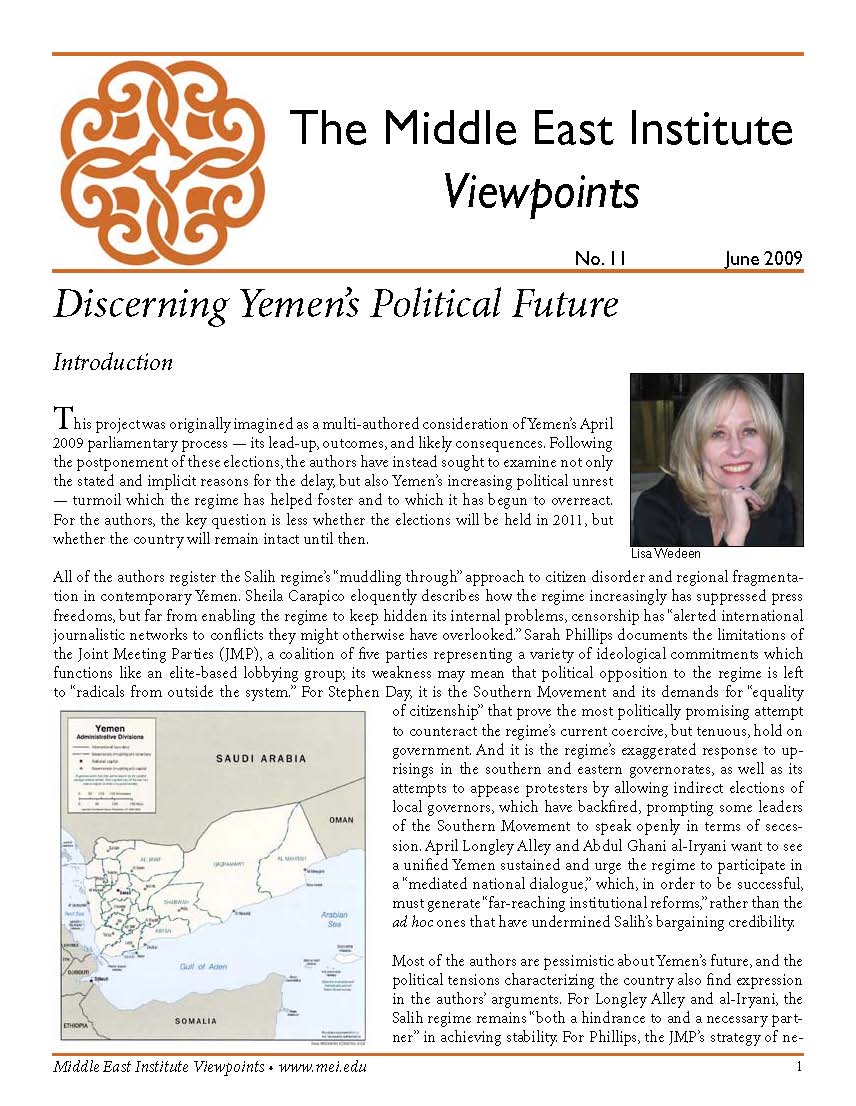
This project was originally imagined as a multi-authored consideration of Yemen’s April 2009 parliamentary process — its lead-up, outcomes, and likely consequences. Following the postponement of these elections, the authors have instead sought to examine not only the stated and implicit reasons for the delay, but also Yemen’s increasing political unrest — turmoil which the regime has helped foster and to which it has begun to overreact. For the authors, the key question is less whether the elections will be held in 2011, but whether the country will remain intact until then.