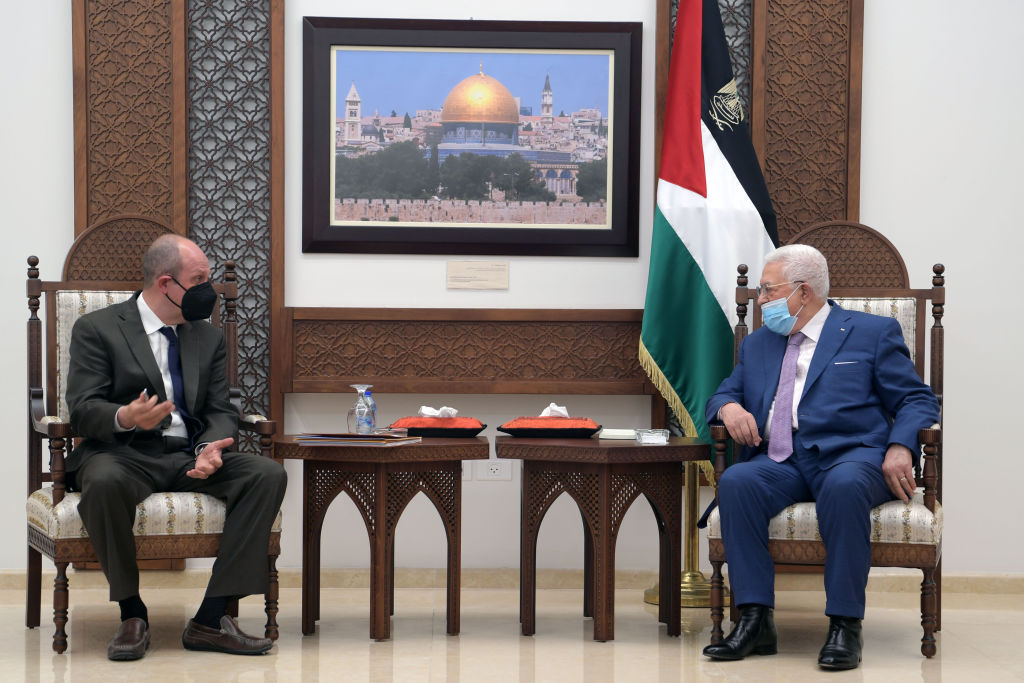
تأجيل الانتخابات الفلسطينية إلى أجل غير مسمى
“في حين أن المدى الكامل لتداعيات القرار لا يزال غير واضح، فليس هناك شك بأن عباس تسبب لنفسه بضرر كبير”.
At the end of Joe Biden’s first 100 days as president of the United States, where do things stand when it comes to U.S. policy toward the Middle East and North Africa? We asked experts and scholars from across MEI to weigh in with their thoughts on the changes we’ve seen so far, the new challenges that have emerged, and what we know about the administration’s key priorities for the region.
In the past several weeks, news has been coming out of Ankara regularly about normalization in relations with countries with which Turkey has had problematic relationships for some time.
The Biden administration should play a key role in building a stronger Egypt where human-rights abuses are both rare and addressed by pushing back against the potential for any new regime.
It’s easy to see why there’s an enduring attraction for a regional security dialogue in the Middle East. Countries in the region face shared and borderless challenges — including terrorism, insurgency, environmental safety, arms races, cybersecurity, maritime piracy, and the proliferation of weapons of mass destruction — that can be dealt with more effectively through multilateral measures.
Read MEI’s weekly briefing featuring expert analysis of key regional developments for the week ahead.
On April 20, Chadian President Idriss Déby was killed by Front for Change and Concord in Chad (FACT) rebels in the country’s northwestern Tibesti region. The sudden death of Déby, who seized power in Chad via a military coup in December 1990 and was re-elected on April 11 with 79.3% of the vote, risks plunging Chad into a state of prolonged instability.
The U.S.-Israel relationship is a close partnership founded on shared national security interests as well as democratic values. Washington’s commitment to the security and wellbeing of the state of Israel is exceptional, and bilateral ties remain strong despite the erosion of support for Israel among progressive and isolationist circles in the U.S. In spite of all this, the Iran issue presents many pitfalls for miscalculation that could derail even the most well-intended efforts at formulating a coordinated U.S.-Israel strategy.
In the 19th century, the Gulf was a British lake. In the 20th century, American warships played an all but unchallenged role securing the safe and unfettered passage of oil to the West. As the 21st century progresses, the transition to a new era is unstoppable.
As a major strategic chokepoint for this trade and maritime security, Suez is fundamental to the West’s commitment to a “free, open, secure and prosperous Indo-Pacific.”
Jonathan Winer and Mirette Mabrouk join host Alistair Taylor to discuss Libya’s new interim government, the complex regional and international dynamics at play, and what Libya’s future might look like.
Read MEI’s weekly briefing featuring expert analysis of key regional developments for the week ahead.
Khaled Elgindy and Lara Friedman discuss the public launch of their congressional teach-in series, “Israel-Palestine: Where We Are, What Comes Next, and Why It Matters to Congress.” The series of webinars features an array of American, Palestinian, Israeli, and international experts on topics dealing with the Israeli-Palestinian conflict and U.S. policy.
” يشهد السودان بروزًا في صورته الإقليمية، بينما تكثف مصر والسودان تعاونهما على الجبهات الدبلوماسية والاقتصادية والعسكرية”.
Read MEI’s weekly briefing featuring expert analysis of key regional developments for the week ahead.